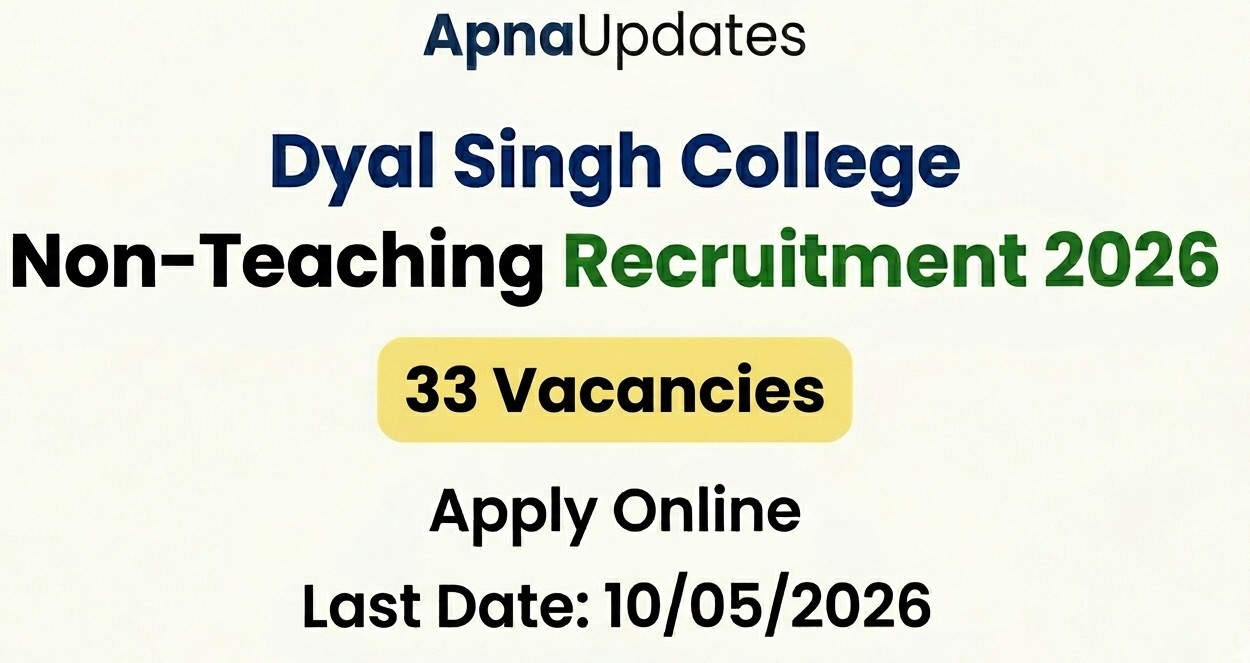
Dyal Singh College Non-Teaching Recruitment 2026
⚠️ Corrigendum Update
Dyal Singh College has revised the eligibility criteria and subject-specific requirements for the posts of Senior Technical Assistant (STA) and Laboratory Assistant (LA). The last date for online application submission has also been extended till 10 June 2026.
⬇️ Scroll down to the Important Links section below where the direct link to the official corrigendum PDF has been provided.
....................................................................................................................Dyal Singh College, a part of the University of Delhi, has opened applications for 33 permanent non-teaching positions. This recruitment drive includes different roles ranging from administrative staff to laboratory and library support. This is an opportunity for those interested in working in an academic setting at a highly-rated institution. If you are thinking about applying, it is important to review the details to see if you meet the requirements. So instead of rushing to apply, it makes more sense to first understand the job properly. That’s exactly what this guide will help you do in a clear and practical way.
Quick Facts
| Feature | Details |
|---|---|
| Authority | Dyal Singh College, University of Delhi |
| Total Posts | 33 |
| Post Types | Senior Assistant, Junior Assistant, Laboratory Attendant, Library Attendant, and others |
| Salary Range | ₹18,000 - ₹56,900 (Level 1 to Level 6) |
| Job Type | Permanent (Non-Teaching) |
| Selection Process | Written exam + skill test (for relevant posts) |
| Application Mode | Online |
| Last Date | May 10, 2026 (Extended) |
About the College
Dyal Singh College is a well-known college under the University of Delhi, located at Lodhi Road, New Delhi. It holds a NAAC ‘A’ Grade, which reflects its academic and administrative standards. It is a professional workplace with many departments that require different staff members to help students and teachers run the college smoothly every day.
Available Positions
| Post Name | Total Vacancies | Pay Level |
|---|---|---|
| Senior Assistant | 01 | Level-06 |
| Senior Technical Assistant (STA) | 01 | Level-06 |
| Assistant | 01 | Level-04 |
| Laboratory Assistant | 01 | Level-04 |
| Junior Assistant | 03 | Level-02 |
| Laboratory Attendant | 17 | Level-01 |
| Library Attendant | 09 | Level-01 |
| Total | 33 | - |
The college has a high number of openings for support staff, as most of the vacancies are for Laboratory Attendants and Library Attendants. These two roles makes the majority of the 33 available positions. The college is also looking to fill specialized technical roles, specifically for the Computer Science and Physics departments. Because there are many spots for entry-level support jobs, competition for these positions may be quite high.
Required Qualifications and Experience
Senior Assistant: You must have a bachelor’s degree with 03 years of experience as an assistant or in an equivalent role at Pay Level 04. Proficiency in computer applications and skills in official drafting are also required.
Senior Technical Assistant: You need a master’s degree in a relevant subject with 02 years of experience. Alternatively, a first-class bachelor’s degree in a relevant subject with 05 years of experience in maintaining complex scientific laboratory instruments is accepted.
Assistant: This post requires a bachelor’s degree and 02 years of experience in a junior assistant or equivalent administrative role. You must also possess a typing speed of 35 words per minute in English or 30 words per minute in Hindi and be proficient in computer operations.
Laboratory Assistant: You need a bachelor’s degree and 02 years of direct experience working with and maintaining sophisticated scientific instruments in a formal laboratory setting.
Junior Assistant: You must have a bachelor’s degree, strong computer proficiency, and a typing speed of 35 words per minute in English or 30 words per minute in Hindi. No formal prior work experience is required.
Laboratory Attendant: You need a 10+2 qualification with a science stream. Alternatively, you must have passed the 10th grade and possess a relevant skill certificate in laboratory technology. No prior work experience is required.
Library Attendant: You need a 10+2 qualification or an equivalent degree along with a certificate course in library science from a recognized institution. No prior work experience is required.
Note on Experience: For all positions requiring experience, the service must be from a university, research establishment, central or state government organization, or an autonomous body. Please ensure you satisfy these requirements fully before applying, as all qualifications must be met by the application deadline.
Age Limit Details
The college sets age limits to keep the recruitment process fair for everyone. Please check the limit for your specific role below.
| Post Name | Upper Age Limit |
|---|---|
| Senior Assistant/ Senior Technical Assistant (STA) | 35 Years |
| Assistant/ Laboratory Assistant/ Junior Assistant/Laboratory Attendant/ Library Attendant | 32 Years |
Specific Age Relaxation Details
You can get extra age relaxation if you belong to certain groups. Candidates from the SC and ST groups get 05 extra years. Candidates from the OBC (NCL) group get 03 extra years. If you are a person with a disability (PwBD) in the general group, you get 10 extra years. If you are a person with a disability in the SC or ST group, you get 15 extra years. If you are a person with a disability in the OBC group, you get 13 extra years.
Also, if you are already a permanent government worker with at least three years of experience, you can get up to 05 extra years. If you are working for the University of Delhi or its colleges on a contract, daily wage, or ad-hoc basis, you can get extra years equal to the time you have already worked, as long as you have worked for at least one year.
Application Fee Structure
You must pay an application fee based on your category to complete your registration. You can pay this fee online through the official website. Please remember that once you pay, the money cannot be refunded.
| Candidate Category | Application Fee |
|---|---|
| General and Unreserved | Rs. 1000/- |
| OBC (NCL), EWS, and Female Candidates | Rs. 800/- |
| SC, ST, and PwBD Candidates | Rs. 600/- |
How to Fill the Online Application Form
Follow these steps exactly to submit your application the right way to avoid any mistakes.
Step 1: Visit the Official Portal
All applications must be submitted through the official portal at dunt.uod.ac.in. You can also visit the college website at www.dsc.du.ac.in to find the recruitment section and the direct link to apply.
Step 2: Register Yourself
Click on the button labeled "New Registration." Enter your full name exactly as it appears on your 10th-grade certificate, your date of birth, your personal mobile number, and your email address. You must verify your details using the OTP sent to you to create your login password. Please avoid using someone else’s contact details, as all official updates will be sent to the information you provide here.
Step 3: Fill the Application Form Carefully
Log in to your account and enter your personal details like your address, category, and gender. Next, fill in your educational qualifications and experience details exactly as they appear on your official certificates. You may apply for only one post. Please review every single detail carefully before moving forward, because once the form is submitted, you will not be allowed to make any changes.
Step 4: Upload Documents
Keep scanned copies of your passport-size photograph, your signature, and your category certificate (if it applies to you) ready. Before you upload them, ensure that the file size and format meet the requirements listed on the website.
Step 5: Pay Application Fee
You can pay the fee using net banking, a debit or credit card, or UPI. Please wait for the official confirmation message after you pay. Remember that your money being deducted from your bank account does not mean your application is successfully submitted; you must receive a final confirmation.
Step 6: Final Submit & Print
After reviewing all your details one last time, submit the application form. Download your confirmation page and save your payment receipt. It is important to keep both a digital copy and a printed copy of these documents for your future reference.
Salary Package & Career Growth
The salary for these positions is based on the 7th Central Pay Commission (CPC) rules. Your monthly pay will be based on the "Pay Level" assigned to your specific job. In addition to your basic salary, you will also receive extra allowances for house rent, travel, and the rising cost of living, as per government rules.
| Post Name | Pay Level | Starting Basic Salary |
|---|---|---|
| Senior Assistant / Senior Technical Assistant | Level 6 | Rs. 35,400/- |
| Assistant / Laboratory Assistant | Level 4 | Rs. 25,500/- |
| Junior Assistant | Level 2 | Rs. 19,900/- |
| Laboratory Attendant / Library Attendant | Level 1 | Rs. 18,000/- |
Career Growth
Working as a non-teaching staff in a college under the University of Delhi provides a stable and secure career. As you gain experience and complete the required years of service in your current position, you become eligible for promotion to higher posts. Beyond standard promotions, you also have the chance to improve your qualifications and skills. Many staff members participate in internal training and workshops, which helps them gain the necessary experience for higher-level responsibilities. This ensures that your career remains active and full of potential for advancement throughout your time with the institution
Selection Stages and Exam Rules
The selection process for these recruitment is divided into three main stages. You must pass each stage to move forward in the process.
Selection Stages
Stage 1: Preliminary Test (Written Exam): This is an objective-type test used to shortlist candidates. It covers subjects like reasoning, math, general awareness, and language skills.
Stage 2: Main Examination (Descriptive Paper): Candidates who qualify in the preliminary test will appear for this paper. It tests your deeper knowledge of office rules, administration, and specific duties related to the role.
Stage 3: Skill Test: This is a practical test to check your job-related skills, such as computer typing, stenography, or laboratory tasks. This stage is qualifying in nature, meaning you must pass it, but the marks are not added to your final score.
Exam Pattern: Preliminary Test (Paper I)
The preliminary test consists of 150 multiple-choice questions (MCQs) with 3 hour duration. The pattern is as follows:
| Test Component | Questions | Marks |
|---|---|---|
| Specific Area (Post Related) | 50 | 100 |
| General Awareness | 25 | 50 |
| Reasoning Ability | 25 | 50 |
| Mathematical Ability | 25 | 50 |
| Language (English or Hindi) | 25 | 50 |
| Total | 150 | 300 |
Important Exam Rules
Language Choice: You can choose to take the exam in either English or Hindi. You must use the same language for the entire test.
Negative Marking: For every wrong answer in the objective test, you will lose 1/4th of the marks assigned to that question.
Passing Marks: You need to score at least 45% (Unreserved), 40% (OBC), or 35% (SC/ST/PwBD) to qualify for the next stage.
Note: Go through DU Non-teaching Staff Complete Exam Pattern and Syllabus for detailed exam pattern for each posts.
Understanding the Competition and Strategy
Many candidates get discouraged by low vacancy counts. But, this is a misconception. Because these numbers seem small, many experienced aspirants skip this exam to wait for larger national-level recruitment drives. This naturally reduces your competition. Moreover, most applicants are local to the Delhi region, which limits the number of applicants. You are competing against a smaller, focused group rather than lakhs of people.
Exam Attempt Strategy
Success requires a practical approach rather than a perfect one. For the Preliminary MCQ Test, spend the first 3 minutes scanning the questions. Start with your strongest section to build confidence. Do not spend more than 30 seconds on a single question. Use the elimination method for difficult questions, and skip them entirely if you are not sure about the answer, to avoid negative marking. Dedicate the last 15 minutes to double-checking for silly mistakes.
For the Main Descriptive Exam, read all questions before you start. Use a clear structure: a brief introduction, bullet points for the main content, and a simple conclusion. Write clearly, use proper spacing, and underline important keywords.
For the Skill Test, accuracy is more important than speed. Maintain a steady rhythm and do not panic if you make a small mistake. Practicing for just 30 minutes daily is enough to reach the required speed.
Essential Preparation Resources
Start your preparation by reviewing the comprehensive exam syllabus and preparation guide, which consolidates the official exam patterns and detailed topic lists required for all posts. This acts as your main guide for both pattern clarity and syllabus depth.
Must-Have Official Documents
The Notification PDF is your primary source for the official syllabus and exam schemes. The Delhi University Act 1922 is core reading for Higher Educational Institution (HEI) administration. Additionally, refer to GFR 2017, which covers General Financial Rules essential for the descriptive paper.
Recommended Study Resources
To prepare effectively, start by using a dedicated DU Non-Teaching guide that covers both the preliminary and main exams which is provided above. For the descriptive section, Swamy’s books on FR, SR, and GFR are highly recommended. For the general sections like GK, reasoning, and mathematics, standard books like Kiran SSC Combo or Lucent are excellent choices.
You can also use these free online tools for daily practice:
For topic clarity, watch the DU Non-Teaching playlist by UGC NET Mentor on YouTube. To improve your typing speed for the skill test, practice regularly on 10FastFingers or TypingClub.
Make sure you download these official documents, as they are essential for your preparation:
- Official Notification PDF (Includes syllabus and exam schemes)
- General Financial Rules (GFR) 2017 (Required for the descriptive paper)
Pro Tip: Spend at least 40% of your study time on HEI Administration topics, such as the Delhi University Act and General Financial Rules, as these are very important for scoring well.
Note: These insights and resources are based on typical recruitment trends. Always verify specific requirements on the official college website.
If you are exploring other government job options, you can also check the MPPCB Assistant Engineer Recruitment 2026 and similar non-teaching opportunities in Central Sanskrit University Non-teaching Recruitment 2026 before deciding.
Frequently Asked Questions
Q1: I'm 32 years and 2 months old. Can I apply for the Assistant post (age limit 32)?
It depends on your exact date of birth. Age is calculated as of 10 May 2026. If you turn 33 before this date, you are not eligible unless you qualify for age relaxation (SC/ST/OBC/PwBD/experience-based).
Q2: Can I apply for both Junior Assistant and Library Attendant?
No. You can apply for only one post per recruitment. Choose based on your eligibility and preference.
Q3: My typing speed is currently 28 wpm. Should I still apply for Junior Assistant?
Only if you are confident you can reach 35 wpm with practice before the Skill Test (which could be 3–4 months away). Start practicing daily. If you cannot reach the required speed, you will not qualify.
Q4: I have an OBC certificate from 2024. Is it valid?
The OBC (NCL) certificate should be valid for the current financial year (2025–2026). If it is outdated, get a fresh one before document verification.
Q5: I am 34 years old (OBC category). Can I apply for Assistant (age limit 32)?
Yes. OBC candidates get 3 years of age relaxation. So, your effective age limit becomes 35 years, and you are eligible.
Q6: Will there be negative marking in the exam?
There is negative marking in the preliminary test. It is typically 1/4th of the marks assigned to a question for every wrong answer. Always confirm this from the official exam instructions.
Q7: I have a B.A. from IGNOU. Am I eligible?
Yes, as long as the university is UGC-recognized. IGNOU degrees are valid for government jobs.
Q8: What if I do not have 2 years of experience for Laboratory Assistant but have a strong B.Sc.?
Experience is mandatory. Without the required experience, you are not eligible, regardless of your degree.
Q9: Is this a permanent job or contractual?
These are permanent non-teaching positions under the University of Delhi system. Once selected, you get long-term job security along with standard government benefits.
Q10: Can I apply if I am from another state?
Yes. Candidates from any state in India can apply. There is no state restriction for this recruitment.
A Note to All Candidates
The first step toward success in this recruitment process is to fully understand how the system works. Many candidates rush into studying without looking at the details, but the real path to clearing this exam starts with a clear plan. You must read the recruitment notification carefully to understand the rules, the stages of the exam, and the specific requirements for each post. Knowledge of the process is your greatest advantage. Once you understand the core, you can focus your energy on what truly matters rather than wasting time on unnecessary topics. Start here, stay organized, and build your preparation on a solid foundation. As you prepare, remember that success comes from both your hard work and your attention to detail. Many candidates lose their opportunity by making simple mistakes, so take care to manage your preparation well. Always check your age eligibility carefully against the date of 10 May 2026 and ensure all your documents, especially caste and experience letters, are accurate and ready long before they are needed. Do not treat the preliminary exam as a small step. Aim for a high score to stay safe above the cutoff. Also, balance your study time wisely. Many students focus too much on general subjects and forget about Educational Administration, which is very important for the main exam. Practical skills like typing and descriptive writing cannot be learned in a few days. Start practicing these from the first day instead of waiting until the end. Finally, do not leave your application submission for the last day to avoid technical problems or payment delays. By staying consistent, focusing on the real exam pattern, and taking care of these small tasks early, you will be much better prepared than most other candidates.
Note: This information is based on official sources and standard recruitment patterns. Candidates should always verify details from the official website.
| Application Start Date | 11/04/2026 |
| Application End Date | 10/06/2026 (Extended) |
| Exam Date | To be notified |