RPSC RAS/RTS Combined Competitive Exam 2026
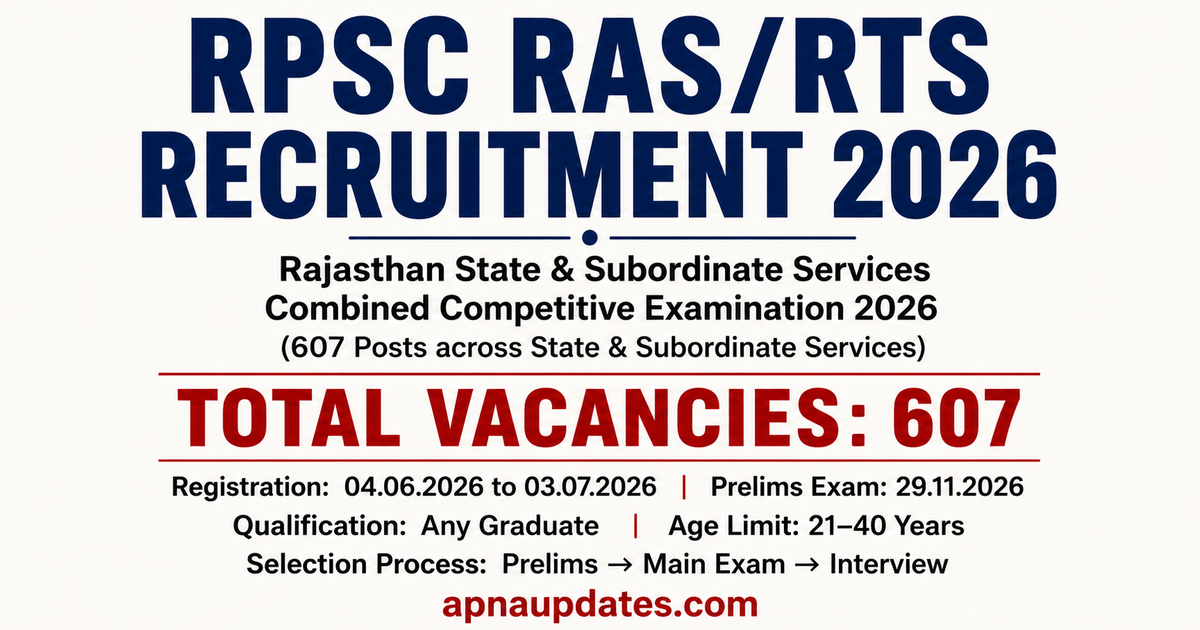
⚠️ RPSC RAS/RTS Combined Competitive Examination 2026 Exam Date Revised
Rajasthan Public Service Commission (RPSC) has issued an official press note revising the examination schedule for the RAS/RTS Combined Competitive Examination 2026. As per the latest update, the Preliminary Examination will now be held on 06 December 2026 (Sunday) instead of the earlier scheduled date of 29 November 2026.
> The Commission has also announced that the RAS/RTS Main Examination 2026 is scheduled to be conducted on 01 May and 02 May 2027. A detailed examination schedule will be released separately in due course.
⬇️ Scroll down to the Important Links section below where the direct link to the official exam schedule notice has been provided.
----------------------------------------------
Rajasthan Public Service Commission (RPSC), Ajmer
Last Date: July 3, 2026
The Rajasthan Public Service Commission has released the detailed advertisement for the RAS and RTS Combined Competitive Examination 2026, covering a total of 607 vacancies spread across 21 State Service posts and 26 Subordinate Service posts. Online applications open on June 4, 2026, and the window closes on July 3, 2026 at 12:00 noon. This is one of the most keenly watched state-level administrative recruitment notifications in the country.
A full picture of the recruitment before the details:
| Feature | Details |
|---|---|
| Organization | Rajasthan Public Service Commission (RPSC), Ajmer |
| Advertisement No. | 02/परीक्षा/RAS&RTS/RPSC/EP-I/2026-27, dated 27.05.2026 |
| Post Names | RAS, RPS, Rajasthan Accounts Service, Tehsildar, and 43 other State and Subordinate Services |
| Total Vacancies | 607 (State Services: 192; Subordinate Services: 415) |
| Job Type | State Government, Regular Basis (State Cadre) |
| Application Mode | Online only via https://rpsc.rajasthan.gov.in |
| Application Start Date | June 4, 2026 |
| Last Date to Apply | July 3, 2026 (12:00 noon) |
| Minimum Qualification | Degree from any recognized University/Institution |
| Age Limit | 21 to 40 years as on 01.01.2027; relaxations apply |
| Selection Process | Preliminary Exam → Main Written Exam → Personality and Viva-Voce |
| Salary / Pay Scale | Pay Matrix Level-10 to Level-14 (post-wise) |
| Job Location | Anywhere in Rajasthan (State Cadre) |
| Prelims Exam Date | December 06, 2026 (Revised) |
| Official Website | https://rpsc.rajasthan.gov.in |
RPSC RAS/RTS Combined Competitive Exam: Detailed Info
RPSC's Combined Competitive Examination is the state's single most important recruitment event for administrative and revenue services. Under the 2026 cycle, advertised on May 27, the commission is filling 607 posts spread across 47 distinct services everything from the Rajasthan Administrative Service, which places officers at the district management level, to field-intensive revenue posts like Tehsildar and specialized social welfare roles under the Social Justice department. All posts are filled through one unified examination, meaning that a candidate registers once, competes once, and receives a posting based on their rank and preference ordering.
What makes this particular notification stand out from past RPSC combined exam announcements is that the Preliminary Examination date of November 29, 2026 was released in a separate press note on the same day as the main advertisement. That is unusual. In most RAS cycles, the exam schedule is announced weeks or months after the notification, leaving candidates uncertain about the preparation timeline. The simultaneous release of the exam date here gives candidates a firm 148 day window from the application close date to the Prelims. That precision is rare and practically valuable.
Previous RPSC Combined Competitive Examination cycles have drawn applicant pools well into the lakhs. This 2026 cycle extends the age ceiling to January 1, 2027 as the reference date, two years forward from the base used in recent cycles. which means candidates who narrowly aged out in the 2021 or 2023 rounds can now apply again.
Vacancy Details
The 607 vacancies are divided into two distinct tiers, each with its own pay levels and functional profiles.
State Services: 192 Posts
| Service Name | Vacancies | Pay Level |
|---|---|---|
| Rajasthan Administrative Service | 57 | L-14 |
| Rajasthan Accounts Service | 36 | L-14 |
| Rajasthan Police Service | 26 | L-14 |
| Rajasthan Industries Service | 12 | L-12 |
| Rajasthan State Insurance Service | 11 | L-14 |
| Rajasthan Transport Service | 10 | L-12 |
| Rajasthan Tourism Service | 06 | L-12 |
| Rajasthan Rural Development Service | 06 | L-14 |
| Rajasthan Cooperative Service | 06 | L-12 |
| Rajasthan Mahila Vikas Service | 04 | L-14 |
| Rajasthan Planning Service | 03 | L-12 |
| Rajasthan Jail Service | 05 | L-12 |
| Rajasthan Transport Service | 10 | L-12 |
| Rajasthan Devasthan Service | 01 | L-12 |
| Rajasthan Food and Civil Supplies Service | 01 | L-12 |
| Rajasthan Labour Welfare Service | 02 | L-12 |
| Rajasthan Minority Affairs Service | 02 | L-12 |
| Rajasthan State Agricultural Marketing Service | 02 | L-14 |
| Rajasthan ICDS Service | 01 | L-14 |
| Rajasthan Excise (General Branch) | 01 | L-12 |
| Rajasthan Excise (Preventive Force) | 0 | L-12 |
| Rajasthan Commercial Tax Service | 0 | L-12 |
| Total | 192 |
Subordinate Services: 415 Posts (Key Posts)
| Service Name | Vacancies (NSA + SA) | Pay Level |
|---|---|---|
| Rajasthan Tehsildar Service | 148 (136 NSA + 12 SA) | L-11 |
| Rajasthan Cooperative Subordinate Service | 113 (109 NSA + 4 SA) | L-10 |
| Rajasthan Labour Welfare Subordinate Service | 35 (34 NSA + 1 SA) | L-10 |
| Rajasthan Social Justice (Social Security Officer) | 22 (20 NSA + 2 SA) | L-11 |
| Rajasthan Employment (Niyojan) Sub. Service | 20 | L-10 |
| Rajasthan Food and Civil Supplies Sub. Service | 19 (17 NSA + 2 SA) | L-10 |
| Rajasthan Excise Subordinate Service | 19 (11 NSA + 8 SA) | L-10 |
| Rajasthan Integrated Child Development Sub. Service | 14 (8 NSA + 6 SA) | L-11 |
| Rajasthan Social Justice (Jail Welfare) | 03 (2 NSA + 1 SA) | L-11 |
| Rajasthan Industries Subordinate Service | 05 | L-11 |
| Rajasthan Devasthan Subordinate Service | 06 (NSA only) | L-10 |
| Rajasthan Junior Marketing Officer | 06 | L-11 |
| Others (including single-digit and zero-vacancy posts) | Remaining | L-10/11/12 |
| Total | 415 |
Note: NSA = Non-Scheduled Area; SA = Scheduled Area. Posts with zero vacancies are part of the recruitment framework but carry no openings this cycle.
The vacancy distribution tells a clear story about where competitive pressure concentrates. Rajasthan Administrative Service at 57 seats is the most sought-after post in this entire exam but represents less than 10 percent of total vacancies. Candidates who aim specifically for RAS must recognize that even at 57 seats, the shortlisting for the personality test will be approximately 855 candidates (15x Prelims shortlisting of 15 times total vacancies). The cutoff depth in that final list tends to be very narrow, and a single interview round can shift many ranks. At the Tehsildar level, 148 posts with a much wider competition still means a demanding written examination cutoff given the same applicant pool.
Application Fee
The examination fee is Rs. 600 for General, OBC Creamy Layer, and MBC Creamy Layer candidates. SC, ST, OBC (Non-Creamy Layer), MBC (Non-Creamy Layer), EWS, and PwD candidates from Rajasthan pay Rs. 400. Candidates from other states who belong to SC/ST/OBC or EWS categories are treated as General for this examination and must pay Rs. 600.
There is an additional consideration for candidates who have never registered on RPSC's portal before. First-time registrations require completion of a One Time Registration (OTR) at the SSO portal (https://sso.rajasthan.gov.in), which carries a separate OTR fee of Rs. 500. A new General category candidate applying for the first time is therefore looking at a total of Rs. 1,100 (Rs. 500 OTR + Rs. 600 exam fee). Candidates who already completed OTR in an earlier RPSC recruitment cycle only pay the examination fee.
The fee is non-refundable, but more importantly, RPSC has a blocking mechanism that affects candidates who register and then skip exams. If a candidate does not appear in two or more recruitment examinations organized by RPSC within a financial year (April 1 to March 31), their OTR gets blocked. Unblocking costs Rs. 750. If they are again absent from two more exams after unblocking, the OTR is blocked a second time. Reactivating a doubly-blocked OTR costs Rs. 1,500. This mechanism is unique to Rajasthan and functions as a practical deterrent against casual applications.
Age Limit
The age is calculated as on January 1, 2027. The minimum age is 21 years and the maximum is 40 years for General (unreserved) male candidates.
| Category | Relaxation | Effective Upper Age |
|---|---|---|
| SC/ST/OBC/MBC/EWS Male (Rajasthan domicile) | 5 years | 45 years |
| SC/ST/OBC/MBC/EWS Women (Rajasthan domicile) | 10 years | 50 years |
| General Category Women | 5 years | 45 years |
| Widows and Divorced Women (General) | 5 years | No upper limit |
| PwD (Benchmark Disability, 40%+) | 5 years | 45 years (General) |
| State Government Employees (Substantive) | Up to | 45 years |
| Panchayat Samiti/Zila Parishad Employees | Up to | 45 years |
| State PSU/Corporation Employees | Up to | 40 years |
| Ex-Servicemen (State Services) | 10 years (max 50 years) | 50 years |
| Ex-Servicemen (Subordinate Services) | 15 years (max 50 or 55 years) | 50/55 years |
Relaxations are non-cumulative meaning a candidate qualifying under multiple provisions takes only the single most favorable one. The only exception is certain PwD candidates from SC/ST who may receive cumulative relaxation under their specific framework. RPSC's previous notifications used January 1, 2025 as the reference date. This cycle has moved it forward by two years, effectively expanding the eligible pool at both the junior and senior ends of the age range. Candidates who were just above the upper limit in the 2021 or 2023 cycles may find themselves eligible this time.
Educational Qualification
The minimum requirement for all posts covered under this examination is a degree from any university incorporated by an Act of the Central or State Legislature in India, or from an educational institution established by an Act of Parliament, or one declared a deemed university under Section 3 of the UGC Act, 1956. An equivalent qualification recognized by the government in consultation with the commission is also accepted.
This is genuinely open eligibility. Any graduate from a recognized Indian university is eligible, regardless of discipline. There is no minimum percentage requirement stated, no specific stream requirement, and no GATE or professional examination score needed. The breadth of this eligibility is exactly what drives the applicant pool into the lakhs. Every graduate in Rajasthan and surrounding states who qualifies on age is a potential competitor. For RAS-level preparation, domain knowledge comes entirely from the exam syllabus, not from any prerequisite degree content.
The notification further requires that candidates' educational qualifications must be complete by the last date of application submission. A candidate appearing in their final degree examination at the time of application is permitted to apply, but must provide proof of having acquired the qualification before the relevant subsequent stages of the examination. Any candidate who submits an application claiming degree possession and is later found to have provided false information faces debarment under BNS Section 217.
Selection Process
Three stages. The way they connect determines how candidates should structure their preparation — and understanding the mechanics of each stage before you start matters more than simply knowing the syllabus exists.
Stage 1: Preliminary Examination
One paper: General Knowledge and General Science, 200 marks, 3 hours, objective type. The Prelims is a pure screening device. Its score does not count toward the final merit list. Approximately fifteen times the total vacancy count is shortlisted for the Main Exam and with 607 vacancies, that means around 9,105 candidates advances to the next stage.
Important Note: RPSC's Prelims uses a five-option answer format, not four. Options 1 through 4 are the answer choices. Option 5 is designated as the deliberate non-attempt marker. If a candidate leaves a question completely blank with no circle darkened, one-third of that question's marks is deducted — identical to the penalty for a wrong answer. To avoid the penalty, a candidate who does not want to attempt a question must actively shade option 5. Additionally, any candidate who leaves more than 10 percent of total questions with no circle at all (not even option 5) is automatically disqualified. This is categorically different from UPSC CSE or SSC CGL, where leaving a question blank typically incurs no penalty. Candidates transitioning from those exams need to understand this distinction before entering the examination hall.
With the Prelims confirmed for November 29, 2026, candidates have a suitable preparation window of approximately five months from the application close date. It is enough time for a candidate who is already prepared to consolidate, but not enough time for someone starting from scratch to build competitive depth across Current Events, Science, and the analytical reasoning components.
Stage 2: Main Written Examination
Four descriptive-analytical papers, each 200 marks and 3 hours. Total: 800 marks.
- Paper I: General Studies I
- Paper II: General Studies II
- Paper III: General Studies III
- Paper IV: General Hindi and General English (Senior Secondary standard)
Shortlisting for the Personality Test: 1.5 times the vacancy count (post-wise and category-wise), meaning roughly 910 candidates across all posts. For RAS specifically at 57 seats, approximately 85 to 90 candidates make it to the interview stage. Qualifying thresholds: minimum 10 percent in each paper individually and 15 percent aggregate across all four papers. SC/ST candidates receive a 5 percent relaxation on both. Ex-servicemen and PwD candidates also receive applicable relaxations.
Paper IV --> General Hindi and General English requirement is rated at Senior Secondary level, which sounds straightforward but actual challenge is that this is a descriptive paper and not MCQ. RPSC explicitly deducts marks for illegible handwriting. The commission's general instructions state this in writing: if a candidate's handwriting is not easily legible, a deduction will be made from total marks. In a competitive pool where candidates may be separated by fractions of marks, handwriting quality in Paper IV should not be taken lightly by the candidates.
Stage 3: Personality and Viva-Voce Examination
100 marks and the Parameters include character, personality, address, physique, and knowledge of Rajasthani culture. For Rajasthan Police Service specifically, candidates with an NCC 'C' Certificate are given preference during the interview. All personality test marks are added to Main Exam marks for the final merit list.
At 100 out of 900 total marks, the interview carries about 11 percent of the selection weight. That is not negligible. In prior RAS cycles, interview marks have determined the difference between securing RAS and being allotted to a subordinate service for candidates clustered around the same written score.
Salary, Job Location, and Service Conditions
Pay levels for State Services range from Level-12 (Rs. 44,900 basic pay per month) to Level-14 (Rs. 56,100 basic pay per month) of the Rajasthan Pay Matrix. RAS, Rajasthan Police Service, Accounts Service, and State Insurance Service are all at Level-14. Subordinate Services range from Level-10 (Rs. 33,800 basic) to Level-12, with Tehsildar and most social welfare posts at Level-11 (Rs. 37,800 basic). These basic pay figures attract Dearness Allowance, HRA, and other applicable state allowances on top.
All posts are State Cadre posts. Candidates selected for any service may be posted anywhere in Rajasthan. There is no zone-specific or district-specific preference at the application stage. For RAS and Rajasthan Police Service in particular, transfers are frequent and part of the service profile. an RAS officer typically serves in a variety of roles across revenue administration, district management, and government schemes over a career. Candidates who want geographic stability should factor this clearly into their decision to apply for State Services versus Subordinate Services, where postings tend to be more localized.
For JE-equivalent or desk-oriented candidates considering Tehsildar: the role involves regular field visits, site inspections, presiding over revenue court hearings, and coordinating with gram sabha functions. It is one of the most publicly visible posts in Rajasthan's district administration structure, carrying quasi-judicial authority. Probation periods and bond conditions are not specified in the notification.
How to Apply
- Go to https://rpsc.rajasthan.gov.in and read the Instructions for Applicants document before starting the form
- Click the Apply Online link, which redirects to the SSO portal at https://sso.rajasthan.gov.in
- Log in with your SSO ID and navigate to Citizen Apps (G2C), then open Recruitment Portal
- Complete One Time Registration (OTR) if you have not already done so —> enter your name, father's name (match your Aadhaar), date of birth, and gender exactly
- Once OTR is complete, return to Recruitment Portal and locate this recruitment by OTR number or application number
- Fill in the application form with accurate personal, educational, and category details
- A live photograph is captured directly by the camera during form submission and auto-populates the form — it is not a file upload
- Upload your signature and left or right thumb impression as required
- Upload all relevant supporting documents: degree certificate, caste certificate, disability certificate, EWS Income and Asset certificate, ex-serviceman discharge documents, or NOC from employer as applicable
- Pay the examination fee (Rs. 600 General; Rs. 400 reserved categories) through the online payment link on the RPSC portal
- Review the completed form in Preview mode before clicking Submit —> check name, category, date of birth, and qualification details against your original documents
- Do not simply click Submit and close the browser. Wait for the Application Number to generate. If no application number appears, the form has not been submitted.
- Download and preserve the final submitted form printout
Correction facility: Within 10 days after the application close date, candidates can correct the submitted form by paying Rs. 500 online. OTR-level data (name, father's name, date of birth, gender) cannot be changed through the form correction; those require documentary support and RPSC's internal processing.
Required Documents and Important Instructions
Keep these documents ready before you begin filling the form:
Degree certificate and mark sheet from recognized university
Caste certificate issued by a competent authority (for SC/ST/OBC/MBC/EWS), for SEBC/OBC the certificate must be current and within validity
Disability certificate (for PwD candidates, must be 40% or more permanent benchmark disability)
Discharge certificate and service documents for Ex-Servicemen
NOC from employer if currently in a Central or State Government job or PSU
Income and Asset certificate for EWS candidates
Proof of domicile for Rajasthan-specific category benefits
Widow/divorced women must furnish proof: death certificate of husband or court decree for divorce
Critical instructions candidates often miss:
The notification contains a clear and enforceable warning: submitting incorrect or false information is grounds for candidature cancellation at any stage, including after selection. Under BNS Section 217, providing false information in an application to a public service authority can lead to legal action. This is printed explicitly in the notification and is not a formality.
Candidates from Rajasthan's OBC (SEBC in state terminology) category must hold a current and valid caste certificate. If the certificate was issued more than the permissible period before the application closing date, the category benefit will not be given.
For EWS candidates: If someone had an EWS certificate at the time of the last application but did not use it correctly in the form, RPSC will not retroactively grant the benefit based on a certificate shown only at document verification. The certificate status at the time of form submission is what matters.
Women candidates claiming widow or divorced/separated status must submit court-issued documents or death certificates from competent authority. Separation without a formal decree is not treated as equivalent to legal divorce for category benefit purposes.
The notification is unusually detailed about departmental candidates (DC and NGE categories). Ministerial employees in specific departments are eligible for reserved departmental seats in posts 1, 3, 4, 7, 8, 13, 23, and 26. These candidates must have completed not less than five years of service (either officiating or substantive) as on January 1, 2027. Non-Gazetted Employee (NGE) seats are filled in order of names on the list, not relative merit — meaning an NGE candidate who qualifies ranks ahead of other candidates for those reserved seats regardless of score.
Before proceeding with the application form, applicants should go through these important practical observations carefully.
What the RAS Competition Actually Looks Like for Candidates Entering in 2026
The RAS exam's reputation is built on a specific competitive reality that the notification numbers alone do not convey. In previous RPSC Combined Competitive Examination cycles, total applications have exceeded four to five lakh candidates for vacancy counts in a similar range. With the age relaxation extended to January 1, 2027 reference date two years forward from the previous cycle's base the eligible pool is wider than in recent years. Candidates who aged out between cycles now re-enter, and the depth of competition at the Prelims cutoff increases accordingly.
The 15x shortlisting for the Main Examination sounds generous, but at 607 total vacancies that means approximately 9,105 candidates advance. What this conceals is the service-specific distribution: for RAS alone at 57 seats, a proportionate 855 candidates clear Prelims but they then compete across 800 marks of descriptive writing where a 5-mark gap can represent 50 rank positions. Candidates who have been preparing for UPSC CSE, especially the General Studies papers, will find meaningful syllabus overlap in Main Exam Papers I through III. The differentiation is the Rajasthan-specific content (geography, polity, history, economy, culture) which runs through all three General Studies papers at varying depths.
What Tehsildar Actually Means as a Career
The Tehsildar post's 148 vacancies make it the dominant number in this recruitment, but candidates choosing it as their primary target often have a limited picture of the actual work and career trajectory. A Tehsildar is the principal officer of a tehsil, Rajasthan's sub-district revenue unit. The day-to-day work involves land records management, mutation entries, revenue dispute resolution, election duties, and coordination across government schemes at the grassroots level. The role combines quasi-judicial functions with administrative responsibilities in ways that are more operationally intense than a desk-based government post.
The career path from Tehsildar within the Subordinate Services eventually leads to Deputy Tehsildar, then through the revenue cadre, with the possibility of promotion to Naib Tehsildar and eventually Tehsildar (for those entering lower). For candidates entering as Tehsildar directly through this exam at Level-11, promotion to Deputy Collector through the Rajasthan Administrative Service depends on vacancy availability and departmental promotion rules, it is not an automatic career ladder. Some RTS officers do cross over to IAS through promotion, but the proportion is small and competitive. Candidates choosing Tehsildar as their primary target should be prepared for a field-intensive career with significant land revenue administration content from day one.
The Personality Test Dimension Most Candidates Underestimate
At 100 marks, the RAS personality and viva-voce examination is genuinely consequential in a way that interviews in many other government exams are not. The commission explicitly lists Rajasthani culture as an evaluation criterion alongside the conventional personality, address, and physique parameters. This is not a cursory nod to regional identity, it reflects that RAS officers are expected to engage meaningfully with Rajasthan's administrative history, its community structures, its cultural geography, and its policy priorities.
Candidates who have been preparing for UPSC CSE or SSC CHSL and pivot to RAS often arrive at the personality test with strong factual foundations in General Studies but thin exposure to Rajasthani art, literature, festivals, folk traditions, and the specific administrative challenges of the state's distinct regions (desert, tribal belt, eastern plains). This gap can cost five to fifteen marks in the interview compared to a candidate who has integrated Rajasthan-specific content into their preparation. For Rajasthan Police Service candidates specifically, an NCC 'C' Certificate is an official preference criterion in the interview. candidates with this credential should ensure it is current and referenced in their application.
Also Check:
- OSSC CTSRE-2025 Recruitment: Apply Online for JE Civil, Architectural Assistant and 9 Other Posts Before July 2, 2026
- TNPSC Combined Technical Services Examination 2026 - 461 Technical and Engineering Vacancies, Last Date June 25
- Haryana Subordinate Courts Clerk Recruitment 2026 - 1265 Vacancies, Apply Online by June 23
- BSNL JTO 2026 Notification Out: 100 Vacancies Across 21 Circles, CBT in August
❓Frequently Asked Questions
How many vacancies are there in RPSC RAS/RTS 2026?
607 total. State Services account for 192 posts and Subordinate Services for 415. RAS itself carries 57 seats the largest post within State Services. Tehsildar (NSA and SA combined) is the single largest post overall at 148 vacancies.When is the RAS/RTS 2026 Preliminary Examination?
November 29, 2026 (Sunday). This was confirmed in a separate RPSC press note dated May 27, 2026, released on the same day as the main recruitment notification. The detailed center-wise schedule and admit card release date will be announced separately on the RPSC website.What is the last date to apply?
July 3, 2026 at 12:00 noon. Applications open on June 4, 2026. A correction window exists for 10 days after the close date on payment of Rs. 500. Candidates who need to correct an already-submitted form can do so within that window — but only for eligible fields.Who can apply for this recruitment?
Any Indian citizen who holds a degree from a recognized university and meets the age requirement as on January 1, 2027. There is no stream or subject restriction. Rajasthan domicile is required to claim category reservation benefits (SC/ST/OBC/EWS). Candidates from other states pay General category fees and receive no reservation benefits.What is the age limit including relaxations?
General male candidates: 21 to 40 years as on January 1, 2027. SC/ST/OBC/MBC/EWS male candidates from Rajasthan: up to 45 years. Women from SC/ST/OBC/MBC/EWS: up to 50 years. General women: up to 45 years. Widows and divorced women (General): 5 years relaxation, no upper ceiling. PwD candidates receive an additional 5-year relaxation.What qualification is needed?
A degree from any recognized university incorporated by a Central or State Legislature Act, or a deemed university under UGC Act Section 3. No specific discipline, no minimum percentage. Even a candidate in the final year of their degree can apply, provided the degree is complete before the verification stage.What is the complete selection process?
Three rounds: Preliminary Examination (200 marks, objective, screening only this score does NOT count in final merit), Main Written Examination (800 marks, four descriptive papers, 3 hours each), and Personality and Viva-Voce (100 marks). Prelims qualifiers for Main: 15 times total vacancies. Main qualifiers for interview: 1.5 times vacancies. Minimum qualifying marks in Main: 10% per paper and 15% aggregate.What is the salary for selected candidates?
RAS and other Level-14 posts: basic pay of Rs. 56,100 per month under the Rajasthan Pay Matrix. Tehsildar (Level-11): Rs. 37,800 basic per month. Cooperative Subordinate Service (Level-10): Rs. 33,800 basic. Allowances including DA and HRA are applicable over the basic pay.What is the application fee?
Rs. 600 for General, OBC Creamy Layer, and MBC Creamy Layer. Rs. 400 for SC, ST, OBC Non-Creamy Layer, MBC Non-Creamy Layer, EWS, and PwD candidates of Rajasthan. First-time SSO/OTR registrants pay an additional Rs. 500 one-time registration fee. Candidates from outside Rajasthan always pay Rs. 600 regardless of their category.How do I apply?
Through https://rpsc.rajasthan.gov.in using your SSO ID from https://sso.rajasthan.gov.in. Complete OTR first, then fill the online application form. A live photograph is captured through the camera not uploaded from a file. Fee is paid online through the RPSC payment portal. No postal or offline submissions are accepted.What is the official website?
https://rpsc.rajasthan.gov.in is the only source for all official information including notifications, exam dates, admit cards, answer keys, and results. RPSC helpdesk: 0145-2635212 and 2635200.Does RPSC's OTR blocking policy affect candidates who miss this exam after registering?
Yes. Candidates absent from two or more RPSC examinations within a financial year have their OTR blocked. Unblocking requires Rs. 750. A second block after that requires Rs. 1,500 to reactivate. This policy applies regardless of the reason for absence, with narrow exceptions for court-issued divorce/separation documents in specific personal circumstances.What is the unique negative marking rule in RPSC's Preliminary Examination?
RPSC uses five-option OMR sheets. Options 1 to 4 are the answer choices. Option 5 means deliberate non-attempt. Leaving a question with no circle darkened not even option 5 triggers a 1/3 mark deduction, same as a wrong answer. Candidates with over 10% of total questions completely unmarked are disqualified. This is fundamentally different from four-option MCQ formats used in most other competitive exams.Will RPSC's Prelims syllabus overlap with UPSC CSE Prelims preparation?
Significantly, yes, particularly in Indian polity, geography, economy, history, and science. Where the overlap breaks down is in Rajasthan-specific content: state geography, administrative history, cultural heritage, tribal communities, and state-level current affairs. Candidates using UPSC preparation as a base must supplement it with active Rajasthan-specific study, especially given the five months between application close and the November 29 Prelims.
The November 29 Exam Date Is Now the Starting Point
With the Preliminary Examination confirmed for November 29, 2026, the most useful thing a serious candidate can do right now is count backward from that date and build a study calendar, a week-by-week schedule that allocates specific blocks for Rajasthan current affairs, national affairs, science fundamentals, and timed mock test sessions. The application window is open from June 4, the real work starts the day the form is submitted.
For admit card and exam center information, RPSC will release a detailed schedule and the official timetable separately before the exam. All updates will appear at https://rpsc.rajasthan.gov.in. The commission does not send admit cards by post, candidates must download them from the website when released. The Recruitment Portal under Exam Dashboard in the SSO account is where exam-related documents will appear for registered candidates.
The syllabus, which was published alongside the exam date in RPSC's note, is available on the official website for both Main Exam papers and the Personality Test framework. Read it before building a preparation plan, not after.
This article is based on the official notification and simplified for easy understanding. For the most accurate and updated information, always refer to the official website.
| Notification Release | May 27, 2026 |
| Application Start Date | June 4, 2026 |
| Last Date to Apply | July 3, 2026 (12:00 noon) |
| Last Date for Fee Payment | July 3, 2026 (12:00 noon) |
| Form Correction Window | Within 10 days after last date (fee: Rs. 500) |
| *Preliminary Examination | December 06, 2026 (Revised) |
| Admit Card Release | To be announced on official website |
| Preliminary Exam Date | To be announced |
| Main Exam Date | To be announced |
| Personality Test / Viva-Voce | To be announced |
| Result Date | To be announced |
| *Note | Check https://rpsc.rajasthan.gov.in for all updates regarding exam schedule. |