TNPSC Combined Technical Services Examination 2026
Tamil Nadu Public Service Commission (TNPSC)
Last Date: June 25, 2026
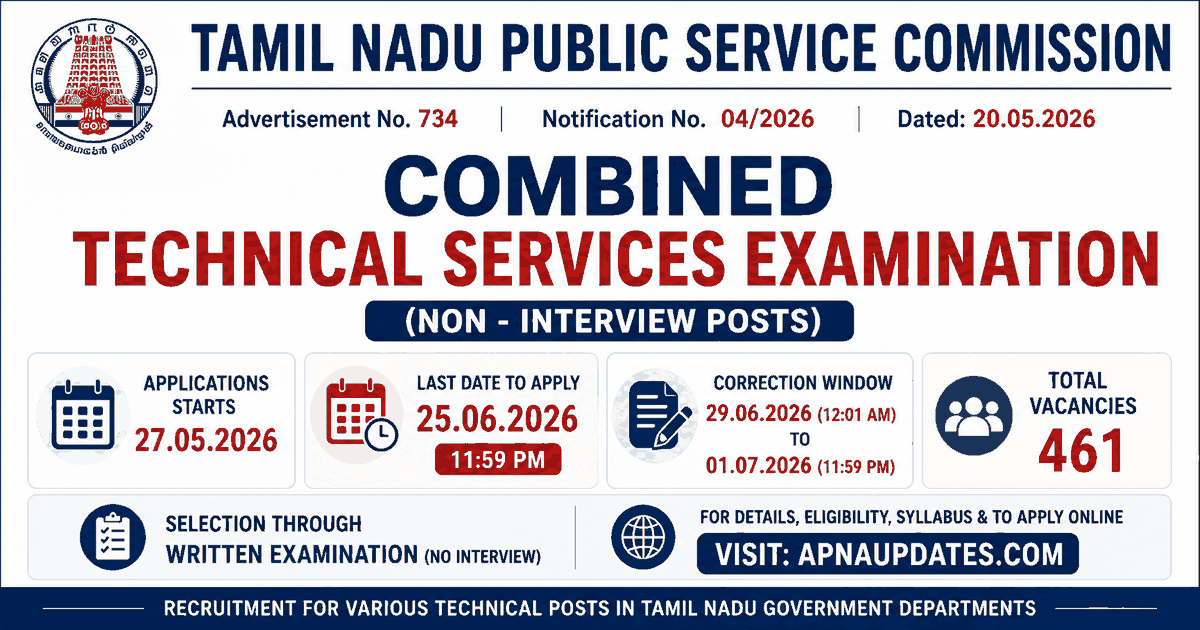
Tamil Nadu Public Service Commission has released Notification No. 04/2026 (Advertisement No. 734) for the Combined Technical Services Examination covering 45 posts with 461 total vacancies across multiple state government departments and public sector organisations. Online applications open May 27, 2026 and close June 25, 2026 at 11:59 PM. This is a non-interview examination, meaning final selection is based entirely on written exam marks - a structure that consistently draws very large applicant volumes in Tamil Nadu.
Before the details, a comprehensive overview is presented below:
| Feature | Details |
|---|---|
| Organization | Tamil Nadu Public Service Commission (TNPSC) |
| Post Name | 45 posts including Assistant Engineer (various disciplines), Assistant Geologist, Agriculture Officer, Drug Inspector, Horticultural Officer, System Manager, and others |
| Total Vacancies | 461 |
| Job Type | State Government, Direct Recruitment, Permanent |
| Application Mode | Online only at www.tnpscexams.in |
| Application Start Date | May 27, 2026 |
| Last Date to Apply | June 25, 2026 (11:59 PM) |
| Application Correction Window | June 29, 2026 (12:01 AM) to July 1, 2026 (11:59 PM) |
| Minimum Qualification | Varies by post —> Degree/BE/BTech/MSc/PG Degree as specified |
| Age Limit | 21 years minimum; maximum varies by post (32 to 52 for Others; SC/ST/MBC/BC: higher) as on 01.07.2026 |
| Selection Process | Written Examination (Paper I: OMR + Paper II: CBT) followed by Onscreen Certificate Verification, Physical Certificate Verification / Counselling |
| Salary / Pay Scale | Pay Level 8 to Pay Level 20 depending on post |
| Job Location | Tamil Nadu (Pan-India for one post) |
| Official Website | www.tnpsc.gov.in / www.tnpscexams.in |
| Helpline | For queries: Toll-Free No. 18004190958 (on working days from 10 AM to 5:45 PM). OTR/online application queries: helpdesk@tnpscexams.in. Other communications: grievance.tnpsc@tn.gov.in. |
What TNPSC's CTS Exam Covers and Why It Attracts Heavy Competition
The Tamil Nadu Public Service Commission's Combined Technical Services Examination bundles vacancies from across a wide spectrum of state departments and PSUs into a single consolidated notification. In a single application cycle, a civil engineer, a pharmacist, a geologist, a horticulturist, and a librarian can all sit for the same Paper I and only their respective Paper II subject paper differs. This design makes the exam genuinely efficient for candidates with technical qualifications but creates a competitive pool that runs far deeper than the 461 vacancy count suggests.
TNPSC's non-interview format is structurally significant. Because there is no interview, the written exam marks determine everything. Past TNPSC CTS examinations in comparable cycles have attracted well over a lakh registrations, with the engineering posts in particular drawing dense competition given the volume of BE/BTech graduates produced annually by Tamil Nadu's engineering colleges. The final merit list is strict and rank-based, which means a few marks' difference at the top of the list determines who gets recommended for appointment.
This cycle includes backlog vacancies across several posts, which means some of these positions have been advertised before without filling from reserved categories. Candidates from reserved communities applying for those posts will find the competition more manageable than in posts where fresh vacancies dominate, but the combined merit list structure still applies.
Vacancy Details
The 461 vacancies span 45 posts across government departments, statutory boards, and public sector undertakings. Pay levels range from Level 8 to Level 20, reflecting the significant seniority and technical depth variation across the posts.
| Pay Level | Key Posts | Total (Selected) |
|---|---|---|
| Level 20 | Assistant Engineer (Agricultural Engg), Agriculture Officer, Drug Inspector, Horticultural Officer, Assistant Engineer (Highways), Assistant Director (Industrial Safety and Health) | 64+11+9+17+38+3 = 142 |
| Level 19 (EPF) | Junior Assistant Director of Boilers, Junior Architect, AE (Civil-PWD), AE (Electrical), AE (Civil-RDPR), AE (Water Resources) | 2+5+14+13+4+2 = 40 |
| Level 18 | Assistant Geologist (Geology & Mining), Architectural Assistant/Planning Assistant, AE (Pollution Control, Town Planning, etc.) | Varies |
| Level 17 | Archaeological Officer, Research Assistant, Junior Scientific Officer, Asst Superintendent Approved Schools | 10+2+6+3 = 21 |
| Level 16 | AE (Civil) multiple departments, Statistical Assistant | Various |
| Level 15 | Deputy Manager (Dairying), Asst Manager IT/Civil/Electrical (ELCOT) | 1+4+2+2 = 9 |
| Level 13/12 (EPF) | Asst Accounts Officer, Librarian, Translator, System Manager | 1+1+9+1 = 12 |
| Level 11/10 | Block Health Statistician, Assistant Statistical Investigator, Junior Photographer | 23+62+1 = 86 |
| Level 9 | Assistant Librarian | 5 |
| Level 8 / 8 (EPF) | Assistant Warehouse Manager / Junior Assistant, Junior Chemist, AE (Mechanical-TNPDCL) | 3+3+1 = 7 |
| Level 1$$ (EPF) | Assistant General Manager / Regional Manager (Handloom Society) | 10 |
| Total | 461 |
The largest single category is Assistant Statistical Investigator with 62 vacancies, followed by Assistant Engineer (Agricultural Engineering) with 64 and Block Health Statistician with 23. Several posts have only 1 or 2 vacancies. These single-seat posts are worth careful consideration since the rule of reservation of appointments does not apply to posts with a cadre strength of one, which means competition is purely on general merit regardless of category.
The notation markers in the vacancy table carry practical meaning. Posts marked with a single asterisk (*) include backlog vacancies. Posts marked with (#) include shortfall vacancies. Posts marked (**) are exclusively backlog seats. The post of Assistant Statistical Investigator (1824) carries both * and @ markers, meaning it includes backlog vacancies and sports reservation deductions.
Application Fee
The base examination fee is Rs 100 per subject paper chosen. Candidates opting for multiple subject papers must pay Rs 100 for each additional paper. This per-paper fee structure is unique to TNPSC's consolidated exam format and means a candidate applying for posts under two different subject paper codes will pay Rs 200 total (plus service charges), not Rs 100.
Payment is through online mode only —> Net Banking, Credit Card, Debit Card, or UPI on or before the last date of submission of the online application. Offline payment is not accepted.
Candidates from eligible special categories can claim fee exemption. The details of who qualifies for fee concession are in Annexure II of the notification. Importantly, fee concession is tracked across all applications - each application claiming free chance reduces the total free chances available to the candidate. The fee concession option (Yes/No) cannot be modified after final submission. Candidates who have already exhausted their free chances in previous TNPSC examinations must choose "No" and pay the fee. False claims for fee exemption result in candidature rejection and a one-year debarment from TNPSC examinations.
Age Limit
Age is calculated as on July 1, 2026. The minimum age for all posts is 21 years. The maximum age varies significantly by post and category.
For candidates not belonging to SC, SC(A), ST, MBC/DC, BC(OBCM), or BCM communities ("Others"), the age ceiling across posts ranges from 32 years (several engineering posts) to 52 years (Assistant Superintendent of Approved Schools), with the most common ceiling at 42 years. A few posts have no upper age limit for reserved categories, subject to the candidate being under 60 years at the time of selection.
For SC, SC(A), ST, MBC/DC, BC(OBCM), and BCM candidates, the upper age ceiling is 5 to 10 years higher than the "Others" limit for most posts - the specific figures are listed post-wise in the notification. For posts where Others have no maximum age limit, the same applies to reserved category candidates.
Age concessions for Ex-Servicemen and Destitute Widows exist for most posts as indicated in the notification tables. Persons with Benchmark Disabilities have no maximum age limit for eligible posts, subject to the 60-year overall cap. "No maximum age limit" in this notification is defined as the candidate must not have completed 60 years as on July 1, 2026, or at the time of selection/appointment.
The age limit is notably favourable at the upper end for many posts compared to similar technical recruitments in other states. The 42-year ceiling for posts like Assistant Geologist and Environmental Scientist means candidates who started in private sector roles and are now mid-career have a genuine window.
Educational Qualification
With 45 posts across disciplines, the qualification requirements are post-specific. Each candidate must choose subject paper(s) corresponding only to the qualification they actually hold, the notification explicitly states that candidates should not choose subject papers for which they do not possess the required educational qualification.
Key qualification requirements by post group:
Engineering posts (most AE positions): BE/BTech in the relevant discipline (Civil, Electrical, Electronics and Communication, Mechanical, Agricultural, Computer Science, IT, etc.) from a recognised university. The Assistant Manager (IT) at ELCOT specifically requires first class or equivalent CGPA in the degree, plus first class in SSLC and HSC making it one of the more restrictive eligibility conditions in this notification.
Geology posts: MSc in Geology or Applied Geology or Hydrogeology (for Post Code 1750); MSc (Geology) for other codes recognised by UGC.
Agriculture and allied: Bachelor degree in Agriculture for Agriculture Officer (Extension); BSc Horticulture for Horticultural Officer.
Pharmacy/Drug: Degree in Pharmacy, Pharmaceutical Sciences, or Medicine with specialization in Clinical Pharmacology or Microbiology.
Statistics-related posts: Degree in Statistics, Mathematics, or Economics for Block Health Statistician (2010) and Assistant Statistical Investigator (1824); first class PG degree in Economics, Econometrics, Statistics, Business Administration, Mathematics, Social Work, Sociology, Anthropology, Agricultural Economics, or Public Administration for Research Assistant.
Library posts: Degree plus BLib Science for Librarian; Degree plus BLib Science or Library and Information Science for Assistant Librarian.
Archaeology posts: PG degree in Ancient History/Archaeology or equivalent plus Tamil passed at degree level, or BE Civil with Tamil at SSLC level.
Translator: Law degree (LLB) plus proficiency in Tamil.
In addition to subject-specific qualifications, all candidates must possess adequate knowledge of Tamil. This is satisfied if Tamil was studied as a subject in SSLC/HSC/Degree, or if the candidate studied in Tamil medium through High School, or if the candidate has passed the Second Class Language Test (Full Test) in Tamil conducted by TNPSC. Candidates who cannot produce documentary proof of Tamil knowledge at the application stage are not automatically disqualified, but they will be required to pass the TNPSC Tamil test within two years of appointment - failing which they will be discharged from service.
Selection Process
The examination structure for most posts (other than Translator) runs as follows.
Paper I is common for all candidates, taken via OMR, and has three parts. Part A is the Tamil Eligibility Test at SSLC standard - 40% qualifying marks (60 marks out of 150) are required. Only candidates who clear Part A have their Part B and Part C evaluated. Part B is General Studies at Degree standard (100 marks). Part C is Aptitude and Mental Ability at SSLC standard (100 marks). Duration is 3 hours.
Paper II is the subject-specific paper, taken via Computer Based Test (CBT), 3 hours, 200 marks at Degree/PG Degree standard depending on the post. The syllabus is available in Annexure III of the notification.
Minimum qualifying marks for the combined total of Part B + Part C of Paper I + Paper II (total 400 marks): 150 marks (37.5%) for Others, 135 marks (33.75%) for SC/ST/MBC/BC categories.
For the Translator post, Paper I is OMR-based (same structure), and Paper II is a descriptive Translation paper of 2.5 hours worth 100 marks. Total is 250 marks; minimum qualifying marks: 75 for Others and 60 for SC/ST/MBC/BC.
After the written exam, the Commission draws a shortlist for Onscreen Certificate Verification (OCV) in the ratio of 1:3 for General and 1:2 for reserved categories based on minimum qualifying marks and reservation rules. After OCV, candidates admitted to Physical Certificate Verification and Counselling are called in a ratio of 1:3 (General) and 1:1.5 (reserved categories) for posts requiring counselling, and 1:1.2 for all categories for posts not requiring counselling. Final selection is based solely on total marks in Part B + Part C of Paper I and Paper II. Part A marks do not count toward final ranking.
Tie-breaking follows: higher qualification first, then seniority in age, then earlier application number.
The Part A Tamil Eligibility Test is the first and most consequential gate. Candidates who prepare thoroughly for Part B (GS) and Part II (subject paper) but fail Part A at 40% will not have their other marks counted at all. For candidates whose schooling was not in Tamil or who studied Tamil only briefly, this requires dedicated attention.
Salary and Service Conditions
Pay levels span from Level 8 (approximately Rs 19,500 basic pay) to Level 20 (approximately Rs 56,100 basic pay) under the Tamil Nadu government's revised pay structure. The Assistant General Manager/Regional Manager post in the Handloom Society has a separate contractual pay scale of Rs 39,800–1,26,500 (Rs 28,480–90,570 EPF), which is outside the standard government pay matrix.
Posts in EPF-covered organisations (Electronics Corporation of Tamil Nadu, Tamil Nadu Magnesite, TNPDCL, Tamil Nadu Co-operative Milk Producers' Federation, etc.) follow the EPF pension scheme rather than the government pension framework. This is a meaningful difference for long-term financial planning - EPF-covered posts do not carry the same pension security as regular government appointments. Candidates applying specifically for PSU posts should note this distinction.
Posting for most posts is within Tamil Nadu. The exception is the Assistant General Manager/Regional Manager post (Post Code 3798) in Tamil Nadu Handloom Weavers Co-operative Society, where candidates must be ready to be posted anywhere in India.
How to Apply
- Visit the Commission's website at www.tnpscexams.in
- Click on the One Time Registration (OTR) link if not already registered; complete registration with personal, educational, and community details
- Log in using the OTR credentials and navigate to the Combined Technical Services Examination (Non-Interview Posts) application
- Select the subject paper(s) for which you hold the required qualification —> choose only papers matching your actual educational background
- Upload proof of adequate knowledge of Tamil (SSLC/HSC/Degree marksheet showing Tamil as a subject, or proof of Tamil medium study)
- Upload date of birth proof (SSLC/HSC mark sheet; if date not mentioned there, upload Birth Certificate/Transfer Certificate/Degree marksheets)
- Upload community certificate and any age concession supporting documents if applicable
- Choose the fee concession option carefully (Yes/No) —> this cannot be changed after submission; if claiming fee concession, ensure free chances have not been exhausted
- Pay the examination fee —> Rs 100 per subject paper through Net Banking, Credit Card, Debit Card, or UPI
- Review the filled application carefully and submit before June 25, 2026 at 11:59 PM
- If corrections are needed, use the Application Correction Window from June 29 to July 1, no modifications are permitted after this window closes
- Download and retain the Hall Ticket from www.tnpscexams.in when available
For queries: Toll-Free No. 18004190958 on working days from 10 AM to 5:45 PM. OTR/online application queries: helpdesk@tnpscexams.in. Other communications: grievance.tnpsc@tn.gov.in.
Required Documents and Key Instructions
Keep these ready before starting the application:
- SSLC mark sheet (date of birth proof) or alternative if DOB not on SSLC
- HSC/Degree/PG Degree mark sheets (proof of educational qualification and Tamil knowledge)
- Community certificate from competent authority (must be in the format prescribed in G.O. Ms. No.781, Revenue Department, dated May 2, 1988 — certificates citing spouse's name for community claims will be rejected)
- Age concession supporting documents (Ex-Servicemen discharge book, disability certificate, widow/destitute widow evidence as applicable)
- Physical fitness certificate for Assistant Superintendent of Approved Schools (Post Code 2078) —> minimum height 160 cm (men) / 145 cm (women), with chest measurement standards
- Council of Architecture registration for Junior Architect (Post Code 1860)
- For Assistant Manager (IT) at ELCOT: first class certificates for SSLC, HSC, and Degree/PG Degree
Critical instructions candidates frequently miss:
Appearance in both Paper I and Paper II is compulsory. Absence from either paper, even if minimum qualifying marks are secured in the paper attended, disqualifies the candidate from selection consideration.
The fee concession option cannot be edited after submission, not even during the Application Correction Window. If you are unsure about remaining free chances, choose "No" and pay the fee.
Candidates belonging to "Others" (non-reserved communities) with 5 or more years of service in any Central or State Government job are not eligible to apply even if within the age limit.
PwBD candidates are not eligible for 13 specific posts listed in the notification. They must check the list before applying under PwBD category.
The vacancy list and structure of this examination present certain questions, which are detailed below:
Understanding the Per-Paper Fee Structure and What It Means for Multi-Post Applicants
TNPSC's CTS examination allows candidates who hold qualifications in multiple disciplines to apply for more than one subject paper group in a single application cycle. A candidate with a degree in Civil Engineering who also holds a postgraduate qualification in Statistics can theoretically apply for both Civil Engineering (subject code 398) and Statistics and Mathematics (subject code 506) papers by paying Rs 100 for each. However, candidates must genuinely hold the qualification for each paper opted. Applying for papers without the requisite qualification is a misrepresentation that can result in candidature rejection after due process. The per-paper fee also means that if a candidate withdraws from a paper after payment, the fee for that paper is not refunded under any circumstances.
The Tamil Eligibility Test: The Gate Most Out-of-State Candidates Underestimate
Part A of Paper I —> the Tamil Eligibility Test is worth 150 marks and requires 40% (60 marks) to proceed. For candidates who studied through Tamil medium throughout, this is routine. For candidates from other states, those educated entirely in English medium, or those who studied Tamil only at Class 10 level decades ago, this 40% requirement deserves genuine preparation time. The test is at SSLC (Class 10) standard, which suggests it tests foundational Tamil comprehension and composition, but time pressure during a 3-hour combined paper means Tamil preparation cannot be afterthought. Differently-abled candidates can claim exemption from Part A but must declare this in the online application itself; no subsequent claim is entertained.
What the Single-Vacancy Posts Mean for Competition
Thirteen posts in this notification carry just 1 or 2 vacancies total including Assistant Geologist (Post Code 1677, 2 vacancies), Research Assistant (Post Code 1861, 2 vacancies), Archaeological Officer (Post Code 1843, 10 vacancies with most from reserved categories), and Junior Chemist (Post Code 3609, 3 vacancies). For posts with a total cadre strength of one, reservation rules do not apply, selection is purely on general merit. For the truly rare posts with a single vacancy, the Commission admits only 3 candidates to the physical certificate verification/counselling stage. This means the exam must be treated as highly competitive regardless of the post's narrow vacancy count. The combination of no reservation rules and a razor-thin selection funnel means the written exam score matters even more for these posts than for the larger-vacancy categories.
Similar Posts:
- APSC Junior Engineer (Electrical) Recruitment 2026: 53 Vacancies Under PWD, Apply by June 10
- UPSC NDA 2 2026 Notification Out for 394 Vacancies, Apply Online Till 9 June
- Haryana Subordinate Courts Clerk Recruitment 2026 - 1265 Vacancies, Apply Online by June 23
- RSSB Computer Instructor Recruitment 2026 - 3951 Vacancies for Senior and Basic Posts, Apply by June 23
❓Frequently Asked Questions
How many vacancies are available in TNPSC CTS Exam 2026?
There are 461 total vacancies across 45 posts and multiple departments and organisations. The count includes backlog vacancies being advertised again. The number is tentative and may be revised before certificate verification/counselling commences.What is the last date to apply?
June 25, 2026 at 11:59 PM at www.tnpscexams.in. An Application Correction Window is available from June 29 to July 1, 2026.Who is eligible to apply?
Indian citizens who meet the post-wise educational qualification, minimum age of 21 years, and possess adequate knowledge of Tamil. Candidates in the "Others" (non-reserved) category with 5 or more years of government service are not eligible. PwBD candidates cannot apply for 13 specific posts listed in the notification.What is the age limit including relaxations?
Minimum age 21 years for all posts as on July 1, 2026. Maximum age varies by post —> ranging from 32 to 52 years for "Others" category (no maximum age limit for some posts, subject to 60-year cap). SC/ST/MBC/DC/BC candidates get relaxation of 5 to 10 additional years depending on the post. Ex-Servicemen and Destitute Widows have no maximum age limit for most posts. Full details are post-wise in the notification.What qualification is required?
It varies by post —> BE/BTech for engineering posts, MSc for geology, BSc for Agriculture/Horticulture, Degree in Pharmacy for Drug Inspector, PG degree for Research Assistant and Archaeological Officer, Law degree for Translator, and so on. All candidates must also possess adequate knowledge of Tamil. Check the post-specific qualifications in Section 4.2 of the notification.What does the selection process involve?
A two-paper written examination: Paper I (OMR, 3 hours —> Tamil Eligibility Test + General Studies + Aptitude), and Paper II (CBT, 3 hours —> subject-specific paper). Minimum 40% in Part A of Paper I required for other parts to be evaluated. Final selection is based on marks in Part B + Part C of Paper I + Paper II. After written results, shortlisted candidates go through Onscreen Certificate Verification, then Physical Certificate Verification/Counselling.What is the salary for these posts?
Pay levels range from Level 8 to Level 20 under Tamil Nadu revised pay scales. Level 8 starts at approximately Rs 19,500 basic pay; Level 20 at approximately Rs 56,100. EPF-covered PSU posts follow EPF rules rather than government pension. One post (Assistant General Manager/Regional Manager, Handloom Society) has a separate pay scale of Rs 39,800–1,26,500.What is the application fee?
Rs 100 per subject paper opted, payable online only (Net Banking, Credit/Debit Card, UPI). Eligible special category candidates can claim fee exemption subject to the free chance limit being available. Fee once paid is non-refundable even if the candidate withdraws from a paper.How do I apply online?
Register through OTR at www.tnpscexams.in, then fill the application for the Combined Technical Services Examination. Choose subject papers matching your actual qualifications, upload required documents, select fee concession option carefully, pay the fee, and submit before June 25, 2026 at 11:59 PM.What is the official website for TNPSC CTS 2026?
www.tnpsc.gov.in for official updates and www.tnpscexams.in for application submission and Hall Ticket download. Hall Tickets will not be sent by post. candidates must download from the website.What happens if I skip Paper I but appear for Paper II?
You will not be considered for selection. Appearance in both Paper I and Paper II is compulsory, and absence from either paper disqualifies the candidate irrespective of marks scored in the attended paper.Can a candidate apply for multiple subject papers in the same exam?
Yes, candidates can apply for more than one subject paper group if they hold the required qualifications for each. An additional fee of Rs 100 per extra paper applies. Applying for a paper without the required qualification constitutes a false claim and is grounds for rejection.Check Everything Before June 25, The Correction Window Is Limited
The application window is just under four weeks, and this notification's complexity —> 45 posts, post-specific qualifications, multiple subject codes, per-paper fees, and fee concession tracking means rushed applications are where most mistakes happen. The fee concession choice is the single most irreversible decision in this application: it cannot be changed after submission, not even during the three-day correction window. Candidates with previous TNPSC applications should verify how many free chances remain before choosing "Yes" on fee exemption.
Exam dates have not been announced yet. Watch www.tnpsc.gov.in and www.tnpscexams.in for Hall Ticket availability and exam date notification. The Commission does not send individual communications by post. All updates go through the website, SMS, and email to the registered ID.
The Tamil Eligibility Test (Part A, 40% threshold) is the first hurdle and determines whether any other preparation counts. Candidates who clear it comfortably free up mental space for Paper II. Those who are uncertain about their Tamil proficiency should begin dedicating specific preparation time to it now, well before the exam.
This article is based on the official notification and simplified for easy understanding. For the most accurate and updated information, always refer to the official website.
| Notification Date | May 20, 2026 |
| Application Start Date | May 27, 2026 |
| Last Date to Apply | June 25, 2026 (11:59 PM) |
| Application Correction Window | June 29, 2026 (12:01 AM) to July 1, 2026 (11:59 PM) |
| Exam Date | To be announced |
| Hall Ticket (Memorandum of Admission) | To be announced at www.tnpscexams.in |
| Onscreen Certificate Verification | To be announced |
| Physical Certificate Verification / Counselling | To be announced |
| Result | To be announced |
| *Note | All updates will be published at www.tnpsc.gov.in and www.tnpscexams.in only. |