State Bank of India Apprentice 2026
⚠️ SBI Apprentice Recruitment 2026 Final Result Declared
The State Bank of India (SBI) has released the Final Result for the engagement of Apprentices under Advertisement No. CRPD/APPR/2026-27/07. The result contains the roll numbers of provisionally selected candidates for engagement as Apprentices. Candidates should search for their roll number in the result PDF to check whether they have been shortlisted.
> However, the selection is not unconditional. SBI has clearly stated that the selection remains provisional and is subject to:
1. Qualifying the proficiency test in the specified local language(s)
2. Fulfilment of the eligibility conditions mentioned in the recruitment advertisement.
3. Verification of the information provided during online registration.
> Candidates whose roll numbers appear in the final result should wait for further instructions from the SBI Local Head Office of their respective State. The result notice specifically asks provisionally selected candidates to await these instructions. Candidates should also keep their original educational, identity and other relevant documents ready, as eligibility and information furnished during registration will be verified before engagement.
⬇️ Scroll down to the Important Links section below where the direct link to check the SBI Apprentice Recruitment 2026 Final (Exam) Result has been provided.
State Bank of India (SBI), Central Recruitment & Promotion Department
Last Date: 15.06.2026 (EXTENDED)
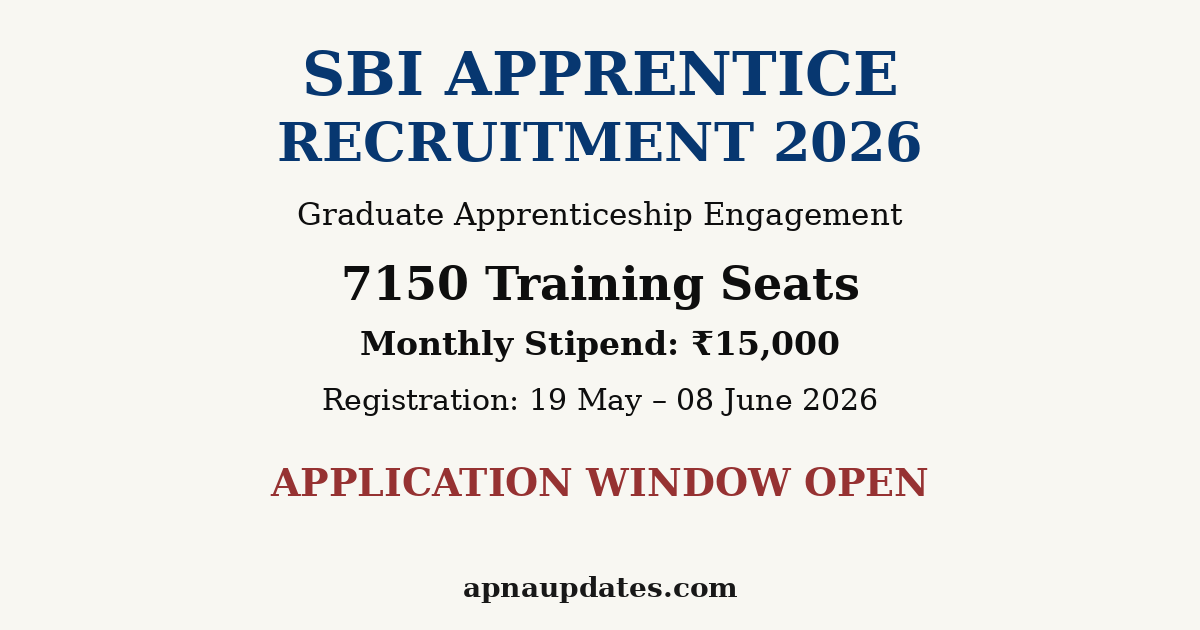
State Bank of India's Central Recruitment and Promotion Department has released Advertisement No. CRPD/APPR/2026-27/07 for the engagement of 7,150 Apprentices under the Apprentices Act, 1961, across 34 States and Union Territories. Online registration is open from May 19, 2026, and closes on June 8, 2026. The online examination is scheduled tentatively for July 2026. At 7,150 seats, this is the largest bank apprentice batch notified in 2026 so far, surpassing even Bank of Baroda's concurrent 5,000-seat drive issued the same week.
Here is the full picture before the details:
| Feature | Details |
|---|---|
| Organization | State Bank of India (SBI), Central Recruitment & Promotion Department |
| Advertisement No. | CRPD/APPR/2026-27/07 |
| Post Name | Apprentice |
| Total Training Seats | 7,150 (Provisional) |
| Job Type | Apprenticeship under Apprentices Act, 1961 (Not regular employment) |
| Application Mode | Online via NAPS portal + SBI website |
| Application Start Date | 19.05.2026 |
| Last Date to Apply | 15.06.2026 (EXTENTED) |
| Minimum Qualification | Graduation from a recognized University/Institute |
| Age Limit | Min: 20 years, Max: 28 years (as on 01.04.2026) |
| Selection Process | Online Written Test + Local Language Test + Medical Examination |
| Stipend | Rs. 15,000/- per month |
| Training Duration | 12 months |
| Online Exam Date | Tentatively July 2026 |
| Official Website | sbi.co.in / sbi.bank.in |
State Bank of India Apprentice 2026: Full Details
State Bank of India needs no introduction as a hiring organization, but the nature of this engagement does. The SBI Apprentice programme under Advertisement CRPD/APPR/2026-27/07 is not a recruitment for SBI employees. It is a structured one-year training engagement under the Apprentices Act, governed by central government guidelines on working conditions, leave, and holidays. Apprentices are not on SBI's payroll in the conventional sense - they receive a stipend, not a salary, and carry no entitlement to regular employment at the end of the year.
What makes this batch particularly significant is the 7,150 seat count, which is the largest SBI apprentice notification in recent history. Earlier SBI drives ran between 8,500 seats (2023-24 batch) and about 6,000 seats in shorter cycles. The 2026-27 batch at 7,150 reflects SBI's sustained commitment to the programme, and more importantly, it comes with a clause that no other bank apprentice programme currently offers: successful apprentices who pass the skill evaluation test and obtain the joint SBI-NSDC/BFSI-SSC National Apprenticeship Certificate receive weightage and relaxation in SBI's Junior Associates (Clerk) recruitment. This is the structural differentiator between SBI and BOB's simultaneous apprentice drives, and it fundamentally changes how candidates should evaluate the opportunity.
For candidates preparing for SBI Clerk, this is not a parallel opportunity to consider alongside the exam - it is a pathway that feeds directly into it with formally acknowledged preparation value.
Vacancy Details
The 7,150 seats are spread across 34 States and Union Territories. The state-wise and category-wise breakdown is as follows.
| State / UT | SC | ST | OBC | EWS | UR | Total |
|---|---|---|---|---|---|---|
| Andhra Pradesh | 113 | 49 | 191 | 70 | 286 | 709 |
| Telangana | 78 | 34 | 132 | 49 | 198 | 491 |
| Kerala | 40 | 4 | 108 | 40 | 211 | 403 |
| Tamil Nadu | 75 | 3 | 106 | 39 | 173 | 396 |
| Assam | 25 | 44 | 99 | 36 | 164 | 368 |
| Punjab | 100 | 0 | 72 | 34 | 139 | 345 |
| Rajasthan | 59 | 45 | 70 | 35 | 141 | 350 |
| Haryana | 60 | 0 | 85 | 32 | 143 | 320 |
| UT J&K | 24 | 33 | 81 | 30 | 132 | 300 |
| Madhya Pradesh | 42 | 57 | 42 | 28 | 116 | 285 |
| Karnataka | 44 | 19 | 74 | 27 | 112 | 276 |
| Odisha | 36 | 50 | 27 | 22 | 94 | 229 |
| Gujarat | 15 | 32 | 58 | 21 | 91 | 217 |
| Himachal Pradesh | 45 | 7 | 36 | 18 | 74 | 180 |
| Uttarakhand | 20 | 3 | 14 | 11 | 67 | 115 |
| Delhi | 15 | 7 | 28 | 10 | 45 | 105 |
| Uttar Pradesh | 117 | 5 | 150 | 55 | 234 | 561 |
| Maharashtra | 50 | 44 | 135 | 50 | 225 | 504 |
| West Bengal | 105 | 23 | 101 | 46 | 185 | 460 |
| Chhattisgarh | 11 | 29 | 5 | 9 | 39 | 93 |
| Tripura | 14 | 27 | 1 | 8 | 38 | 88 |
| Bihar | 9 | 0 | 15 | 5 | 29 | 58 |
| Mizoram | 0 | 24 | 2 | 5 | 23 | 54 |
| Sikkim | 2 | 10 | 12 | 5 | 21 | 50 |
| UT Andaman & Nicobar | 0 | 3 | 11 | 4 | 24 | 42 |
| UT Puducherry | 2 | 0 | 4 | 1 | 11 | 18 |
| Goa | 0 | 1 | 2 | 1 | 12 | 16 |
| UT Ladakh | 1 | 1 | 4 | 1 | 8 | 15 |
| UT Chandigarh | 2 | 0 | 4 | 1 | 8 | 15 |
| Arunachal Pradesh | 0 | 11 | 0 | 2 | 13 | 26 |
| Nagaland | 0 | 9 | 0 | 2 | 9 | 20 |
| Meghalaya | 0 | 3 | 0 | 0 | 5 | 8 |
| Manipur | 0 | 2 | 0 | 0 | 4 | 6 |
| Jharkhand | 3 | 7 | 3 | 2 | 12 | 27 |
| Total | 1107 | 586 | 1672 | 699 | 3086 | 7150 |
Andhra Pradesh leads with 709 seats, the highest allocation for any single state, followed by Uttar Pradesh (561), Maharashtra (504), Telangana (491), and West Bengal (460). Together these five states account for nearly 40 percent of all seats nationally. PwBD reservations are horizontal: 92 seats for VI, 79 for HI, 70 for LD, and 63 for the d&e category.
The category distribution nationally puts OBC at 1,672 seats (23.4%), UR at 3,086 (43.2%), SC at 1,107 (15.5%), EWS at 699 (9.8%), and ST at 586 (8.2%). The UR pool is the largest single block, as expected at this scale.
Application Fee
The fee structure here is noticeably more candidate-friendly than the concurrent BOB drive. General, OBC, and EWS candidates pay Rs. 300. SC, ST, and PwBD candidates pay nothing. The fee is non-refundable, paid online only, and must be deposited before the last date for the registration to be considered complete.
The relatively low fee for General/OBC/EWS candidates —> Rs. 300 compared to BOB's Rs. 800 for General males - reflects SBI's mass recruitment orientation. It will also contribute to very high application volumes; a lower barrier to entry historically drives larger applicant pools in SBI drives.
Age Limit
The age reference date here is April 1, 2026. Candidates must be minimum 20 years and maximum 28 years as on that date, meaning born not later than April 1, 2006, and not earlier than April 2, 1998. SC and ST candidates get 5 years of relaxation, OBC (NCL) candidates get 3 years, and PwBD candidates get relaxation as per Government of India guidelines.
The April 1 cutoff is an important detail. Candidates who checked their eligibility against BOB's May 1 cutoff should re-verify for SBI using April 1, 2026, as candidates born in April or May 1998 who are eligible for BOB may find themselves just outside the SBI age window.
Educational Qualification
A graduation degree from any recognized university or institution is the sole academic requirement. No minimum percentage, no specific discipline. The eligibility cutoff date is also April 1, 2026.
Two critical work experience conditions apply. First, candidates who have completed one year or more of training or job experience after attaining their educational qualification are ineligible. Second, candidates who have previously undergone apprenticeship - whether with SBI or any other organization - or are currently pursuing an apprenticeship under the Apprentices Act, cannot apply. These are hard disqualifications, not soft preferences. A candidate who did a 12-month banking apprenticeship with another institution before applying to SBI is ineligible, even if a significant amount of time has passed since that engagement ended.
One additional eligibility condition that does not appear in most other bank apprentice notifications: candidates with a record of default in repayment under any lending arrangement with banks, NBFCs, or financial institutions, including credit card dues, who have not regularized outstanding amounts by the date of offer of engagement, are not eligible. SBI explicitly runs CIBIL verification. Candidates with adverse CIBIL records must clear outstanding dues before the offer letter stage or their candidature will be withdrawn.
Selection Process
Stage 1: Online Written Test —> 100 objective questions across four sections, each with its own 15-minute timer: General/Financial Awareness (25 marks), General English (25 marks), Quantitative Aptitude (25 marks), and Reasoning Ability and Computer Aptitude (25 marks). Total duration is 60 minutes.
This is where SBI's exam structure differs meaningfully from BOB's. SBI has negative marking at 1/4th of a mark per wrong answer. BOB's concurrent apprentice exam has no negative marking. This changes preparation strategy significantly — SBI demands accuracy, not just speed. Candidates who attempt all 100 questions to maximize raw attempts will be penalized. The section-wise timers also mean you cannot borrow time from one section to compensate for difficulty in another.
The exam is available in English, Hindi, and 13 regional languages depending on the state applied for. General English is in English only. The exam is conducted at physical centres across 34 states — unlike BOB's remotely proctored format, SBI's written test requires candidates to appear at designated examination centres at their own expense.
Stage 2: Local Language Test —> Required for candidates who cannot demonstrate proficiency in the specified local language of their applied state through Class 10 or Class 12 mark sheets. Passing this test is mandatory for engagement. The language varies by state; the notification provides the complete state-wise language mapping.
Stage 3: Medical Examination —> Engagement of selected candidates is subject to being declared medically fit as per SBI's requirements.
An important process note: unlike BOB's remotely proctored exam, SBI's written test requires candidates to physically appear at one of the notified examination centres. The centre preference is selected during registration, but no request for change of centre will be entertained after registration. SBI may cancel centres or reallocate candidates to other centres based on administrative requirements.
Stipend, Training Structure, and the Junior Associates Weightage
The monthly stipend is Rs. 15,000 for 12 months, identical to BOB's apprentice programme. No additional allowances or benefits apply. The training is conducted at the district assigned by the bank, and candidates have the option to select three preferred districts within their chosen state at registration though the bank reserves the right to assign any district within the state based on administrative requirements.
At the end of the training year, apprentices appear for a skill evaluation test (Trade Test). Those who pass receive a joint National Apprenticeship Certificate issued by SBI and NSDC/BFSI-SSC. Candidates who complete the apprenticeship with satisfactory conduct and performance and obtain this certificate receive weightage and relaxation in SBI's Junior Associates (Clerical cadre) recruitment, as per the bank's recruitment policy at the time.
This is the defining feature of the SBI apprentice programme and the reason it occupies a different category from other bank apprentice drives. The exact quantum of weightage is subject to SBI's recruitment policy at the time of the Junior Associates exam and is not fixed in this notification. Candidates should monitor SBI's policy updates on this. What is confirmed is that this formal linkage exists - SBI's own notification states it explicitly - which no concurrent bank apprentice programme currently does.
A separate Consent Form (Annexure-IV) allows apprentices to consent to SBI sharing their personal data with SBI's associates and subsidiaries for future engagement or recruitment opportunities after training completion. This is voluntary and opt-in, not mandatory for the apprenticeship itself.
How to Apply
- Register on the NAPS portal at apprenticeshipindia.gov.in —> this step is mandatory before applying through SBI's website
- Go to the official SBI website at sbi.co.in/careers or sbi.bank.in/careers
- Click on Current Openings and find the Apprentice engagement advertisement
- Open the online application form and fill in all details carefully. The form can be saved partially and reopened up to three times using the provisional registration number and password generated by the system
- Upload a scanned photograph (200x230 pixels, 20KB–50KB), signature (140x60 pixels, 10KB–20KB), left thumb impression (240x240 pixels, 20KB–50KB), and a handwritten declaration in English on white paper with black ink (800x400 pixels, 50KB–100KB)
- Also capture and upload a live photograph using the webcam or mobile QR code option on the application portal
- Select one state for the apprenticeship, one local language for examination, and up to three preferred training districts within the state
- Select the examination centre from the list provided for your applied state
- Pay the application fee online using debit card, credit card, or internet banking
- Submit the final application —> no changes are permitted after final submission
- Download and save the e-receipt and the system-generated application form printout
Do not send any hard copy to SBI. Call letters will be available for download from the SBI website tentatively in June 2026. No hard copy call letter will be sent by post.
Required Documents and Important Instructions
Four items must be uploaded during application: photograph, signature, left thumb impression, and a handwritten declaration. The declaration text is fixed and must be written in the candidate's own handwriting in English only. Signatures and declarations in capital letters are rejected. Uploading the photo at the signature field or vice versa results in disqualification from the exam.
At the examination centre, candidates must carry one valid photo identity proof (passport, Aadhaar, PAN, driving licence, voter ID, bank passbook with photo, school/college ID, or Gazetted Officer certificate) in original along with a self-attested photocopy. Candidates from all states except the Northeastern states must produce their Aadhaar number before contract signing for the apprenticeship.
Candidates applying under OBC must ensure their certificate specifically contains the Non-Creamy Layer clause, is issued in the GoI-prescribed format, and is dated between April 1, 2026 and the date of joining if selected. EWS candidates need an Income and Asset Certificate based on financial year 2025-26, valid for 2026-27. Missing or unproduced certificates at the joining stage result in automatic rejection - no extensions are granted.
Mobile phones, smartwatches, pagers, earphones, and calculators are banned from examination premises. Candidates are advised not to bring these items at all, as safekeeping cannot be guaranteed.
Candidates who have read through the notification now know what SBI is offering. What the notification does not explain is why certain decisions here deserve more careful thought than they typically receive.
The SBI vs BOB Decision for Candidates Applying to Both
Both SBI and BOB have opened apprentice applications simultaneously, both close June 8, and both require state selection. The instinct to apply to both is understandable - but since both require you to select one state and that state cannot overlap across drives, the constraint is really about which state and which bank represents the better strategic choice for a given candidate. SBI's Junior Associates weightage is the decisive differentiator for anyone targeting banking clerical exams. BOB's remote proctored exam format is the decisive advantage for anyone with unreliable access to examination centres. SBI's negative marking changes the preparation approach entirely compared to BOB's no-penalty format. These are not interchangeable programmes.
What the Negative Marking Actually Changes
SBI's 1/4th negative marking in a 60-minute, four-section exam with individual timers creates a very different test dynamic than BOB's format. In high-competition state pools like Andhra Pradesh (709 seats), UP (561), and Maharashtra (504), cutoffs in previous SBI apprentice exams have typically landed between 68 and 78 marks out of 100 in the General category - with negative marking factored in. Candidates who prepared for BOB's format by attempting all questions without regard for accuracy need to recalibrate. Skipping difficult questions in SBI's exam is structurally correct; in BOB's exam, it costs marks unnecessarily. These are different tests requiring different test-taking strategies, not the same paper in different formats.
The CIBIL Condition Nobody Reads Carefully
The explicit CIBIL clause in SBI's general conditions is unusual for an apprentice engagement and signals something worth noting. SBI is treating apprentices with unusual seriousness as future potential hires, and the CIBIL check reflects that orientation. Candidates who have outstanding credit card dues, overdue EMIs, or any adverse loan account as of the offer of engagement date need to clear these before that stage. The bank will check. Candidates who regularize dues but whose CIBIL record has not yet been updated must produce NOCs from the lender. Discovering this at the engagement stage - after clearing the exam and language test - is a preventable outcome.
Also Check:
Bank of Baroda Apprentice Recruitment 2026 – 5000 Seats Across India, Apply Online by June 8
South East Central Railway Bilaspur Apprentice Recruitment 2026: 1191 Posts, Apply by June 11
❓Frequently Asked Questions
How many seats are there in SBI Apprentice Recruitment 2026?
A total of 7,150 training seats are notified provisionally across 34 States and Union Territories. Andhra Pradesh leads with 709 seats, followed by Uttar Pradesh (561), Maharashtra (504), Telangana (491), and West Bengal (460).What is the last date to apply for SBI Apprentice 2026?
June 8, 2026 is the last date. Registration must be completed and fees deposited online before this date. The online registration window opened on May 19, 2026.Who is eligible to apply for SBI Apprentice 2026?
Indian citizens aged 20 to 28 years as on April 1, 2026, holding a graduation degree from a recognized university, who have not previously completed an apprenticeship under the Apprentices Act and have not accumulated one year or more of training or job experience after graduation.What is the age limit including relaxations?
The general age range is 20 to 28 years as on April 1, 2026. SC and ST candidates get 5 years of relaxation (up to 33 years). OBC Non-Creamy Layer candidates get 3 years (up to 31 years). PwBD relaxations are as per Government of India guidelines.What is the selection process for SBI Apprentice 2026?
Selection involves three stages: an online written test of 100 questions in 60 minutes with 1/4th negative marking, a Local Language Proficiency Test for candidates who cannot produce Class 10 or 12 language study proof, and a Medical Examination. Final engagement is subject to passing all three stages and document verification.What is the stipend for SBI Apprentice 2026?
Rs. 15,000 per month for 12 months. No other allowances or benefits are payable. Apprentices are not bank employees and are not entitled to any employee benefits.Is there weightage for SBI Apprentice in future recruitment?
Yes. Apprentices who successfully complete the training, pass the skill evaluation test, and obtain the joint SBI-NSDC/BFSI-SSC National Apprenticeship Certificate receive weightage and relaxation in SBI Junior Associates (Clerk) recruitment as per the bank's prevailing policy. This benefit is specific to SBI and not available in other bank apprentice programmes.What is the application fee for SBI Apprentice 2026?
General, OBC, and EWS candidates pay Rs. 300. SC, ST, and PwBD candidates pay no fee. The fee is non-refundable and is paid online only.How do I apply for SBI Apprentice 2026?
Register first on the NAPS portal at apprenticeshipindia.gov.in, then visit sbi.co.in/careers or sbi.bank.in/careers, go to Current Openings, and open the Apprentice Application Form. Upload all four required documents, pay the fee online, and submit before June 8, 2026.What is the official website for SBI Apprentice 2026?
sbi.co.in/careers and sbi.bank.in/careers are the official SBI websites. All corrigenda, call letters, results, and updates will be published there. Announcements also appear on apprenticeshipindia.gov.in, nsdcindia.org/apprenticeship, and bfsissc.com.Is there negative marking in SBI Apprentice 2026 exam?
Yes. Unlike several other bank apprentice drives, SBI's written test carries negative marking of 1/4th mark for each wrong answer. Candidates should prioritize accuracy over attempt count.Can I apply to more than one state for SBI Apprentice 2026?
No. Each candidate can apply to one state only. The state, local language choice, and exam centre are fixed at the time of registration and cannot be changed. Submitting multiple applications results in all but the last valid one being rejected, with fees forfeited.What documents need to be uploaded during SBI Apprentice 2026 application?
Four items: a passport-size colour photograph, a signature in black ink on white paper, a left thumb impression on white paper in black or blue ink, and a handwritten declaration in the candidate's own handwriting in English on white paper. A live photograph captured via webcam or mobile is also required. Specific size and format requirements are listed in Annexure-I of the notification.Before You Submit - What Needs Your Attention Right Now
The June 8 deadline is shared with BOB's apprentice drive, which means candidates applying to both programmes are managing two registration processes simultaneously. SBI's process involves the NAPS portal registration as a prerequisite, so that step needs to happen before the SBI application form can be completed. Starting the NAPS registration early avoids last-minute portal congestion.
State and language selection in SBI's application is permanent. The exam centre selection is also final after submission. Candidates in large states with multiple centre options should check the full centre list and select a city they can realistically reach in July, since no requests for centre change will be considered.
Watch sbi.co.in/careers and bfsissc.com for the exam date announcement in July and call letter availability in June. No communication will come by post. The registered email ID is the only channel for all correspondence from SBI throughout this process.
Candidates with any adverse CIBIL history should begin the process of regularizing outstanding dues now. The CIBIL check comes at the engagement stage, after the exam and language test, and candidates who discover disqualification at that point will have lost months of preparation time unnecessarily.
This article is based on the official notification and simplified for easy understanding. For the most accurate and updated information, always refer to the official website.
| Notification Date | 19.05.2026 |
| Online Registration Start | 19.05.2026 |
| Last Date to Apply | 15.06.2026 (Extended) |
| Last Date for Fee Payment | 15.06.2026 |
| Correction Window | upto 15.06.2026 |
| Call Letter Download | 29 June 2026 |
| Online Written Examination | 11 July 2026 |
| *Online Written Examination Result | 25 August 2026 |
| Local Language Test | To be announced |
| Result / Final Engagement | To be announced |
| *Note | Updates will be published on sbi.co.in/careers, sbi.bank.in/careers, bfsissc.com, and apprenticeshipindia.gov.in. No postal communication will be sent at any stage. |