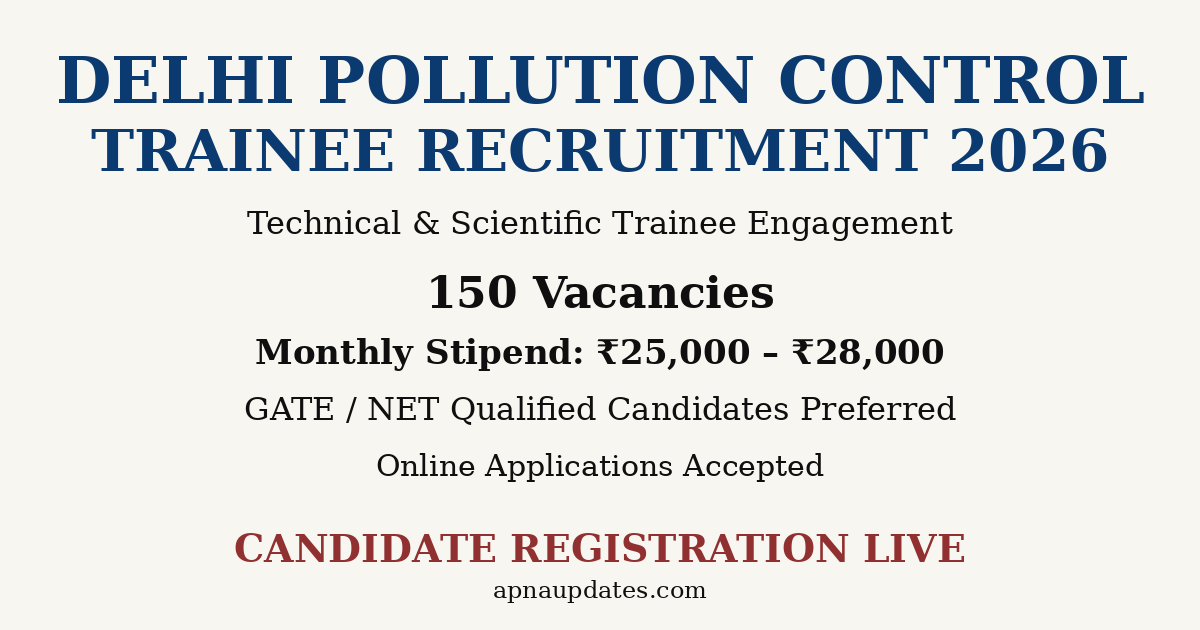
Delhi Pollution Control Trainee Recruitment 2026
Delhi Pollution Control Committee (DPCC), Dept. of Environment, Govt. of NCT of Delhi
Last Date: June 6, 2026 (exactly 21 days from the date of advertisement upload, as stated in the notification)
The Delhi Pollution Control Committee has invited online applications for 150 Trainee posts on a contractual basis, split between Technical Trainees requiring an engineering degree and Scientific Trainees requiring a postgraduate science qualification. Applications opened on May 17, 2026, and the window closes on June 6, 2026 - exactly 21 days from the date of advertisement upload, as stated in the notification. GATE and NET scores from 2023 onwards carry a direct advantage in the selection process, making this a recruitment where exam-prepared candidates are structurally better positioned from the start.
Before the details, here is the full picture at a glance:
| Organization | Delhi Pollution Control Committee (DPCC), Dept. of Environment, Govt. of NCT of Delhi |
| Post Name | Trainee (Technical and Scientific) |
| Total Vacancies | 150 (Tentative) |
| Job Type | Contractual, on Monthly Stipend Basis |
| Application Mode | Online only at dpcc.delhi.gov.in |
| Application Start Date | 17.05.2026 |
| Last Date to Apply | 06.06.2026 ( exactly 21 days from the date of advertisement upload ) |
| Minimum Qualification | B.E./B.Tech (Technical) or M.Sc. (Scientific) in relevant disciplines |
| Age Limit | Not mentioned in the official notification |
| Selection Process | Merit based on GATE/NET score; qualifying exam marks as fallback |
| Salary / Stipend | Rs. 25,000/month (Year 1), Rs. 26,500/month (Year 2), Rs. 28,000/month (Year 3) |
| Job Location | Delhi |
| Official Website | dpcc.delhi.gov.in |
DPCC Trainee Recruitment 2026: Comprehensive Details
The Delhi Pollution Control Committee is the statutory body responsible for monitoring, regulating, and enforcing pollution control norms across the National Capital Territory of Delhi. It functions under the Department of Environment, Government of NCT of Delhi, and operates under the framework of the Water Act (1974) and the Air Act (1981). In practical terms, DPCC is the agency that issues consent orders to industries, conducts ambient air and water quality monitoring, responds to pollution complaints, and coordinates with the Central Pollution Control Board on compliance. Working here means direct involvement in the environmental governance of one of the world's most air-polluted capitals, not back-office administrative work.
This 150-vacancy trainee batch is the largest DPCC has announced in recent years. The 2023 trainee drive had notified 61 posts, and a subsequent cycle in August 2023 added more tranches. A batch of 150 represents a significant scale-up, likely reflecting DPCC's expanding monitoring mandate and the pressure it faces from the National Green Tribunal and CAQM directives to strengthen its technical ground presence. The trainees engaged in this cycle will be working alongside permanent staff on live pollution monitoring, laboratory analysis, and field enforcement - not on peripheral projects.
The GATE and NET preference built into this selection is what distinguishes it from a routine trainee drive. DPCC is effectively signalling that it wants candidates who have already cleared a rigorous national-level technical examination, which is unusual for a contractual engagement at this stipend level. For candidates who hold a valid GATE or NET score from 2023 or later and have been waiting for a suitable opening, this is a directly relevant opportunity.
Vacancy Details
The total of 150 posts is distributed across two trainee streams. The notification specifies that Technical Trainees (B.E./B.Tech) and Scientific Trainees (M.Sc.) will be engaged in a ratio of 10:01, meaning approximately 136 Technical Trainee seats and 14 Scientific Trainee seats.
| Category | Post Type | Approximate Seats (10:1 Ratio) |
|---|---|---|
| SC | Trainee | 22 |
| ST | Trainee | 11 |
| OBC (NCL) Delhi | Trainee | 40 |
| EWS | Trainee | 15 |
| UR | Trainee | 62 |
| Total | 150 |
The 10:1 Technical-to-Scientific ratio means the overwhelming majority of seats are for engineering graduates. M.Sc. candidates are competing for roughly 14 posts across all categories. Given that scientific trainee seats are few and the pool of eligible M.Sc. graduates in biochemistry, microbiology, environmental chemistry, and related fields is broad, competition for those seats will be sharper on a per-seat basis than the overall vacancy count suggests.
The unreserved category holds 62 seats, which is the largest single block. OBC (NCL) Delhi carries 40 seats - note the Delhi-specific OBC tag, which means OBC certificates issued by states other than Delhi will not be valid for availing reservation benefits here. This catches candidates off guard regularly in DPCC recruitments.
Application Fee
Not mentioned in the official notification.
Candidates should visit dpcc.delhi.gov.in and check the online application portal directly for any fee requirement before submitting the form. In previous DPCC trainee cycles, no application fee was charged, but this should be confirmed from the live portal rather than assumed.
Educational Qualification
The notification covers two distinct streams, and the discipline requirements are specific.
Technical Trainees must hold a Bachelor's degree in Engineering (B.E. or B.Tech) in one of the following: Civil, Environmental, Chemical, Electrical, Mechanical, ECE, Biomedical Engineering, Water Resources, Remote Sensing / GIS, or Hydrology, or an equivalent qualification.
Scientific Trainees must hold a Master's degree in Science (M.Sc.) in one of the following: Biochemistry, Microbiology, Life Science, Chemistry, Environmental Chemistry, Analytical Chemistry, Toxicology, or an equivalent qualification.
Both streams require the qualifying degree to have been completed with First Division on a full-time regular basis from a recognized university or institution, completed in the year 2023 or later. This is a firm cutoff. Candidates who completed their degree before 2023 are not eligible, regardless of marks or GATE score. The notification is explicit on this point.
Where GATE or NET scores from 2023, 2024, 2025, or 2026 are available, those candidates will be preferred. In cases where two candidates hold equal GATE or NET scores, the one with the higher percentage in the qualifying examination will rank higher.
Selection Process
DPCC has structured the merit list in a specific sequence, and understanding that sequence matters for how candidates should assess their own chances.
The primary merit list is built on GATE or NET scores from the year 2023 or later. Candidates with these scores are placed first, ranked in order of merit. Only if sufficient candidates are not available under this GATE/NET merit list does DPCC fall back to a secondary merit list based on marks in the qualifying examination (degree completed in 2023 or later).
The practical implication is straightforward: if you hold a valid GATE or NET score, you will be ranked ahead of all candidates who do not, regardless of how high those candidates scored in their degree. The final merit list places GATE/NET holders at the top of the queue before the non-GATE pool is even considered.
There is no written examination specific to this recruitment. There is no mention of an interview stage in the notification. Selection is merit-based and document-driven. This is both an advantage and a risk - faster for candidates who qualify on paper, but it also means there is no second chance to compensate for a weak score through performance in a test.
The notification also states that a waitlisted panel will be prepared for candidates considered for engagement depending on vacancies arising in respective categories. This panel remains valid for one year from the date of the final result published on the DPCC website.
Candidates who have previously served as trainees with DPCC are not eligible to be re-engaged. This is a hard disqualification, not a soft preference.
Stipend, Contract Structure, and Service Conditions
The engagement is on a contractual basis. The monthly stipend is Rs. 25,000 in the first year, Rs. 26,500 in the second year, and Rs. 28,000 in the third year. These are stipend amounts, not salary in the conventional sense, and the engagement does not confer any right to regular or permanent employment in DPCC.
The initial engagement is for six months. After a one-day break, the tenure can be extended for further six-month spells, up to a maximum of three years, subject to satisfactory performance. The one-day break between each spell is a standard contractual mechanism; candidates should not read it as a disruption to continuity but they should be aware that each extension is at DPCC's discretion based on performance and operational need.
Probation period and bond conditions are not mentioned in the official notification.
The job location is Delhi. The notification does not mention transfer provisions, which is consistent with DPCC being a Delhi-specific statutory body. Unlike central government postings, there is no pan-India transfer risk here.
How to Apply
- Go to the official DPCC website at dpcc.delhi.gov.in
- Navigate to the recruitment or careers section and locate the notification for Engagement of Trainees under F. No. DPCC/3(9)(412)/Admn-2026
- Click the online application link provided against this advertisement
- Register with a valid email ID and mobile number that will remain active through the engagement process
- Fill in the application form with accurate personal, educational, and category details
- Select the correct stream: Technical Trainee or Scientific Trainee, based on your qualifying degree
- Upload GATE or NET scorecard (2023 or later) if available, along with mark sheets of qualifying examination
- Upload caste certificate if applying under a reserved category, ensuring the certificate is issued by the competent authority in Delhi for OBC (NCL) Delhi reservations
- Submit the application before the last date
- Download and save the submitted application and any acknowledgement for future reference
- No application in physical form or any mode other than online will be accepted or entertained
Required Documents and Important Instructions
The notification specifies the following documents in the context of GATE/NET mark sheets: copies of GATE/NET mark sheets (2023 or later) must be attached. Additionally, mark sheets of the qualifying examination passed in 2023 or later are required. Caste and category certificates must be attached for availing reservation benefits.
Candidates applying under OBC (NCL) Delhi should note that the reservation follows GNCTD and DoPT rules, and only Delhi-domicile OBC certificates are valid. A certificate from any other state does not qualify for this category.
One condition that carries a serious consequence: candidates who have previously been engaged as trainees with DPCC in any capacity are categorically ineligible to apply again. Any application from such a candidate will be rejected, and if discovered later, the engagement will be cancelled.
DPCC reserves the right to cancel the advertisement and the engagement at any stage without assigning any reason. The vacancy numbers are tentative and may increase or decrease. Trainees cannot claim regular or permanent employment on the basis of this engagement under any circumstances.
The data in the notification tells you what DPCC is hiring. It does not tell you what it is actually like to compete for these posts or what the work involves. Here is what the numbers and structure actually mean.
The GATE Advantage Is Real and Significant Here
In most government trainee drives, GATE scores are listed as "preferred" but rarely function as a hard structural filter. DPCC has been consistent about using GATE/NET as the primary merit criterion across its trainee cycles, and the 2026 notification formalises this by placing the final merit list construction in a two-tier sequence: GATE/NET holders first, qualifying exam holders second. Candidates without a GATE or NET score are not competing for the same 150 seats as those who have one — they are competing for whatever seats remain after the GATE/NET pool is exhausted. In a batch this size, with Delhi being the only posting location and the organization being a well-known name in environmental governance, the GATE/NET pool is unlikely to leave many seats unfilled. Candidates without a qualifying score should factor this realistically into their decision to apply.
What the Technical Trainee Role Actually Involves at DPCC
The title "Technical Trainee" at a pollution control board is not primarily a desk role. DPCC trainees in the technical stream are routinely deployed in ambient air quality monitoring stations, stack emission monitoring at industrial units, effluent sampling at discharge points, and source inspection visits alongside enforcement officers. The Remote Sensing and GIS qualification listed in the eligibility is specifically relevant to DPCC's satellite-based monitoring of construction dust and solid waste burning, which has become a significant part of its winter pollution response under GRAP directives. Candidates from Civil or Environmental Engineering backgrounds tend to find the transition into DPCC's field and lab work more natural than those from Electrical or ECE, though the latter are engaged in instrument maintenance and data management functions. Understanding which stream of the work you are likely to be assigned based on your discipline helps set realistic expectations before joining.
The Delhi OBC Certificate Issue Is a Recurring Problem
Across DPCC's recruitment history, one of the most common causes of application rejection at the document verification stage has been the submission of OBC certificates issued by states other than Delhi. The notification specifies "OBC (NCL) Delhi" which means the Non-Creamy Layer OBC certificate must be issued by the competent authority under the Government of NCT of Delhi. Candidates who have grown up outside Delhi, relocated for studies or work, and hold OBC certificates from their home states are not eligible to claim OBC reservation in this recruitment. They can still apply under the UR category if they meet the qualification criteria, but they cannot claim the 40 OBC seats. This distinction has tripped up a meaningful number of applicants in past DPCC cycles and is worth being clear about before the form is submitted.
Related Posts:
South East Central Railway Bilaspur Apprentice Recruitment 2026: 1191 Posts, Apply by June 11
RBI Junior Engineer Recruitment 2026 Notification Out for 11 Vacancy
Coal India Limited MT Mining 2026: 276 Management Trainee Jobs Across Coalfields
❓Frequently Asked Questions
How many vacancies are there in DPCC Trainee Recruitment 2026?
A total of 150 posts are notified on a tentative basis: 62 UR, 40 OBC (NCL) Delhi, 22 SC, 15 EWS, and 11 ST. The Technical and Scientific trainees are distributed in a 10:1 ratio, meaning approximately 136 engineering and 14 science posts.What is the last date to apply for DPCC Trainee 2026?
June 6, 2026 is the last date for online application submission. The notification states 21 days from the date of advertisement upload on the DPCC website, which was May 17, 2026. No offline application will be accepted.Who is eligible for DPCC Trainee 2026?
Technical Trainees must hold a B.E./B.Tech in Civil, Environmental, Chemical, Electrical, Mechanical, ECE, Biomedical, Water Resources, Remote Sensing/GIS, Hydrology, or equivalent. Scientific Trainees must hold an M.Sc. in Biochemistry, Microbiology, Life Science, Chemistry, Environmental Chemistry, Analytical Chemistry, Toxicology, or equivalent. Both must have First Division and must have completed the degree in 2023 or later.What is the age limit for DPCC Trainee 2026?
Age limit is not mentioned in the official notification. Candidates should check the DPCC website or the online application portal for any age condition that may be specified there.Is GATE score mandatory for DPCC Trainee 2026?
GATE or NET scores from 2023, 2024, 2025, or 2026 are preferred but not mandatory. However, candidates with qualifying GATE/NET scores are placed at the top of the merit list. Candidates without these scores are considered only in the second tier, based on qualifying examination marks.What is the selection process for DPCC Trainee 2026?
There is no written exam or interview. Selection is purely merit-based. The first merit list is built on GATE/NET scores (2023 or later). If seats remain after this list is exhausted, a second merit list based on qualifying examination marks is used. A waitlist panel is also prepared, valid for one year from the result date.What is the stipend for DPCC Trainees?
The monthly stipend is Rs. 25,000 in the first year, Rs. 26,500 in the second year, and Rs. 28,000 in the third year. This is a contractual stipend, not a regular government salary, and carries no entitlement to permanent employment.What is the duration of the DPCC Trainee contract?
Initial engagement is for six months, renewable in six-month spells after a one-day break, up to a maximum of three years, subject to satisfactory performance.What is the application fee for DPCC Trainee Recruitment 2026?
Not mentioned in the official notification. Candidates should verify on the official portal at dpcc.delhi.gov.in before submitting the application.How do I apply for DPCC Trainee 2026?
Applications must be submitted online only at dpcc.delhi.gov.in. No physical or postal application is entertained. Navigate to the recruitment section, find the trainee notification under F. No. DPCC/3(9)(412)/Admn-2026, and complete the online form with all required documents uploaded.Can candidates who previously worked as DPCC trainees apply again?
No. Candidates who have previously served as trainees with DPCC are explicitly ineligible for re-engagement under this notification.What OBC certificate is valid for DPCC Trainee OBC category seats?
Only OBC (Non-Creamy Layer) certificates issued by the competent authority under the Government of NCT of Delhi are valid. State OBC certificates from outside Delhi do not qualify for the OBC (NCL) Delhi reservation category.Closing Note
The application window for this batch closes on June 6, 2026. Given that selection is entirely merit and document-based with no written examination, the only meaningful action between now and that date is submitting a complete and accurate application with the correct documents. Candidates with GATE or NET scores from 2023 onwards should prioritise uploading those certificates; that single document determines which merit tier you are placed in.
Watch dpcc.delhi.gov.in for any corrigendum. DPCC has a history of posting corrections to category-wise seat distribution and eligibility fine print on the website without issuing a separate notification. The online application portal is also where you should verify any fee requirement, since the notification itself does not specify one.
Candidates applying under OBC (NCL) Delhi should double-check that their certificate is Delhi-issued before the form is submitted. A rejected application at verification is not recoverable at that stage.
This article is based on the official notification and simplified for easy understanding. For the most accurate and updated information, always refer to the official website.
| Notification Upload Date | 17.05.2026 |
| Application Start Date | 17.05.2026 |
| Last Date to Apply | 06.06.2026 |
| Last Date for Fee Payment | 06.06.2026 |
| Result / Merit List Date | To be announced |
| Engagement Start Date | To be announced |
| *Note | All updates, corrigenda, and the final merit list will be published on dpcc.delhi.gov.in only. |