Bank of Baroda Apprentice Recruitment 2026
⚠️ Bank of Baroda Apprentice Recruitment 2026 Online Exam Result Released
The Bank of Baroda (BOB) has officially declared the Online Examination Result for the Apprentice Recruitment 2026 conducted under the Apprentices Act, 1961. Candidates who appeared in the examination can now check whether their BFSI SSC Roll Number has been included in the provisional select list for engagement as Apprentices.
> Candidates whose roll numbers appear in the provisional select list will receive detailed instructions on their registered email ID regarding the pre-engagement process. The final selection will be subject to successful completion of Document Verification, Language Proficiency Test (where applicable), and Medical Examination. Candidates are advised to keep all required original documents ready and complete the formalities within the prescribed timeline.
⬇️ Scroll down to the Important Links section below where the direct link to check the Online Exam Result has been provided.
----------------------------------------------------------------------
Bank of Baroda (BOB)
Last Date: 15.06.2026 (EXTENDED)
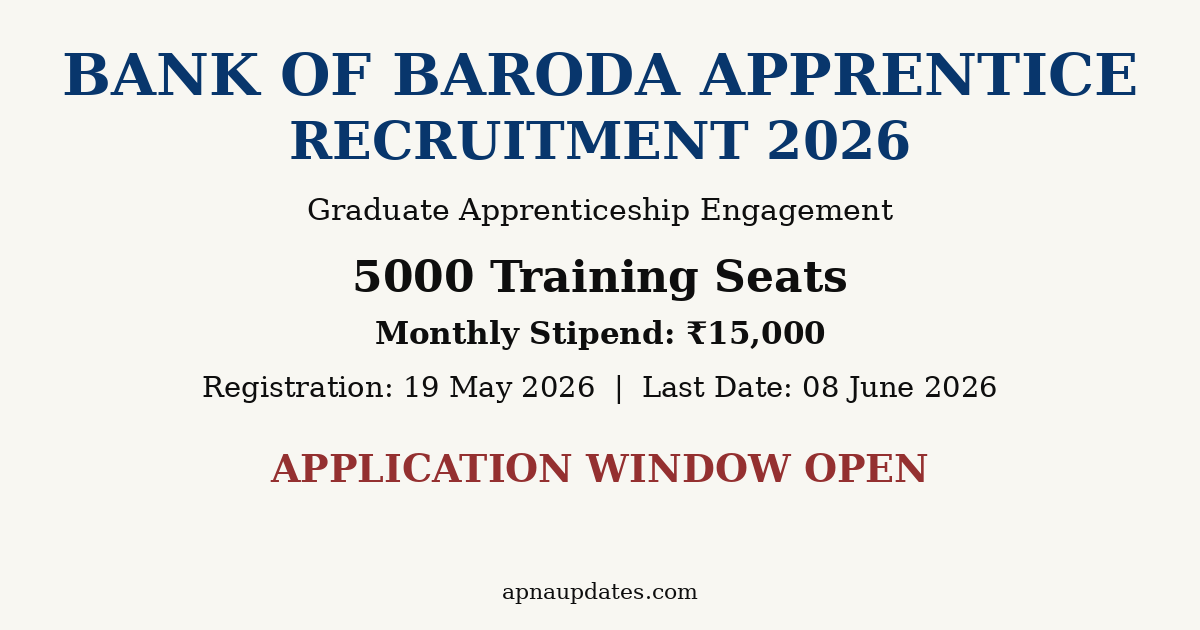
Bank of Baroda has released Advertisement No. BOB/HRM/APPRENTICE/ADVT/2026/01 for the engagement of 5,000 Apprentices under the Apprentices Act, 1961, across 35 States and Union Territories. Online registration opened on May 19, 2026, and the last date for submission of applications is June 8, 2026. This is one of the largest single-batch bank apprentice notifications released in 2026 so far, and given BOB's reach across semi-urban and rural banking centres, training locations span well beyond metro cities.
Here is the complete picture before diving into the details:
| Feature | Details |
|---|---|
| Organization | Bank of Baroda |
| Advertisement No. | BOB/HRM/APPRENTICE/ADVT/2026/01 |
| Post Name | Apprentice |
| Total Training Seats | 5,000 (Provisional) |
| Job Type | Apprenticeship under Apprentices Act, 1961 (Not regular employment) |
| Application Mode | Online via NATS / NAPS portal + BFSI SSC |
| Application Start Date | 19.05.2026 |
| Last Date to Apply | 15.06.2026 |
| Minimum Qualification | Graduation in any discipline from a recognized university |
| Age Limit | Min: 20 years, Max: 28 years (as on 01.05.2026) |
| Selection Process | Online Examination + Language Proficiency Test + Document Verification |
| Stipend | Rs. 15,000/- per month |
| Training Duration | 12 months |
| Official Website | bankofbaroda.bank.in |
Bank of Baroda Apprentice Recruitment 2026: Complete Details
Bank of Baroda is one of India's largest public sector banks, operating through a network of thousands of branches spread across every state in the country. Unlike SBI or PNB apprentice drives that draw enormous applicant volumes primarily in Hindi-belt states, BOB's apprentice programme distributes seats widely, with significant allocations to Gujarat, Maharashtra, Uttar Pradesh, Karnataka, Rajasthan, and Tamil Nadu. This geographic spread means the competition dynamics vary significantly depending on where you apply.
The 2026 batch with 5,000 seats is the largest BOB apprentice notification since the programme resumed post-COVID, and represents a notable scale-up from previous cycles. In the 2023 and 2024 rounds, BOB notified batches in the 2,000 to 3,500 seat range. A batch this size signals that the bank is accelerating its branch-level staffing to support its rural and semi-urban expansion, particularly in states like Gujarat, UP, and Maharashtra where its branch density is highest.
The critical thing to understand from the outset: this is a 12-month apprenticeship, not a job. Apprentices are trainees under the Apprentices Act. They receive a stipend, not a salary. They are not employees of the bank and carry no claim to regular employment upon completion. BOB is explicit about this. Candidates who apply expecting a stepping stone to a confirmed bank job will be disappointed - but for freshers who want structured banking exposure, BFSI SSC certification, and a credible one-year stint that genuinely strengthens future candidacy for bank clerical and officer exams, this is a well-regarded programme.
Vacancy Details
The 5,000 seats are distributed across 35 States and Union Territories. Below is the category-wise state-level breakup for the major states.
| Sr. No. | State / UT | SC | ST | OBC | EWS | UR | Total |
|---|---|---|---|---|---|---|---|
| 1 | Andaman & Nicobar | 0 | 0 | 0 | 0 | 1 | 1 |
| 2 | Andhra Pradesh | 30 | 13 | 50 | 18 | 77 | 188 |
| 3 | Arunachal Pradesh | 0 | 1 | 0 | 0 | 3 | 4 |
| 4 | Assam | 2 | 3 | 7 | 2 | 15 | 29 |
| 5 | Bihar | 28 | 1 | 48 | 17 | 85 | 179 |
| 6 | Chandigarh | 0 | 0 | 1 | 0 | 3 | 4 |
| 7 | Chhattisgarh | 14 | 39 | 7 | 12 | 50 | 122 |
| 8 | Dadra & NH and D&D | 0 | 3 | 0 | 0 | 4 | 7 |
| 9 | Delhi | 13 | 6 | 24 | 9 | 39 | 91 |
| 10 | Goa | 0 | 3 | 5 | 2 | 19 | 29 |
| 11 | Gujarat | 67 | 144 | 259 | 96 | 394 | 960 |
| 12 | Haryana | 15 | 0 | 22 | 8 | 39 | 84 |
| 13 | Himachal Pradesh | 2 | 0 | 1 | 0 | 5 | 8 |
| 14 | Jammu & Kashmir | 0 | 0 | 0 | 0 | 2 | 2 |
| 15 | Jharkhand | 7 | 16 | 7 | 6 | 28 | 64 |
| 16 | Karnataka | 77 | 33 | 130 | 48 | 195 | 483 |
| 17 | Kerala | 11 | 1 | 29 | 11 | 59 | 111 |
| 18 | Ladakh | 0 | 0 | 0 | 0 | 2 | 2 |
| 19 | Madhya Pradesh | 20 | 27 | 20 | 13 | 56 | 136 |
| 20 | Maharashtra | 58 | 52 | 156 | 58 | 256 | 580 |
| 21 | Manipur | 0 | 0 | 0 | 0 | 1 | 1 |
| 22 | Meghalaya | 0 | 1 | 0 | 0 | 3 | 4 |
| 23 | Mizoram | 0 | 0 | 0 | 0 | 2 | 2 |
| 24 | Nagaland | 0 | 1 | 0 | 0 | 2 | 3 |
| 25 | Odisha | 14 | 20 | 11 | 9 | 38 | 92 |
| 26 | Puducherry | 0 | 0 | 1 | 0 | 3 | 4 |
| 27 | Punjab | 22 | 0 | 16 | 7 | 33 | 78 |
| 28 | Rajasthan | 70 | 53 | 82 | 41 | 166 | 412 |
| 29 | Sikkim | 0 | 0 | 0 | 0 | 1 | 1 |
| 30 | Tamil Nadu | 37 | 1 | 53 | 19 | 89 | 199 |
| 31 | Telangana | 13 | 5 | 22 | 8 | 35 | 83 |
| 32 | Tripura | 0 | 0 | 0 | 0 | 3 | 3 |
| 33 | Uttar Pradesh | 160 | 7 | 206 | 76 | 315 | 764 |
| 34 | Uttarakhand | 13 | 2 | 9 | 7 | 45 | 76 |
| 35 | West Bengal | 44 | 9 | 42 | 19 | 80 | 194 |
| Total | 717 | 441 | 1208 | 486 | 2148 | 5000 |
Gujarat leads with 960 seats, followed by UP at 764 and Maharashtra at 580. Together these three states account for nearly 46 percent of all seats nationally. Candidates applying in these states benefit from larger seat pools but face correspondingly higher applicant volumes. States like Himachal Pradesh (8), Goa (29), and Chandigarh (4) have very few seats, meaning competition in those locations is exceptionally tight per seat even if absolute applicant numbers are lower.
PwBD reservations are horizontal across total vacancies, with 54 seats for OC, 51 for HI, 48 for VI, and 36 for ID candidates at the national level.
Application Fee
| Category | Total Fee (Exclusive of GST) |
|---|---|
| SC / ST | Rs. 200/- |
| PwBD | Rs. 200/- |
| General / EWS / OBC – Male | Rs. 800/- |
| General / EWS / OBC – Female / Transgender | Rs. 600/- |
Payment is online only through the secure link provided by BFSI SSC after completing portal registration. The fee is non-refundable under any circumstances, including if the exam is not held, the candidate is not shortlisted, or the recruitment is cancelled. GST is payable additionally on the amounts above. The application registration is considered complete only after the fee has been successfully deposited with BFSI SSC - not merely after portal registration.
This fee goes to BFSI SSC, not directly to Bank of Baroda, and candidates will receive a copy of their Application cum Examination Form from info@bfsissc.com after payment confirmation.
Age Limit
The minimum age is 20 years and the maximum is 28 years as on May 1, 2026. SC and ST candidates get 5 years of relaxation (effective upper limit: 33 years). OBC Non-Creamy Layer candidates get 3 years (effective limit: 31 years). PwBD candidates under UR/EWS categories get 10 years, PwBD OBC candidates get 13 years, and PwBD SC/ST candidates get 15 years.
One important nuance specific to NAPS-registered candidates: the upper age limit under NAPS relaxation provisions applies only where the candidate is registered under the National Apprenticeship Promotion Scheme and should be below 34 years as on the cut-off date. This is separate from the standard category-wise relaxations and applies under specific scheme conditions.
The 28-year general cap is standard for bank apprentice programmes. What is notable here is the 20-year minimum - graduates who completed their degree in three years at the minimum eligible age will typically be around 21 to 22, comfortably within range. The minimum is effectively a mechanism to ensure only genuine freshers and not career-changers with significant experience apply.
Educational Qualification
A graduation degree in any discipline from a recognized university is the only academic requirement. No minimum percentage is specified. The notification adds one important condition for NATS-registered candidates: their graduation must not have been completed more than four years before the cut-off date of May 1, 2026 - meaning the degree must have been passed in 2022 or later.
The discipline-open eligibility means the applicant pool is very wide. Arts, Science, Commerce, and professional degree holders are all eligible, which is typical for banking apprentice drives at this level. What narrows the pool significantly is the work experience condition: candidates who have had training or job experience for one year or more after completing their graduation are not eligible. This is a firm disqualification. Candidates who graduated and then worked even in an internship exceeding one year post-degree need to carefully assess whether they qualify before applying.
Selection Process
The selection has three stages in sequence.
Stage 1: Online Examination —> A 100-question objective paper worth 100 marks, to be completed in 60 minutes. The four sections are General/Financial Awareness (25 marks), Quantitative and Reasoning Aptitude (25 marks), Computer Knowledge (25 marks), and General English (25 marks). The first three sections are available in Hindi and English; General English is English only. There is no negative marking for wrong answers.
The exam is remotely proctored, meaning candidates can appear from home or any location with a stable Wi-Fi connection, using a smartphone, laptop, or desktop with a working front camera and microphone. This is the same format BFSI SSC has used across recent bank apprentice drives and substantially reduces the logistics burden compared to centre-based exams.
Merit lists are drawn state-wise and category-wise based on aggregate marks. Where two candidates are tied at the cutoff, the older candidate ranks higher — age in descending order is the tiebreaker, not the graduation percentage or any other criterion. This is an unusual and often overlooked feature of BOB's apprentice merit list construction.
Stage 2: Language Proficiency Test —> Candidates must demonstrate proficiency (reading, writing, speaking, understanding) in the specified local language of the state they applied to. This test is conducted after the online examination. Candidates who have studied the specified language in Class 10 or Class 12 are exempt from the language test, provided they produce the relevant mark sheet as proof. All other candidates must appear for and pass this test. Failing the language test means no engagement, regardless of online exam performance.
Stage 3: Document Verification —> Conducted at a BOB Regional or Zonal Office in the state applied for. Candidates must appear at their own expense. Bank of Baroda will not reimburse travel costs for document verification or the language test. Medical fitness, as per bank requirements, is also assessed as part of final engagement.
Stipend and Service Conditions
The monthly stipend is Rs. 15,000 for the entire 12-month training period. No other allowances or benefits are payable. The stipend is disbursed at the end of each month after adjusting any Loss of Pay. At the end of the apprenticeship year, candidates undergo a final assessment test and receive an Apprenticeship Certificate based on marks scored.
The engagement is explicitly not regular or contractual employment. Apprentices are not treated as employees of the bank. Labour laws and employee benefits that apply to Bank of Baroda's regular staff do not extend to apprentices. After completion of the 12-month training period, candidates are automatically relieved. The bank has no obligation to offer any form of employment after training ends. Apprentices are also prohibited from forming or joining any union body.
No transport or hostel accommodation is provided. Candidates should factor in cost of living in the training location when making their state selection, especially for high-cost cities like Mumbai, Bengaluru, or Pune where Rs. 15,000 per month will be significantly stretched.
The Application Process
This recruitment has a more complex application process than a standard government job form, and candidates who misunderstand the sequence miss steps that render their application incomplete.
- First, register on the Government of India apprenticeship portals. NATS portal: nats.education.gov.in (use the Student Register/Login section). NAPS portal: apprenticeshipindia.gov.in. Both registrations require Aadhaar (front and back, JPEG under 1MB), PAN card, passport photo, Class X and XII mark sheets, degree mark sheet or provisional certificate, bank passbook or cheque leaf copy, and scanned signature. All documents under 1MB in the format specified.
- After portal registration, log in to the respective portal and search for Bank of Baroda under advertised vacancies (NATS: Apply against advertised vacancies; NAPS: Search by Establishment Name). Apply through the portal.
- After completing the application on NATS/NAPS, you will receive an email from info@bfsissc.com inviting you to fill the Application cum Examination Form, provide location/centre preferences (up to 3 within your chosen state), select category, and pay the examination fee. Registration is complete only after this fee payment. Save the acknowledgement number.
- Go to the official website at bankofbaroda.bank.in
- Check the Current Opportunities section for the apprentice advertisement
- Follow the NAPS and NATS portal links from there for the full application flow
- Note your NATS Enrolment ID and NAPS Apprentice Registration Code - these are needed for all future correspondence
- Retain login credentials for both portals throughout the apprenticeship duration
- Save the system-generated application form printout after final submission
- Monitor info@bfsissc.com and bankofbaroda.bank.in regularly for exam date and call letter updates
Required Documents and Key Instructions
Documents needed at the NAPS/NATS registration stage: Aadhaar (front and back), PAN card, passport photo, Class X mark sheet, Class XII mark sheet, graduation degree or provisional certificate, bank passbook/cheque leaf, and signature scan. All in JPEG or PDF format under 1MB.
Documents for Document Verification: Language Proficiency Test intimation letter, online application printout, date of birth proof (Class X certificate or birth certificate), individual semester/year-wise mark sheets and degree certificate, university CGPA-to-percentage conversion certificate if applicable, caste/EWS/disability certificate as relevant, and any other documents supporting eligibility.
Critical instructions candidates miss: The state and category selected at the time of online application are final and cannot be changed at any stage. Candidates can apply to one state only and must select up to three preferred training centres within that state. The bank may allot any other centre in the state if preferred centres are full based on merit. Multiple applications result in all registrations being cancelled and all fees forfeited. The email ID entered during registration must remain active throughout the process - all call letters, exam dates, and engagement communications come only to that email. No hard copy intimations are sent by post.
OBC candidates must ensure their certificate specifically contains the Non-Creamy Layer clause and that the caste name matches the Central Government list exactly, letter by letter. The certificate should have been issued within one year of the date of advertisement.
Related Posts:
South East Central Railway Bilaspur Apprentice Recruitment 2026: 1191 Posts, Apply by June 11
❓Frequently Asked Questions
How many seats are available in Bank of Baroda Apprentice Recruitment 2026?
A total of 5,000 training seats are notified across 35 States and Union Territories. Gujarat has the highest share at 960, followed by Uttar Pradesh at 764 and Maharashtra at 580. All figures are provisional and subject to change as per the bank's requirement.What is the last date to apply for BOB Apprentice 2026?
June 8, 2026 is the last date for submission of the application. Registration opened on May 19, 2026. Candidates must complete both portal registration and fee payment before this date - incomplete applications are rejected without communication.Who is eligible for Bank of Baroda Apprentice 2026?
Indian citizens aged between 20 and 28 years as on May 1, 2026, who hold a graduation degree in any discipline from a recognized university, are eligible. Candidates must be registered on either the NATS or NAPS government apprenticeship portal. Those who have completed one year or more of training or job experience after graduation, or who are currently pursuing any apprenticeship elsewhere, are not eligible.What is the age limit for BOB Apprentice 2026?
The general age range is 20 to 28 years as on May 1, 2026. SC/ST candidates get 5 years of relaxation (up to 33 years), OBC NCL candidates get 3 years (up to 31 years), and PwBD UR/EWS candidates get 10 years of relaxation.What is the selection process for BOB Apprentice 2026?
Selection involves three stages: an online objective examination of 100 questions in 60 minutes (no negative marking), a Language Proficiency Test in the specified local language of the applied state, and Document Verification. Candidates who have studied the relevant local language in Class 10 or 12 are exempt from the language test.What is the stipend for BOB Apprentice 2026?
Rs. 15,000 per month for 12 months. No additional allowances or benefits are payable. The stipend is paid after each completed month, adjusted for any loss of pay. No transport, hostel, or accommodation facility is provided.What is the application fee for BOB Apprentice 2026?
SC/ST and PwBD candidates pay Rs. 200 plus GST. General, EWS, and OBC male candidates pay Rs. 800 plus GST. General, EWS, and OBC female and transgender candidates pay Rs. 600 plus GST. The fee is paid online only through BFSI SSC's payment link and is non-refundable.How do I apply for BOB Apprentice 2026?
Register on the NATS portal (nats.education.gov.in) and/or NAPS portal (apprenticeshipindia.gov.in), then apply for the Bank of Baroda apprenticeship on the respective portal. After portal application, you will receive an email from info@bfsissc.com to fill the Application cum Examination Form and pay the fee. Only after fee payment is the application complete.What is the official website for BOB Apprentice 2026?
bankofbaroda.bank.in is the official Bank of Baroda website. Updates, corrigenda, exam dates, and results will be published under the Career section. BFSI SSC's website bfsissc.com also carries all relevant updates.Can I apply to more than one state for BOB Apprentice 2026?
No. Each candidate can apply to only one State or Union Territory. The state selected at the time of application is final and cannot be changed. Within the selected state, candidates must indicate up to three preferred training centres.Will BOB offer me a job after the apprenticeship is over?
No. The bank has no obligation to offer any form of employment after the 12-month training period. Apprentices are automatically relieved upon completion. The Apprenticeship Certificate issued at the end is a credential for future banking job applications, not a guarantee of employment with BOB.Is the online exam conducted at home or at a test centre?
The exam is remotely proctored, meaning candidates can appear from home or any location with reliable Wi-Fi, using a device with a front camera and microphone. No physical exam centre is required for the written test. The language test and document verification are conducted at a bank-designated centre in the applied state at the candidate's own expense.Final Instructions for Applicants
The application window for this batch is exactly three weeks, opening on May 19 and closing June 8. Given the two-step nature of the process, portal registration on NATS/NAPS followed by the BFSI SSC form and fee payment, candidates should not wait until the final days. BFSI SSC's email from info@bfsissc.com arrives after portal registration and may take time to reach; applying early ensures there is buffer to complete the fee payment step without last-minute technical issues.
The state selection and preferred centre choices entered in the form are permanent. Think through the language test implication, the commute distance to likely training centres, and the category-wise seat count for your state before hitting submit. For candidates in states with very few seats - single-digit allocations in states like Tripura, Sikkim, or Manipur - the competition per seat is acute despite lower absolute applicant numbers.
Watch bankofbaroda.bank.in and bfsissc.com for the online exam date announcement. It will not come by post, and it will come to the registered email only. Keeping that inbox active and checking spam folders will matter when call letter communications begin.
This article is based on the official notification and simplified for easy understanding. For the most accurate and updated information, always refer to the official website.
| Notification Date | 19.05.2026 |
| Application Start Date | 19.05.2026 |
| Last Date to Apply | 15.06.2026 (23:59 hours) |
| Last Date of Fee Payment | 15.06.2026 (23:59 hours) |
| Online Examination Date | 21 June 2026 |
| Online Exam Result | 18 July 2026 |
| Language Proficiency Test Date | To be announced |
| Document Verification | To be announced |
| Result / Final Selection | To be announced |
| *Note | All updates will be published on bankofbaroda.bank.in (Career section) and bfsissc.com. No postal communication will be sent. |