MPPCB Assistant Engineer Recruitment 2026
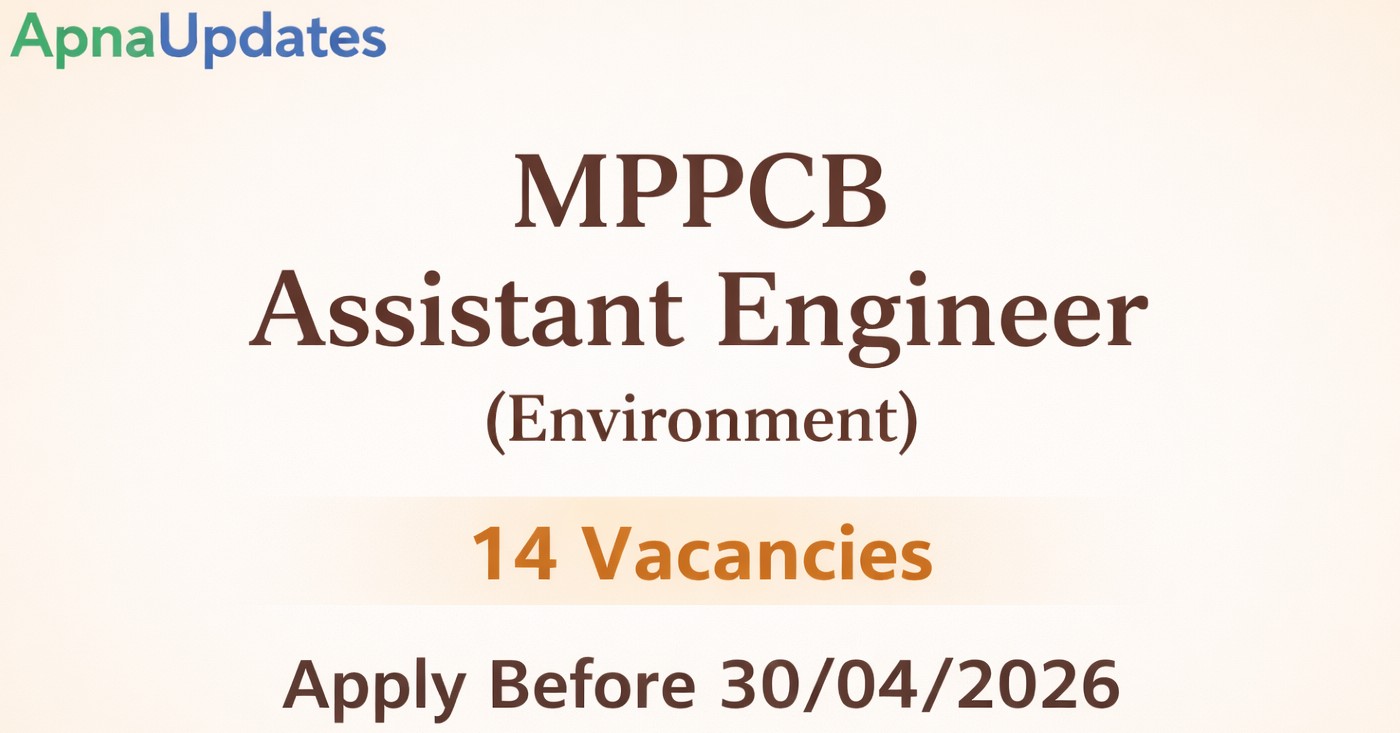
Recruitment Overview
Before diving into the deep details, here is a quick summary of the recruitment drive.
| Feature | Details |
|---|---|
| Organization | Madhya Pradesh Pollution Control Board (MPPCB) |
| Post Name | Assistant Engineer (Environment) |
| Total Vacancies | 14 Posts |
| Pay Scale | Level-12 (₹ 56,100 - ₹ 1,77,500) |
| Grade Pay | ₹ 5,400 |
| Application Mode | Online (via MP Online) |
| Selection Method | CBT (80%) + Interview (20%) |
| Job Location | Madhya Pradesh |
Vacancy Breakdown
| Category | Posts |
|---|---|
| Unreserved (UR) | 05 |
| OBC (Non-Creamy Layer) | 03 |
| Scheduled Caste (SC) | 02 |
| Scheduled Tribe (ST) | 03 |
| Economically Weaker Section (EWS) | 01 |
There are a total of 14 posts available. Additionally, there is horizontal reservation for women (05 posts) and PwD candidates as per government rules.
Job Responsibilities
As an Assistant Engineer, you will manage a mix of office tasks and field duties. Your primary responsibilities include reviewing industrial pollution control proposals and visiting factories or treatment plants to verify that they follow environmental safety standards.
A major part of your work involves analyzing technical reports and lab test results. You will document your findings in inspection reports and recommend necessary actions. You must follow regulations such as the Water Act of 1974 and the Air Act of 1981. Given that your assessments impact both the environment and industrial operations, this role requires high attention to detail and careful decision-making.
Eligibility Criteria
To be eligible for the Assistant Engineer (Environment) position at the Madhya Pradesh Pollution Control Board (MPPCB), you must satisfy specific educational and age requirements.
Educational Qualification
The board requires a specific combination of undergraduate and postgraduate engineering degrees. You are considered eligible if you possess:
- A Bachelor’s degree (B.E./B.Tech) in Civil Engineering.
- A Master’s degree (M.E./M.Tech) in Environmental Engineering.
Both degrees must be from a recognized university or institution. Degrees in Environmental Science (M.Sc.) or general management programs do not meet the core engineering requirements for this specific post.
Age Limits
Your age is calculated as on January 1, 2026. The requirements are as follows:
| Category | Age Range |
|---|---|
| General/Unreserved | 21 - 40 Years |
| SC/ST/OBC/Women/Govt. Employees | 21 - 45 Years |
Note: Age relaxation for reserved categories is applicable only for candidates holding a valid Madhya Pradesh domicile.
Salary and Career Expectations
The Assistant Engineer position follows the 7th Pay Commission, Level-12 pay-level. The basic pay starts at Rs.56,100 per month and can increase up to Rs.1,77,500 over time through yearly raises and promotions. Your total monthly income also includes extra benefits such as Dearness Allowance (DA), House Rent Allowance (HRA), travel allowances, and long-term retirement pension benefits.
Probation Period: All newly selected candidates must complete a mandatory two-year probation period. This phase is a crucial part of the recruitment process to assess professional performance and suitability for the role. During this time, you will receive a fixed stipend. Once you finish your probation period, you will become a permanent staff and start receiving the full salary as per the Level-12 pay scale.
Career Growth and What to Expect
Once you finish your probation, you enter a path where your progression depends on your work performance, available vacancies, and department rules:
- Entry Level: Assistant Engineer (Pay Level-12)
- Mid-Level: Executive Engineer (usually after 4 to 5 years)
- Senior Level: Superintending Engineer (usually after 10 to 12 years)
- Leadership: Senior roles like Chief Engineer or Member Secretary
As you progress, you will gain experience in environmental laws, pollution control systems, and official auditing. This role requires a balance of office and field work. You should analyse if this career path matches with your long-term professional objectives compared to alternative options in the private or research sectors.
How to Apply for MPPCB Assistant Engineer 2026
Follow these steps to submit your application online:
Step 1: Visit the Official Portal
Go to the official MP Online website and click on the link for MPPCB Assistant Engineer recruitment.
Step 2: Register
Sign up with your email ID and mobile number to create your account.
Step 3: Fill the Form
Enter your personal, educational, and category details exactly as they appear on your documents.
Step 4: Upload Documents
Upload your photo, signature, and any required certificates in the requested file format.
Step 5: Pay the Fee
Pay the application fee using a debit card, credit card, or net banking.
Note: Please check the official MP Online portal during registration to see the exact application fee amount.
Step 6: Submit and Save
Review your information, submit the form, and download the confirmation page to keep for your records.
Important: Please apply early to avoid technical problems, and double-check all your information before clicking submit.
Important Documents for Verification
Having the correct documentation is important for a smooth process. You will need to provide various documents both during the initial online registration and during the final document verification stage if you are selected.
Documents to keep ready:
Educational Certificates: Mark sheets and degrees (10th, 12th, Graduation, and Post-Graduation).
Age Proof: 10th-grade certificate or birth certificate.
Category Certificate: Must be valid, updated, and in the required format.
Identity Proof: Aadhaar card, PAN card, or Voter ID.
Other Documents: Domicile certificate (if applicable), NOC for currently working candidates, and recent passport-size photographs.
Important Checks: Ensure your name and date of birth match exactly in all documents. Always have your final degree certificate available, and keep all originals along with two sets of self-attested copies organized in a folder to avoid last-minute issues.
Selection Process
The selection for the Assistant Engineer (Environment) post consists of two stages: a Computer Based Test (CBT) and an interview. The process is managed by MP Online on behalf of the Madhya Pradesh Pollution Control Board.
Exam Pattern
| Component | Weightage | Marks |
|---|---|---|
| Computer Based Test (CBT) | 80% | 80 |
| Interview | 20% | 20 |
| Total | 100% | 100 |
Syllabus for CBT
The CBT contains multiple-choice questions covering the following topics:
- Environmental Engineering: Based on the postgraduate syllabus of RGPV, Bhopal, covering water and wastewater treatment, environmental management, industrial waste recycling, air/noise pollution control, and solid/hazardous waste management.
- Laws and Regulations: Questions on environmental acts and rules issued by the Government of India and the Madhya Pradesh state government.
- General Knowledge: Focuses on current affairs, with specific emphasis on Madhya Pradesh.
- Basic Skills: Includes basic computer knowledge, IT, and logical reasoning.
Exam Preparation Strategy
Success in this competitive exam comes from smart time management. Instead of giving equal attention to every topic, prioritize your study based on the exam weightage.
Study Plan Priorities
High-Priority (60% of your time): These core technical topics are essential. Focus on understanding how and why systems work rather than just memorizing definitions.
Wastewater Treatment: Master primary, secondary, and tertiary processes, including activated sludge, trickling filters, and membrane bioreactors.
Industrial Effluent: Learn treatment methods for specific industries like textiles, leather, pharmaceuticals, and food processing.
Air Pollution Control: Study the mechanics of cyclones, ESPs, scrubbers, and NOx control techniques.
Waste Management: Understand the rules for municipal, hazardous, biomedical, e-waste, and plastic waste.
Medium-Priority (30% of your time): Focus on the legal and regulatory framework.
EIA: Learn the notification process, clearance requirements, and public hearing procedures.
Management Systems: Understand ISO 14001, auditing, and corporate responsibility.
Legal Framework: Be familiar with the Water Act, Air Act, EP Act, and recent amendments.
Low-Priority (10% of your time): Dedicate a small portion of your study to General Knowledge (especially Madhya Pradesh-specific geography and government initiatives) and basic computer skills like MS Office and internet security.
Interview Preparation
The interview is worth 20 marks and tests your judgment, communication, and decision-making skills. The panel looks for clarity and practical understanding rather than just technical language.
What the panel evaluates:
- Your ability to explain complex technical concepts in simple terms.
- Your knowledge of current real-world environmental issues.
- Your ability to handle practical scenarios, such as inspections or industrial enforcement.
- Your professional communication style.
Success Tips:
- Be Honest: If you don't know an answer, admit it politely.
- Organize Your Answers: Take a moment to think before you speak.
- Be Professional: Dress formally, maintain eye contact with all panel members, and stay calm even if you disagree with a point.
- Show Interest: Show genuine curiosity about the regulatory challenges facing the state.
Related Job Opportunity
For more government jobs in Madhya Pradesh, refer to the MPPSC Scientific Officer Recruitment 2026 for detailed information on eligibility, salary, and selection process.
Frequently Asked Questions
Q1. I graduated in 2020. Do I need work experience?
No, work experience is not required. Fresh graduates who meet the age and education requirements can apply.
Q2. How long does the selection process take?
The entire process usually takes about 6 to 8 months, from the exam to the final selection.
Q3. Will I be posted in my home city?
Postings are across Madhya Pradesh. Usually, you will not be posted in your home district.
Q4. Is this a technical job only?
No, the role involves both technical and office work, such as inspections, reports, and coordination.
Q5. Can I prepare while working?
Yes, you can, but it requires regular daily study and good time management.
Q6. Do I need coaching classes?
No, coaching is not required. You can prepare well through self-study with standard materials.
Q7. What if I am selected for multiple exams?
You will need to choose one job before you join.
Q8. Is there a service bond?
Usually, there is no bond, but please check the official notification to be sure.
Q9. Can candidates from other engineering branches apply?
Only candidates who meet the specific requirements listed in the official notification are eligible to apply.
Final Considerations for the MPPCB AE 2026
After reviewing the requirements and responsibilities, you should now have a clearer view on whether this role matches with your professional goals. This position is a practical choice if you meet the eligibility criteria, prioritize the stability of government service, and are prepared to dedicate the necessary time to exam preparation. Success in this field requires a readiness to handle both office-based administration and consistent fieldwork throughout Madhya Pradesh.
When you think about applying, remember that there are 14 openings, which is a fair opportunity even though there will be competition. Your success will depend mainly on your preparation, the accuracy of your documentation, and your performance during the selection process. While this job provides job security, a pension, and a clear path for promotion, it also requires you to follow strict rules and deal with the public every day. You should think carefully about whether these responsibilities match what you want for your career, compared to other jobs in private companies or research.
Before you take the next step, make sure to read the official job notification very carefully. Follow all the instructions, double-check that your documents are correct, and complete every step of the application process properly before the final deadline.
| Application starts | 10 April 2026 |
| Correction window starts | 13 April 2026 |
| Last date to apply | 30 April 2026 |
| Last date for correction | 2 May 2026 |