Supreme Court Junior Court Attendant Recruitment 2026: 130 Posts
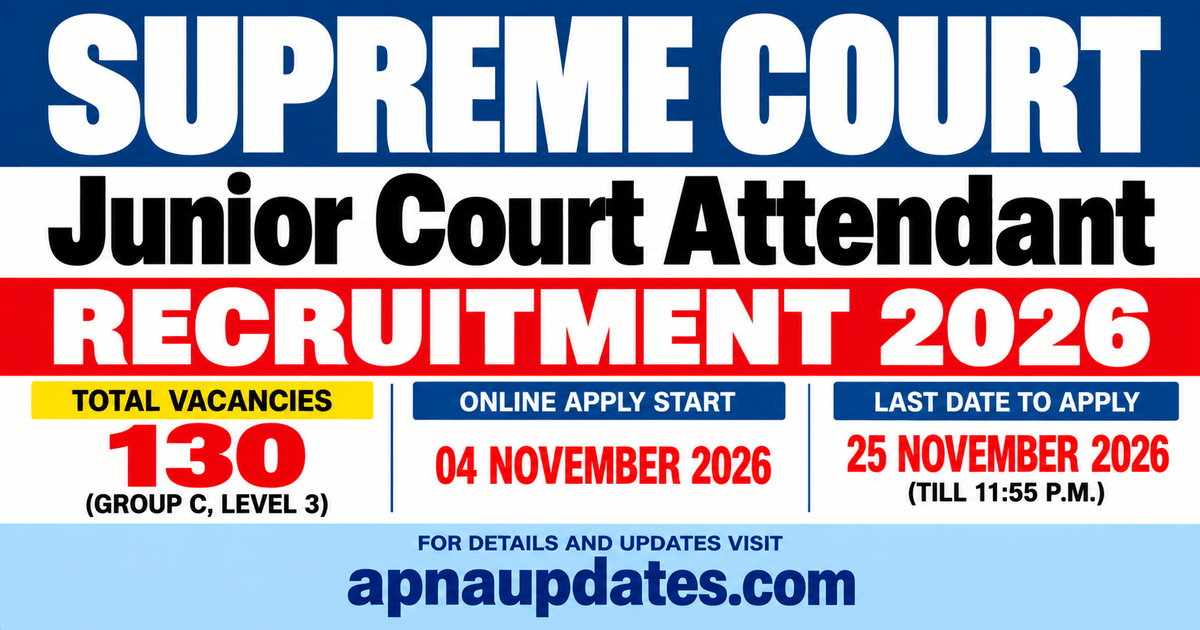
Supreme Court of India (Registry)
Last Date: 25 November 2026
Supreme Court Junior Court Attendant Recruitment: Quick Overview
| Organization | Supreme Court of India (Registry) |
| Advertisement No. | F.3/2026-SC (RC), dated 15 October 2026 |
| Post Name | Junior Court Attendant (Group C, non-clerical) |
| Total Vacancies | 130 (tentative) |
| Job Type | Direct recruitment through a merit panel |
| Application Mode | Online only |
| Application Start Date | 4 November 2026 |
| Last Date to Apply | 25 November 2026, 11:55 pm |
| Minimum Qualification | Class 10 pass (Class 12 is the highest qualification allowed) |
| Age Limit | 18 to 27 years as on 1 October 2026, with relaxation as per rules |
| Selection Process | Objective test (100 marks) and interview (25 marks) |
| Salary / Pay Scale | Level 3, Rs 21,700 to Rs 69,100, initial basic pay Rs 21,700 plus allowances |
| Job Location | New Delhi |
| Official Website | www.sci.gov.in |
| Topic/Subject-wise Practice Quizzes For All Types of Exams | apnaupdates.com/apna-quiz |
Supreme Court Junior Court Attendant Recruitment: Quick Intro
The Supreme Court of India has invited online applications for 130 tentative vacancies of Junior Court Attendant under Advertisement No. F.3/2026-SC (RC), dated 15 October 2026. The post is classified as Group C, non-clerical, and falls under Pay Level 3 of the Pay Matrix. The online application window will remain open from 4 November to 25 November 2026, with the deadline set at 11:55 PM on the closing date. The objective test is tentatively scheduled for 26 December 2026. Candidates should keep track of official updates in case the recruitment schedule changes.
The Supreme Court Registry manages filings, official records and the day-to-day work of its officers' chambers. Junior Court Attendants help support these routine operations and ensure the smooth functioning of the Registry. It is an entry-level Group C post filled through direct recruitment. This notification is for preparing a panel, or a ranked list of selected candidates. Inclusion in the panel does not guarantee appointment. Appointment depends on the Registry's requirements and the applicable recruitment conditions.
The Supreme Court previously issued Advertisement No. F.3/2024-SC (RC) in August 2024 for 80 Junior Court Attendant (Cooking Knowing) posts. That recruitment required a culinary diploma and three years of cooking experience, limiting eligibility to candidates with relevant qualifications and experience. The current Junior Court Attendant Recruitment 2026 has no specific trade or cooking qualification requirement. Candidates whose highest educational qualification is Class 10 or Class 12 can apply, subject to the prescribed eligibility conditions. This broader eligibility may attract applicants from a wider range of educational backgrounds.
Vacancy Details
The Supreme Court has announced 130 tentative vacancies for Junior Court Attendant Recruitment 2026. The Registry may revise this number with the approval of the competent authority.
The advertisement doesn't provide a category-wise vacancy breakdown. Reservation will be governed by Rule 4A of the Supreme Court Officers and Servants (Conditions of Service and Conduct) Rules, 1961.
The Registry's model reservation roster for this post provides a reference for understanding the potential distribution. It is based on a cadre strength of 600, with 15% reservation for SC candidates and 7.5% for ST candidates. Applying the roster to the first 130 points gives an indicative category-wise count, as shown below:
Category | Roster points among the first 130 | Share of 130 |
| SC | 19 | about 14.6% |
| ST | 9 | about 6.9% |
| Unreserved | 102 | about 78.5% |
Total | 130 | 100% |
Important: This is an estimate calculated from the model roster, not an official vacancy distribution. The actual numbers may differ depending on which roster points have already been used. Candidates should wait for an official category-wise vacancy list before drawing conclusions about the number of posts available in each category.
The panel system is an important part of Supreme Court Junior Court Attendant Recruitment 2026. Candidates are empanelled according to merit, but inclusion in the panel does not guarantee appointment. Actual appointments depend on the number of vacancies the Registry decides to fill. Candidates placed lower on the panel may therefore have to wait for further appointments.
Reserved category candidates who qualify using relaxed standards can be considered only against vacancies reserved for their respective categories, regardless of how high their marks are.
Application Fee
The application fee for Supreme Court Junior Court Attendant Recruitment 2026 varies by category:
General / Unreserved => ₹1,500
SC, ST, OBC (Non-Creamy Layer), Ex-Servicemen and Persons with Disabilities => ₹750
Applicable bank charges are extra and must be paid by the candidate.
The fee must be paid online through the payment gateway provided by UCO Bank. Candidates should verify their category and the applicable fee before completing the payment.
The application fee is non-refundable. It will not be returned even if the application is rejected later. Before making payment, carefully check whether you meet all the eligibility conditions. Pay particular attention to the maximum educational qualification of Class 12 and the age limit calculated as of 1 October 2026.
Women candidates are not eligible for a separate application fee concession under this recruitment. Also a separate fee of ₹100 per objection applies when challenging the answer key. This amount will be refunded only if the objection is accepted as valid.
Age Limit
For Supreme Court Junior Court Attendant Recruitment 2026, the candidate's age will be calculated as of 1 October 2026. Applicants must be at least 18 years old and not more than 27 years old. The prescribed date-of-birth range is 2 October 1998 to 1 October 2008, inclusive.
Candidates should carefully check the date of birth printed on their Class 10 certificate, as the Supreme Court Registry will accept only this document as proof of age.
Category | Upper age limit |
| General / Unreserved | 27 years |
| SC, ST, OBC (Non-Creamy Layer), Physically Challenged, Ex-Servicemen | 27 years plus relaxation as per Government of India rules |
| Dependants of freedom fighters | Up to 5 years over the prescribed limit |
| Widows, divorced and judicially separated women, not remarried: General | 35 years |
| Same women: OBC (Non-Creamy Layer) | 38 years |
| Same women: SC / ST | 40 years |
| Departmental candidates of the Supreme Court Registry | No upper age limit |
| Employees of other Government departments, PSUs, statutory bodies, nationalised banks | No age relaxation |
Age relaxation is applicable to eligible SC, ST, OBC (Non-Creamy Layer), Persons with Disabilities and Ex-Servicemen candidates, subject to the prescribed rules. The notification doesn't specify the exact relaxation period for each category. Under the usual Central Government rules, SC/ST candidates receive 5 years of relaxation, while OBC (Non-Creamy Layer) candidates receive 3 years. However, candidates should verify the applicable age relaxation on the official application portal or in the detailed recruitment instructions before relying on these general provisions.
Candidates working in other government departments or organisations do not receive age relaxation solely because of their government employment. They must meet the prescribed age limit unless they qualify for another applicable relaxation. The exemption from the upper age limit applies to departmental candidates of the Supreme Court Registry, subject to the applicable recruitment rules. Employment in another government body does not provide the same benefit.
Educational Qualification
Candidates applying for this recruitment must have passed at least Class 10 and must not hold a qualification higher than Class 12. The qualification must be obtained from a Board or Institute recognised by the Government.
Both Class 10 pass and Class 12 pass candidates are eligible, provided they meet all other prescribed eligibility conditions.

School marks do not carry weightage in this recruitment and there is no minimum percentage requirment for Class 10 or Class 12. Also Candidates do not need any specific trade skills, computer knowledge or prior work experience. Selection is based on performance in the objective test and interview, as prescribed in the recruitment process.
Selection Process
- The selection process for Supreme Court Junior Court Attendant Recruitment 2026 consists of an objective test, an interview and document verification.
- 1. Stage 1, Objective Type Test => The written test consists of 100 multiple-choice questions carrying 100 marks, with a duration of 90 minutes.
*The minimum qualifying mark is 50 out of 100.Subject
Questions
Marks
General Intelligence and Reasoning 25 25 Numerical Aptitude 25 25 General English 25 25 General Awareness 25 25 Total
100
100
2. Stage 2, Interview => The interview carries 25 marks, with a minimum qualifying score of 13 marks. It may be conducted online or in person in Delhi, as decided by the competent authority.
3. Document Verification and Panel Preparation => The Registry will verify candidates' eligibility and supporting documents. Eligible candidates will be empanelled in order of merit, subject to the recruitment rules.
Important: Meeting the qualifying marks does not guarantee appointment. Final selection depends on merit, eligibility verification and the Registry's requirements.
Negative Marking and Expected Cut-Off: Each question in the objective test carries 1 mark, while every incorrect answer attracts a penalty of 0.25 marks. With 100 questions to be completed in 90 minutes, candidates have an average of 54 seconds per question. Speed and accuracy are both important. The minimum qualifying score is 50 out of 100, but candidates should aim higher rather than treat 50 marks as their target.
Interview Shortlisting: The written test plays a major role in shortlisting candidates. If many candidates score 50 marks or above, the Registry will call candidates for the interview in a 1:3 ratio against the vacancies, based on merit. For 130 tentative vacancies, this would mean approximately 390 candidates shortlisted for the interview. Therefore, qualifying with 50 marks doesn't guarantee an interview call. The actual shortlisting cut-off will depend on candidates' performance and the number of candidates who appear for the examination.
The interview carries 25 marks, making it a smaller part of the overall selection process. However, these marks can still affect the final merit order when candidates have similar written-test scores. Candidates must also secure at least 13 marks to qualify for the interview stage.
The Registry will decide whether the interview is conducted online or in person in Delhi. Candidates should prepare for both possibilities. If the interview is online, ensure you have a stable internet connection, a quiet room and a suitable device. Regularly check the official website for instructions about the interview mode and schedule.
The written examination will be conducted in the cities listed in Annexure A of the official notification PDF. The list includes 131 examination centres across most states. Candidates can select their preferred cities in order of priority. However, the Registry reserves the right to allot a different examination city. Requests to change the allotted city or examination date will not be entertained.
Admit cards will be available only through the official website and will not be sent by post. Candidates must download them when released. No TA/DA will be paid for appearing in the written examination or interview. Candidates should plan their travel and related expenses accordingly.
The answer key of written test is tentatively scheduled for release on 28 December 2026, two days after the objective test. Candidates can submit objections online from 28 to 29 December 2026, tentatively until 11:55 PM on the closing date. The objection fee is ₹100 per question. This amount will be refunded if the objection is found valid.
Before raising an objection, check the answer carefully and keep a reliable printed source to support your claim. The fee for a rejected objection will not be refunded, so submit objections only when you have sufficient evidence.
Salary, Job Location and Service Conditions
The Junior Court Attendant post falls under Pay Level 3 of the Pay Matrix, with a pay scale of ₹21,700 to ₹69,100. The initial basic pay is ₹21,700 per month, plus applicable allowances under the prescribed rules. The upper end of the pay scale is generally reached through service progression over time, subject to the applicable pay and promotion rules.
The Junior Court Attendant post is based at the Supreme Court Registry in New Delhi. Candidates selected for the post should be prepared to relocate to Delhi if they currently live elsewhere. The interview may also be conducted in Delhi, depending on the mode decided by the competent authority. Any dispute related to the recruitment will fall under Delhi jurisdiction.
The post includes a probation period, but its duration has not been specified in the available recruitment details. As this is a non-clerical post, candidates do not need to prepare for a separate typing or computer skill test. The selection process focuses on the prescribed objective test and interview.
How to Apply Online
Open the official website www.sci.gov.in and go to the Recruitment section once the application link goes live on 4 November 2026.
- Find the Junior Court Attendant advertisement F.3/2026-SC (RC) and click the Apply Online link.
- Register with your own active email ID and mobile number. Interview dates and updates will be sent to them by SMS and email.
- Enter your name, father's name, mother's name and date of birth exactly as printed on your Class 10 certificate.
- Fill in your category details. Reserved category candidates must enter the caste or community certificate and non-creamy layer certificate details at this stage.
- Choose your test cities in order of preference from the list in Annexure A of the advertisement.
- Upload your recent photograph, signature, Class 10 certificate, Class 12 certificate if you have passed it, and caste or disability certificates where they apply, in the format shown on the portal.
- Accept the undertaking that you have read and understood the terms and conditions of the advertisement.
- Pay Rs 1,500 or Rs 750, plus bank charges, through the online payment gateway provided by UCO Bank.
- Check every entry in the preview before final submission. A submitted application cannot be withdrawn or modified.
- Take a printout of the filled form and note your application number, which you need to generate the admit card. The printout need not be sent to the Registry.
Required Documents and Important Instructions
Keep the following documents ready before the application window opens on 4 November 2026. Check the application portal for the prescribed photograph and signature size, format and other upload requirements.
1. Recent photograph and signature: Scanned copies in the format and dimensions specified on the application portal.
2. Class 10 certificate: Required as proof of date of birth and educational qualification.
3. Class 12 certificate: Required if you have passed Class 12.
4. Caste or community certificate: For candidates claiming reservation benefits under the applicable category.
5. OBC Non-Creamy Layer (NCL) certificate: For OBC candidates claiming applicable benefits, issued by the competent authority.
6. Disability certificate: For candidates claiming benefits under the Persons with Disabilities (PwD) category.
7. No Objection Certificate (NOC): For candidates employed in Central or State Government departments, Public Sector Undertakings (PSUs), statutory bodies or nationalised banks. The NOC is required at the document verification stage.
8. Gazette Notification: Required if your name or surname has changed and documentary proof of the change is needed.
Important: Check the official recruitment notification and application portal for the exact document requirements. Ensure that all certificates are valid, legible and issued by the appropriate authority, wherever applicable.
Candidates should carefully follow the recruitment instructions to avoid rejection or cancellation of their candidature:
1. Personal details: The candidate’s name, father’s name, mother’s name and date of birth will be accepted only as recorded in the Class 10 certificate or an equivalent certificate issued by the concerned Board.2. Category changes: Requests to change the category after submitting the application will not be accepted.
3. Provisional admission: Admission to the objective test and interview is provisional. If a candidate is found ineligible at any stage, before or after the test or interview, their candidature may be cancelled without prior notice.
4. False information or impersonation: Providing false information, submitting fake documents or impersonating another person may lead to removal from the recruitment process, prosecution and a ban on future appointment in the Supreme Court Registry, even after confirmation of service.
5. Incorrect applications: Applications that do not comply with the prescribed instructions may be summarily rejected.
6. New employment during recruitment: Candidates who obtain employment after submitting their application or at any stage during or after the examination process must immediately inform the Recruitment Cell at recruitment.cell@sci.nic.in. Failure to do so may lead to adverse consequences.
7. Scribe facility for PwD candidates: Eligible Persons with Disabilities may use a scribe by submitting Appendix-I or Appendix-II, as applicable, along with the required certificates. A candidate’s own scribe must not be appearing in the same examination and must not act as a scribe for more than one candidate. Compensatory time will be provided as admissible under the applicable rules.
Related Reading:
- Supreme Court India Junior Court Assistant Recruitment 2026: 250 Posts
- Punjab District Courts Clerk Recruitment 2026: 1,270 Posts
- Supreme Court Senior Personal Assistant Recruitment 2026: 65 Posts
- JKSSB Class-IV MTS and Sanitation Worker Recruitment 2026: 2863 Posts, Apply Now
❓Frequently Asked Questions (FAQs)
How many vacancies are there in Supreme Court Junior Court Attendant Recruitment 2026?
A total of 130 tentative vacancies have been notified for Junior Court Attendant, and the number can rise or fall with the Registry's needs.
What is the last date to apply?
Applications close on 25 November 2026 at 11:55 pm, and registration opens on 4 November 2026, which gives a window of 22 days.
Who is eligible to apply?
Any Indian citizen who is at least 18 and not above 27 years old on 1 October 2026, with relaxation where it applies, and who has passed Class 10 but holds nothing higher than Class 12. Candidates already in government service can apply, but they need a No Objection Certificate at document verification.
What is the age limit, including relaxation?
The age limit is 18 to 27 years as on 1 October 2026. SC, ST, OBC (Non-Creamy Layer), Physically Challenged and Ex-Servicemen candidates get relaxation as per Government of India rules. Dependants of freedom fighters get up to 5 years, and widows or divorced women get an upper limit of 35, 38 or 40 years by category.
What qualification is required?
A Class 10 pass from a Board or Institute recognised by the Government is the minimum, and a Class 12 pass is the maximum allowed.
What is the selection process?
Selection has two stages: an objective test of 100 questions for 100 marks in 90 minutes, with 50 marks needed to qualify and 0.25 marks cut for each wrong answer, and an interview of 25 marks, with 13 needed to qualify. The panel is then made in order of merit after document verification.
What is the salary of a Junior Court Attendant?
The post is in Level 3 of the Pay Matrix, with a pay range of Rs 21,700 to Rs 69,100. Initial basic pay is Rs 21,700 plus allowances.
What is the application fee?
General and Unreserved candidates pay Rs 1,500, while SC, ST, OBC (Non-Creamy Layer), Ex-Servicemen and Physically Challenged candidates pay Rs 750. Bank charges are extra, payment is online only, and the fee is not refunded under any circumstances.
How do I apply online?
Open the recruitment section of www.sci.gov.in on or after 4 November 2026, register, fill in the form as per your Class 10 certificate, upload your photograph, signature and certificates, and pay the fee through the UCO Bank gateway. Take a printout and keep your application number, which you need for the admit card.
What is the official website?
The official website is www.sci.gov.in. The application link, admit cards, answer key and interview dates will be posted there, and the Registry will also send updates by SMS and email to your registered contacts.
Do I have to travel to Delhi for the exam?
Not for the objective test. Annexure-A lists 131 test cities across most states, and you choose cities in order of preference, though the Registry can shift you to another city. Only the interview is tied to Delhi, where it may be held in person or online, as decided by the competent Authority.
Can I correct my form after submitting it?
No, an application once submitted cannot be withdrawn or modified, and a request to change the category is not entertained. If you submit more than one form, only the last one is considered.
Conclusion
We hope the information provided above about the Supreme Court Junior Court Attendant Recruitment 2026 helps you understand the eligibility criteria, application process, selection procedure and other important details.
Before applying, carefully check your date of birth and highest educational qualification against the conditions mentioned above. Keep your Class 10 certificate ready for verification, as the application fee is non-refundable, even if your candidature is rejected due to ineligibility.
the application link goes live on 4 November 2026. After applying, keep track of these important updates:
Admit card and exam city: Check the admit card for your examination centre and other test-related instructions.
Answer key and interview schedule: Follow official announcements for the answer key, objection window and subsequent interview process.
The objective test is tentatively scheduled for 26 December 2026. Since the date may change, check the official Supreme Court website regularly for the latest updates and confirm the final examination schedule before making travel arrangements.
Disclaimer: This article is based on the official notification and simplified for easy understanding. For the most accurate and updated information, always refer to the official website.
Tags: Supreme Court Recruitment, Junior Court Attendant, Group C Jobs, 10th Pass Govt Jobs, 12th Pass Govt Jobs, Court Jobs 2026, Delhi Jobs, Government Jobs October 2026
| Notification Release | 15 October 2026 |
| Application Start Date | 4 November 2026 |
| Last Date to Apply | 25 November 2026, 11:55 pm |
| Last Date for Fee Payment | 25 November 2026, 11:55 pm |
| Admit Card Release | To be announced |
| Objective Type Test | 26 December 2026 (tentative) |
| Answer Key Release | 28 December 2026 (tentative) |
| Objection Window | 28 to 29 December 2026, till 11:55 pm (tentative) |
| Interview Date | To be announced |
| Result Date | To be announced |