JNU Non-Teaching Recruitment 2026
Jawaharlal Nehru University (JNU), New Delhi
Last Date: 27 July 2026
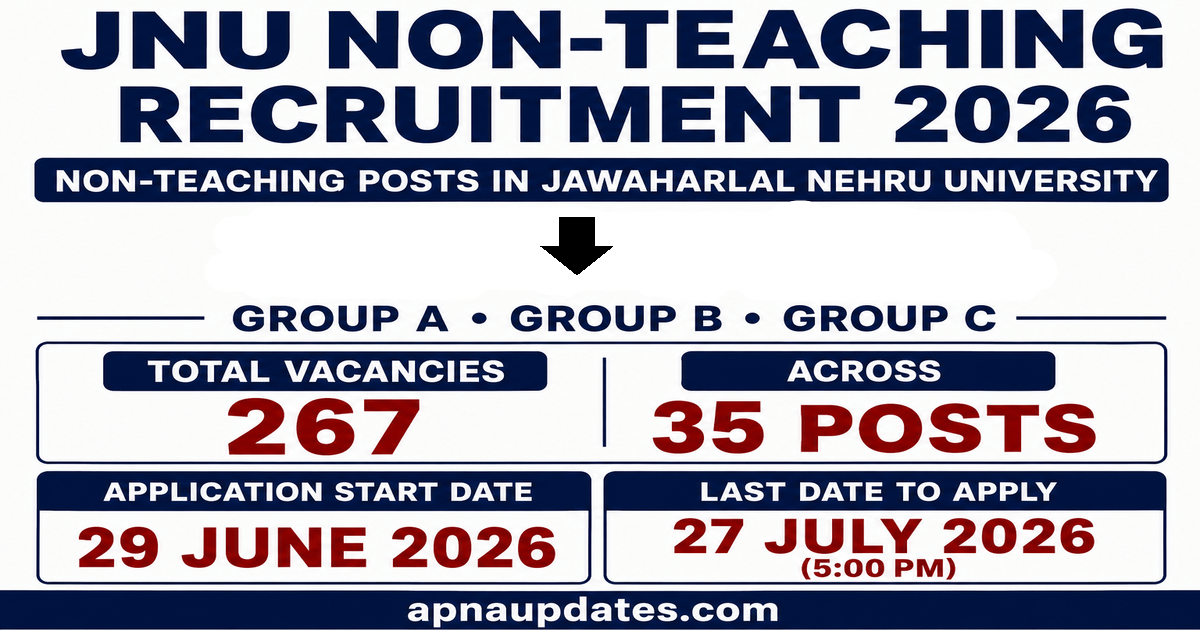
Jawaharlal Nehru University has opened one of its largest non-teaching recruitment drives in recent years, with 267 posts spread across Group A, Group B and Group C cadres. The notification was issued under Advertisement No. 01/RC(NT)/2026, which covers everything from Executive Engineer to Multi Tasking Staff. Online applications are open now and will close on 27 July 2026 at 5:00 PM through the university's dedicated recruitment portal.
JNU Non-Teaching Recruitment 2026: Quick Overview
Feature | Details |
|---|---|
| Organization | Jawaharlal Nehru University (JNU), New Delhi |
| Advertisement No. | 01/RC(NT)/2026 |
| Post Name | 35 non-teaching posts (Executive Engineer to Anti-Malaria Worker) |
| Total Vacancies | 267 |
| Job Type | Regular, direct recruitment |
| Application Mode | Online only |
| Application Start Date | 29 June 2026 |
| Last Date to Apply | 27 July 2026, 5:00 PM |
| Minimum Qualification | 10th pass to Master's Degree, varies by post |
| Age Limit | 40 years for most posts, 45 years for Executive Engineer posts |
| Selection Process | Paper I, Paper II (select posts), Skill Test (select posts), Interview (Group A only) |
| Salary / Pay Scale | Pay Level 1 to Pay Level 11, 7th CPC |
| Job Location | JNU Campus, New Delhi |
| Official Website | jnu.ac.in/career |
JNU Non-Teaching Recruitment 2026: Quick Intro
JNU manages its non-teaching cadre in three tiers i.e., Group A for officer-level administrative and technical roles, Group B for supervisory and stenography positions, and Group C for support staff positions.
JNU's last major non-teaching recruitment was held in 2019 and after nearly six years, university has released a new notification with 267 vacancies across different posts. During this period, vacancies have increased due to retirements, resignations, and promotions, making this one of the biggest non-teaching recruitment drives in recent years.
Out of the 267 vacancies, 229 posts belong to Group C, including positions such as Junior Assistant, Mess Helper, Cook, and Engineering Attendant. For several of these posts, the minimum educational qualification is 10th Pass, making the recruitment accessible to a large number of candidates.
Vacancy Details
The total 267 vacancies break down as 13 posts in Group A, 25 in Group B and 229 in Group C. The complete Group and category wise break down of vacancies are detailed below:
Group A (13 vacancies)

Group B (25 vacancies)

Group C (229 vacancies)

Note: Although the official notification does not provide a combined category-wise summary, the total 267 vacancies are distributed as = 100 UR, 26 EWS, 69 OBC, 36 SC, 23 ST, and 13 PwD, in which UR category has the highest number of vacancies, also the OBC and SC categories together account for a significant share of the total posts.
The highest number of vacancies are available for Junior Assistant (46 posts), followed by Mess Helper (30 posts) and Engineering Attendant (30 posts). Together, these three posts account for more than one-third of the total 267 vacancies. Also it is important to remember that these posts also have broader eligibility criteria, therefore expected to attract a large number of applicants, As a result, the competition for these positions is likely to be higher than for many other posts.
Application Fee
Fee varies accross groups and categories. The group and category wise breakdown of application fee is mentioned below:

Note: The application fee can be paid only through the online application portal. If you are eligible and planning to apply for more than one post, remember that the application fee must be paid separately for each post. It is also important to note that once the fee is paid, it will not be refunded or adjusted under any circumstances. Therefore, carefully check your post selection and application details before making the payment.
Age Limit
For most posts in this recruitment, the maximum age limit is 40 years. However, the Executive Engineer (Electrical) and Executive Engineer (Civil) posts have a higher maximum age limit of 45 years due to the experience required for these positions. The age limit for all posts will be calculated as on the last date of application, 27 July 2026.

Note: Regular JNU employees with at least 3 years of continuous service will face no upper age limit at all for these posts, which is a meaningful advantage that outside candidates do not get. Candidates should also note that, if they belong to a reserved category but choose to apply under the Unreserved (UR) category, then they will not be eligible for the age relaxation or other reservation benefits applicable to their category.
Educational Qualification
With 35 different posts, the educational qualifications range from basic literacy to a Ph.D. therefore, Instead of looking at each post separately, it is easier to understand the eligibility by grouping the posts based on their qualification requirements:
10th Pass Level: Candidates who have passed Class 10 can apply for several posts. Multi Tasking Staff (MTS) requires only a 10th Pass qualification, while Mess Helper, Groundsman, and Anti-Malaria Worker also require 3 to 5 years of relevant work experience along with 10th pass qualification.
10th/12th Pass with ITI or Skill Certificate: Some posts require a 10th or 12th Pass qualification along with an ITI or trade certificate and relevant work experience. For example, the Cook post requires a 10th Pass, an ITI Certificate in Bakery & Confectionery, and 3 years of catering experience. Similarly, posts such as Laboratory Attendant, Library Attendant, Lift Operator, and Engineering Attendant (Khalasi) generally require a 12th Pass or an ITI certificate in the relevant trade, along with 2 to 3 years of work experience, depending on the post.
Bachelor's Degree with Typing or Stenography Skills: Several posts require a Bachelor's degree along with specific typing or stenography skills, such as, Junior Assistant and Assistant require a Bachelor's degree with a typing speed of 35 words per minute in English or 30 words per minute in Hindi.
Posts such as Stenographer, Personal Assistant, and Private Secretary require a Bachelor's degree along with stenography skills. Depending on the post, the required shorthand speed ranges from 80 to 120 words per minute, and the senior posts also require relevant work experience.
Also, For the posts of Senior Assistant and Section Officer, candidates must have a Bachelor's degree along with 3 to 8 years of administrative experience in a Central or State Government department, a university, or a private company with an annual turnover of at least Rs. 200 crore.
Postgraduate Degree with Relevant Experience: Several posts require a Master's degree in the relevant field along with professional experience, such as, Assistant Registrar, Public Relations Officer, Research Officer, Curator, Assistant Librarian, and Assistant Archivist. Also, depending on the post, candidates must have 5 to 8 years of relevant work experience as well. For the Assistant Librarian post, candidates must also qualify NET or an equivalent eligibility test.
Technical Degree with Senior Experience: Some technical posts require specialized qualifications along with significant work experience. For example, System Analyst post requires a B.Tech in Computer Science/Electronics with programming experience in languages such as C, C++, or Java, or an M.Tech/MCA with the required experience. For Executive Engineer (Civil) and Executive Engineer (Electrical), candidates must have a B.E./B.Tech in the relevant engineering discipline with at least 55% marks, along with the prescribed senior-level engineering experience. These posts are mainly suitable for experienced professionals already working in engineering services.
Candidates belonging to the SC, ST, OBC, and PwD categories are eligible for a 5% relaxation in the minimum marks required for the educational qualification, wherever the official notification specifies a minimum percentage. (You can also check detailed postwise Qualification requirments for every post in the official notification, which is available in Important Links section toward end of the page)
Selection Process
The complete process is detailed below, read it carefully:
The selection process begins with Paper I, which is compulsory for all applicants, regardless of the post they have applied for. It is a 2-hour objective-type (MCQ) examination carrying a total of 300 marks:
Paper I (Syllabus):
In addition to Paper I, candidates applying for certain posts must also appear for Paper II. This paper is conducted for posts such as Assistant Registrar, Section Officer, Senior Assistant, System Analyst, Executive Engineer (Civil), and Executive Engineer (Electrical). It is a 90-minute, post-specific examination carrying 100 marks and is designed to assess candidates' knowledge in their respective fields. The exam pattern along with Syllabus are mentioned below:
Note: Both papers carry negative marking of a quarter mark for every wrong answer.
Candidates applying for stenography and typing-related posts must also qualify a Skill Test in addition to the written examination. This test is qualifying in nature and is conducted to assess the required typing or stenography proficiency for the respective post. See the details below:

Note: Only Group A posts include an Interview/Personality Test as the final stage of selection. The interview carries 100 marks, with the final merit prepared by giving 70% weightage to the written examination and 30% weightage to the Interview/Personality Test.
> To qualify the written examination, General and EWS candidates must secure at least 40% marks, while the minimum qualifying marks for OBC-NCL, SC, ST, and PwD candidates are 35%.
> Candidates who clear the written exam are shortlisted for the next stage based on the number of vacancies. For Personal Assistant, Private Secretary, and Stenographer posts, up to 10 times the total vacancies are called for the Skill Test. For Assistant and Junior Assistant, the shortlist is limited to 5 times the number of vacancies. In the case of Group A posts, up to 15 times the vacancies are shortlisted for the Interview/Personality Test.
Salary, Job Location and Service Conditions
The salary for available all posts is based on the 7th Central Pay Commission (CPC) Pay Matrix, and pay levels varies according to the post. Level 1 posts, such as Multi Tasking Staff (MTS), Mess Helper, and Attendant, have a starting basic pay of around ₹18,000. Level 6 posts, including Senior Assistant and Personal Assistant, start at around ₹35,400, while Level 11 posts like Executive Engineer have a starting basic pay of around ₹67,700. In addition, selected candidates will also get benefits such as Dearness Allowance (DA), House Rent Allowance (HRA), and other applicable government allowances, depending on the posting location and govt. rules.
All selected candidates will be posted at the JNU campus in New Delhi, so there is no transfer liability for these posts, which makes this recruitment a gud option for candidates looking for a stable job at a single location. However, candidates applying for posts such as Cook, Mess Helper, and Engineering Attendant should be aware that these roles may involve shift duties and a heavy workload during busy periods such as admissions, convocation, and other important university events.
The official notification does not mention any probation period or service bond for these posts. However, selected candidates will have to complete document verification as a part of the recruitment process. Candidates who are already working in a Central Govt, State Govt, PSU, Autonomous Body, or other govt organization must also produce a No Objection Certificate (NOC) from their current employer, whenever required.
How to Apply
- Go to the official application portal at jnunt.samarth.edu.in
- Complete a one-time registration using a valid email ID and an active mobile number
- Log in and select Advertisement No. 01/RC(NT)/2026, then choose the post you are applying for
- Fill in personal, educational and experience details exactly as per your certificates
- Upload your photograph, signature and scanned certificates in the format and size specified on the portal
- Pay the application fee online for the selected post through the available payment gateway
- If applying for more than one post, repeat the post selection and fee payment separately for each one
- Review every field on the preview screen before final submission, since edits are not guaranteed afterward
- Download and save the submitted form and the fee receipt for your records
Required Documents and Important Instructions
Keep these ready before you start the Application form:
= Class 10 certificate for date of birth proof,
= your highest qualifying degree and mark sheet,
= experience certificates and relieving letters where experience is a requirement,
= a valid caste or category certificate where applicable,
= an Income and Asset certificate for EWS claims,
= a disability certificate of at least 40 percent for PwD claims,
= and a No Objection Certificate if you currently work in govt. service.
Candidates should also keep these important points/Instructions in mind:
> OBC-NCL candidates must submit a certificate issued on or after 1 April 2026. Similarly, EWS candidates must have a valid certificate issued before last date of application.
> canvassing or influencing the selection process in any form will lead to disqualification.
> no Travelling Allowance (TA) or Dearness Allowance (DA) will be paid for attending any stage of the recruitment process, including the Interview/Personality Test for Group A posts.
These important Practical observations may help help you better understand this recruitment:
Understand the Overall Competition
Many Group C posts, such as Multi Tasking Staff (MTS), Mess Helper, and several Attendant positions, require only a 10th Pass qualification which makes a large number of candidates eligible to apply, it also means the competition is likely to be high. Also another point is that, this is a Central University recruitment with 267 vacancies, therefore, candidates from across the country are expected to apply, as a result, the cut-off of any stage for entry-level Group C posts may be driven more by the large number of applicants instead of minimum educational qualification.
Why the No-Interview Rule Is Important
For Group B and Group C posts, there is no interview, which means the final selection for 254 out of the 267 vacancies depends mainly on the written examination (along with the prescribed skill test, where applicable). Since there is no interview to improve your overall performance, your written exam score becomes the most important factor in the selection process. therefore a candidate should focus more on regular mock tests, revision, and improving their exam accuracy.
Related Posts:
- RRB CEN 02/2026 Technician Recruitment: 6557 Technician Grade I and Grade III Posts Open Across All Zones, Apply Online by 29 July
- ISRO ISTRAC Recruitment 2026 for 26 Posts: Technical Assistant, Scientific Assistant, Technician-B and More, Apply Online by July 20
❓Frequently Asked Questions (FAQs)
How many vacancies are there in JNU Non-Teaching Recruitment 2026?
There are 267 vacancies in total, spread across 35 posts in Group A, Group B and Group C, including a number of backlog seats carried forward from earlier recruitment cycles.What is the last date to apply for JNU Non-Teaching Recruitment 2026?
Online applications close on 27 July 2026 at 5:00 PM. No applications are accepted after this deadline under any circumstances.Who is eligible to apply for these posts?
Eligibility varies by post, ranging from a 10th pass certificate for Multi Tasking Staff to a master's degree with years of relevant experience for Group A officer roles. Check the qualification tier that matches your post before applying.What is the age limit for JNU Non-Teaching Recruitment 2026?
The maximum age is 40 years for most posts and 45 years for the two Executive Engineer posts. Relaxation of up to 15 years applies for PwD candidates from SC or ST backgrounds.What qualification is required for Junior Assistant and similar posts?
A bachelor's degree from a recognized university along with English typing speed of 35 words per minute or Hindi typing at 30 words per minute.Is there an interview for all posts in this recruitment?
No. Interviews are held only for Group A posts. Group B and Group C posts, which make up 254 of the 267 vacancies, are filled purely through the written test and skill test wherever applicable.What is the salary for these posts?
Pay follows the 7th Central Pay Commission matrix, starting near Rs. 18,000 basic for Level 1 posts and going up to around Rs. 67,700 basic for Level 11 posts, plus admissible allowances.What is the application fee for JNU Non-Teaching Recruitment 2026?
Group A fee is Rs. 1,500 for UR/EWS/OBC and Rs. 1,000 for SC/ST/Women. Group B and C fee is Rs. 1,000 for UR/EWS/OBC and Rs. 600 for SC/ST/Women. PwD candidates are exempted in all groups.How do I apply online for this recruitment?
Applications are submitted only through jnunt.samarth.edu.in. Register, select your post, fill in your details, upload documents and pay the fee separately for each post you apply to.What is the official website for JNU Non-Teaching Recruitment 2026?
The recruitment portal is jnunt.samarth.edu.in, and general information is also available at jnu.ac.in/career.Can I apply for more than one post in this notification?
Yes, as long as you meet the eligibility for each post. You will need to pay the application fee separately for every post you apply to.Why does this recruitment cover so many posts at once?
JNU's last major non-teaching recruitment drives were in 2019. A gap of this length typically means vacancies from retirements and resignations have accumulated, which is why this single notification carries 267 posts instead of a smaller routine batch.
Conclusion
We hope above provided details were helpful for you and since online application process is ongoing, important thing is matching your qualification and experience to the exact post you plan to apply for, because a mismatch discovered later in document verification can cancel your candidature even after you clear the written test. Keep your caste, EWS and disability certificates dated correctly, particularly the OBC-NCL certificate that must carry a date on or after 1 April 2026.
For a recruitment of this scale, it is possible that university may release corrigenda, addendums, or other updates during the selection process. all such notices/updates will be published only on official website. Therefore, candidates should regularly check the official website for the latest updates, announcements, and important notifications until the recruitment process is completed (you can also bookmark this page and follow our social media handles such as telegram and WhatsApp for quick updates).
This article is based on the official notification and simplified for easy understanding. For the most accurate and updated information, always refer to the official website.
| Notification Release | 29 June 2026 |
| Application Start Date | 29 June 2026 |
| Last Date to Apply | 27 July 2026, 5:00 PM |
| Last Date for Fee Payment | 27 July 2026, 5:00 PM |
| Admit Card Release | To be announced |
| Exam Date | To be announced |
| Result Date | To be announced |
| *Note | Any change to these dates will be posted only on the official JNU website, so check jnu.ac.in/career regularly closer to the exam. |