Indian Navy Agniveer Apprentice Recruitment 2026
Indian Navy (Directorate of Manpower Planning & Recruitment, Naval HQ, New Delhi)
Last Date: July 05, 2026 [EXTENDED]
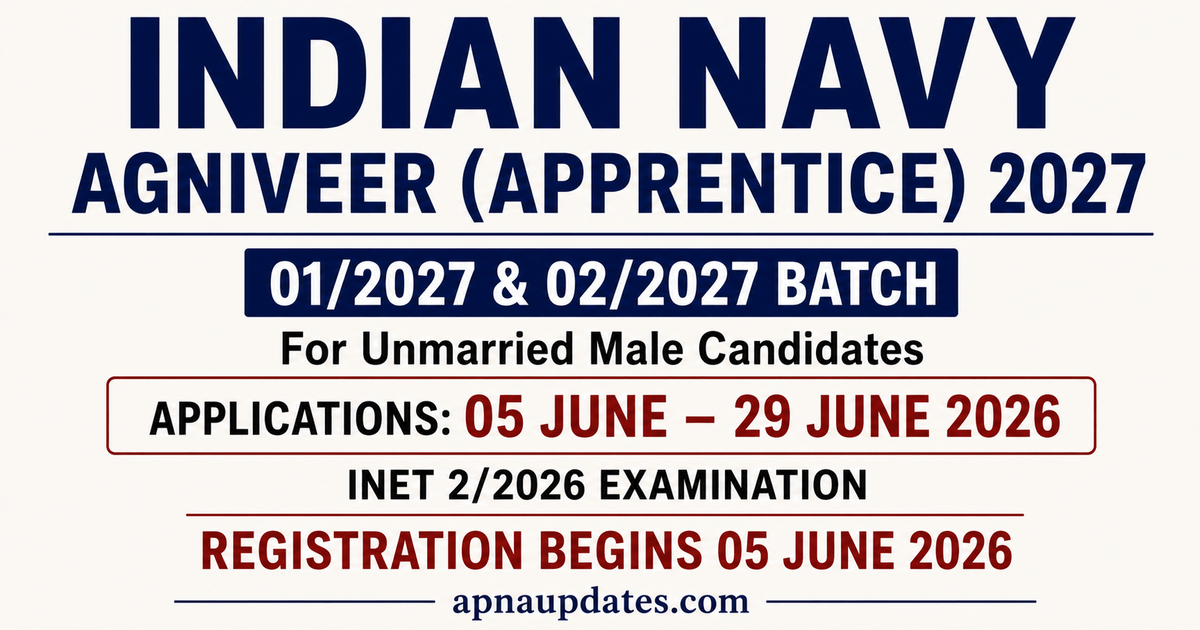
The Indian Navy has opened online applications for Agniveer (Apprentice) recruitment covering both the 01/2027 and 02/2027 batches through a single application window. Applications are accepted from June 5, 2026 (10 AM) to June 29, 2026 (05 PM) at joinindiannavy.gov.in. The Stage I INET exam is scheduled for August 2026, with SSC as exam partner. Vacancy numbers are not disclosed in the notification and will be decided based on service requirement.
Indian Navy Agniveer Apprentice Recruitment: Quick Overview
Feature | Details |
|---|---|
| Organization | Indian Navy (Directorate of Manpower Planning & Recruitment, Naval HQ, New Delhi) |
| Batch | Agniveer (Apprentice) 01/2027 and 02/2027 |
| Entry Type | Agniveer (Apprentice) - Engineering and Electrical streams |
| Total Vacancies | Not specified; decided based on service requirement |
| Job Type | Short-term engagement, 4 years under Navy Act 1957 |
| Application Mode | Online only at https://joinindiannavy.gov.in |
| Application Start Date | June 5, 2026 (10:00 hrs) |
| Last Date to Apply | July 05, 2026 (17:00 hrs) [EXTENDED] |
| Correction Window | July 6, 2026 |
| Minimum Qualification | Matriculation (50%) + 3-year AICTE Diploma (50%) in Engineering or Electrical trades |
| Age Limit | 01/2027 batch: Born 01 Dec 2004 to 31 May 2009; 02/2027 batch: Born 01 May 2005 to 31 Oct 2009 |
| Selection Process | Stage I: INET (Aug 2026) + Stage II: PFT + Written Exam + Medical |
| Salary / Pay Scale | Year 1: Rs. 30,000/month (Rs. 21,000 in-hand); Year 4: Rs. 40,000/month (Rs. 28,000 in-hand) |
| Training Location | INS Chilka, Odisha |
| Official Website | https://joinindiannavy.gov.in |
Indian Navy Agniveer Apprentice Recruitment: Quick Intro
Indian Navy's Agniveer (Apprentice) entry is one of the most technically specific recruitment channels within the Agnipath framework. Unlike the Sailor (SSR/MR) entries which are open to Class 10 and 12 qualified candidates, the Apprentice entry requires a 3-year AICTE diploma in engineering or electrical trades, making this a domain-specific recruitment targeting polytechnic graduates. Two batches, 01/2027 and 02/2027, are being recruited through a single application window and a single INET exam, which is an efficient structure that compresses timelines but demands that candidates understand the batch-specific age criteria before applying.
Agniveer recruitment under the Agnipath scheme has been a consistent feature of Navy hiring since 2022. Each cycle has drawn hundreds of thousands of applications from across the country, and the Apprentice entry, despite its technical eligibility filter, attracts strong competition because it positions candidates for trade-specific roles on naval ships and shore establishments. The INET, which serves as the Stage I filter, shortlisting happens within each state, not at a national aggregate level.
This is also the first recruitment cycle for the 2027 induction batches, and the Navy has retained the two-batch structure introduced in recent cycles.
Vacancy Details
Official notification does not mention the number of vacancies for either batch. The trade-wise distribution of vacancies will be determined based on service requirement, as stated by the Navy. This is standard practice in naval recruitment, where operational deployment needs drive batch size. Past Agniveer Apprentice recruitment cycles have admitted candidates in the hundreds per batch across various trades, but no specific figure can be stated for this recruitment.
What is confirmed is that vacancies are in two streams. The Engineering stream covers trades such as Marine Engineering, Mechanical, Production, Automobile, Refrigeration and Air Conditioning, Repair and Maintenance, Power Plant Engineering, Mechatronics, Metallurgy, Instrumentation, and Electronics Instrumentation and Control Engineering. The Electrical stream covers Electrical, Electronics and Communication, Instrumentation Technology, Electronics, Electrical and Electronics, and Electronics Instrumentation and Control Engineering.
Candidates from diploma trades that fall under both streams should check which stream their specific trade aligns with before selecting their INET paper, as separate exams are conducted for Engineering and Electrical entries. Also do remember, Applying under the wrong stream is a common mistake that leads to candidature issues.
Application Fee
The examination fee for Stage I INET is Rs. 550 plus 18% GST, total of approximately Rs. 649. Payment is accepted online through net banking, Visa, MasterCard, RuPay credit or debit card, or UPI. The fee is payable only at the Stage I application stage; there is no separate fee for Stage II.
The fee is non-refundable in all cases, including even if the application is found ineligible. Candidates who register multiple times will be rejected and debarred; fee reimbursement will not be done in such cases. If money is deducted during online payment but the admit card is not generated, the refund is processed automatically within 7 working days. For candidates without internet access, the application can also be submitted at Common Service Centers (CSC) across the country for an additional service charge of Rs. 60 plus GST.
Age Criteria
This recruitment is for two separate batches with different age windows for Stage II, though both appear under the same INET 2/2026 Stage I exam. but Understanding which batch you qualify for is important before applying.
Candidates eligible for INET 2/2026 overall are those born between 01 December 2004 and 31 October 2009 (both dates inclusive). However, eligibility for Stage II depends on which batch's age window your birth date falls under.
For the 01/2027 batch Stage II, candidates must be born between 01 December 2004 and 31 May 2009. For the 02/2027 batch Stage II, the birth date must fall between 01 May 2005 and 31 October 2009. Candidates born between 01 May 2005 and 31 May 2009 qualify for Stage II of both batches and may be shortlisted for either or both. Candidates born between December 2004 and April 2005 are eligible for Stage II of the 01/2027 batch only. Candidates born from June 2009 to October 2009 are eligible for the 02/2027 batch Stage II only.
If two candidates have the same percentage score and both fall within a shortlist cutoff, the one with the earlier date of birth is given priority, as that candidate has fewer future chances to apply.
Educational Qualification
Two qualifications must both be present, each with a minimum percentage requirement. First, passing Matriculation (Class 10th) with at least 50% marks in aggregate from a board recognised by the Ministry of Education, Government of India. Second, completing a 3-year diploma course from an AICTE recognised Polytechnic Institute with at least 50% marks in aggregate in one of the listed Engineering or Electrical trades.
One important point: The diploma must be from an AICTE-recognised institution specifically, not just any government-recognised body. Candidates whose polytechnic is recognised by their state's technical education board but not by AICTE should verify their institution's AICTE status before applying.
The diploma trade determines which INET paper a candidate writes, Engineering or Electrical. Some trades like Electronics Instrumentation and Control Engineering appear in both streams, so candidates in those trades should read the stream definitions carefully and pick accordingly.
Selection Process
Selection runs through two stages. Stage I is the INET (Indian Navy Entrance Test), scheduled for August 2026. Stage II comprises a Physical Fitness Test, a Written Examination, and Recruitment Medical Examination.
The INET is a 100-question computer-based test of 1 hour duration, with four sections: English and General Awareness, Science, Mathematics, and Diploma (Trade Specific). The paper is bilingual (Hindi and English) and objective type. There is negative marking at 0.25 marks per wrong answer. Candidates must pass in all four sections individually as well as in aggregate. The Navy reserves the right to set the pass marks in each section; this is not fixed and may vary across batches.
Separate INET papers are set for Engineering and Electrical entries. Results are declared at end of August or early September 2026. State-wise shortlisting for Stage II follows with cut-off marks varying from state to state since vacancies are allotted state-wise.
Stage II begins with the Physical Fitness Test. Qualifying it is mandatory. The standards are shown in the table below.
| Event | Standard |
|---|---|
| 1.6 km Run | Within 6 minutes 30 seconds |
| Squats (Uthak Baithak) | 20 repetitions |
| Push-ups | 15 repetitions |
| Bent Knee Sit-ups | 15 repetitions |
Only candidates who clear the PFT sit for the Stage II Written Examination. This exam is also 100 marks, 1 hour, bilingual, with the same four sections as INET and a passing requirement in all sections and aggregate. Separate papers are held for Engineering and Electrical streams.
Recruitment Medical Examination is conducted for candidates who qualify the PFT. Candidates declared medically unfit may appeal within 5 days at a designated military hospital allocated by the Navy. Medical fitness certificates from any other hospital are not accepted, and no further appeal is permissible beyond this review.
The Provisional Select List is based on Stage II written exam marks, subject to PFT and medical qualification. Merit is state-wise. Those who are selected will receive a call-up for Pre-Enrolment Medical at INS Chilka, Odisha. Candidates not qualifying the Pre-Enrolment Medical at INS Chilka are rejected at that stage.
Medical and Physical Standards
The minimum height requirement is 157 cm. Medical examination is conducted by authorised military doctors as per current service regulations.
For vision, uncorrected vision must be 6/12 in each eye, corrected to 6/6 in each eye, and Colour Perception must be CP PASS. Candidates with significant refractive errors should check their uncorrected vision before applying, as spectacle users who do not meet the uncorrected 6/12 standard will fail the medical even if their corrected vision is perfect.
On tattoos: permanent body tattoos are permitted only on the inner face of the forearm (inside of elbow to the wrist) and on the reversed/dorsal side of the palm or back of the hand. Tattoos on any other part of the body are a bar from recruitment.
Candidates are advised to get their ears cleaned for wax and tartar removed from teeth before the medical examination. Any candidate found to have predominant characteristics of the opposite gender on external physical examination, or who has undergone gender reassignment surgery, will be declared medically unfit.
Pay, Seva Nidhi, and Service Terms
This is a fixed-term engagement of four years under the Navy Act 1957. The pay structure is as follows.
| Year | Monthly Package | In-Hand (70%) | Agniveer Corpus Contribution | GoI Matching Contribution |
|---|---|---|---|---|
| 1st Year | Rs. 30,000 | Rs. 21,000 | Rs. 9,000 | Rs. 9,000 |
| 2nd Year | Rs. 33,000 | Rs. 23,100 | Rs. 9,900 | Rs. 9,900 |
| 3rd Year | Rs. 36,500 | Rs. 25,550 | Rs. 10,950 | Rs. 10,950 |
| 4th Year | Rs. 40,000 | Rs. 28,000 | Rs. 12,000 | Rs. 12,000 |
| Total in Corpus | Rs. 5.02 Lakh | Rs. 5.02 Lakh |
On completion of the four-year engagement, Agniveers receive a one-time Seva Nidhi package comprising their total corpus contribution plus the matching Government of India contribution, amounting to approximately Rs. 10.04 lakh in total. There is no pension, no gratuity, and no entitlement under the Naval Pension Regulations. Agniveers also receive a non-contributory life insurance cover of Rs. 48 lakh for the duration of engagement. Additional risk and hardship, dress, and travel allowances are paid on top of the monthly package. Medical facilities at service hospitals and CSD provisions are available during the engagement period.
The four-year tenure cannot be cut short at the Agniveer's own request. Early release is possible only in the most exceptional circumstances and requires approval from the competent authority. Agniveers do not earn ex-serviceman status on completion of their engagement. Leave entitlement is 30 days per year plus sick leave on medical advice.
Training for the 01/2027 batch is tentatively scheduled to begin in December 2026 at INS Chilka, Odisha. For the 02/2027 batch, training is tentatively expected to begin in May 2027 at the same location.
How to Apply
- Visit the official website at https://joinindiannavy.gov.in
- Click "Register" and register as AVR (Apprentice) with a valid email ID and mobile number
- After successful registration, click "Login" as (Apprentice) INET 2/26 and proceed to fill the application
- Fill in all personal, educational, and contact details carefully; incorrect information at any stage leads to cancellation of candidature
- Select your state preference for the INET examination centre; note that the centre allocation is at the Navy's discretion and once selected or allotted, the choice cannot be changed
- Upload all required original documents including diploma marksheets, matriculation certificate, domicile certificate, and NCC 'C' certificate or Sponsor certificate if applicable
- Upload your passport-size colour photograph (taken not before May 2026, 10 KB to 50 KB, front portrait, light background, no headgear except for Sikhs, with date of photograph clearly written at the bottom)
- Note that a live photograph will also be captured through webcam during the application process; ensure your face is clearly visible and the quality is good
- Pay the examination fee of Rs. 550 plus 18% GST through net banking, Visa, MasterCard, RuPay credit or debit card, or UPI
- Save and print the submitted application form and payment confirmation for future reference; no admit card or communication will be sent by post
Required Documents and Important Instructions
Candidates must bring original documents at every stage of recruitment including the INET exam, Stage II, and INS Chilka. Documents required include diploma certificate and marksheets, matriculation certificate and marksheets, domicile certificate, NCC 'C' certificate (if applicable), and Sponsor certificate (if applicable). If the details in the online application do not match the originals at any stage, the candidature is cancelled immediately.
Before reporting at INS Chilka, all selected candidates must obtain a verified Police Verification Form from the Superintendent of Police of their jurisdiction (either place of domicile or place of residence). Candidates without a verified Police Verification Report, or whose report carries adverse comments, are not eligible for enrolment. The Police Verification Form format can be downloaded from joinindiannavy.gov.in.
Candidates must not submit more than one application. Multiple applications result in immediate cancellation and debarment from the examination. A correction window opens on July 6, 2026, for correcting details submitted during the application. An additional 2-day correction window will be activated after the INET exam. No corrections are accepted after these windows close.
Admit cards for the INET will be available for download approximately one week before the examination on the website. Candidates who arrive 30 minutes late for the INET exam will not be permitted to sit for the examination. Mobile phones and communication devices are not allowed inside examination premises; violation results in disciplinary action including a ban from future examinations.
Incorrect declaration of domicile, gender, or other details at any stage including training and thereafter leads to cancellation. Candidates declaring counterfeit NCC certificates or any unauthorised documents face disqualification. Selection for a particular batch is valid only for that batch; candidates not selected cannot claim automatic consideration in the next batch.
The following practical insights may help candidates better understand this Indian Navy Agniveer Apprentice Recruitment 2026 process:
What the 25% Permanent Retention Figure Actually Means
The notification states that up to 25% of each batch may be offered permanent enrolment as Artificers after the four-year engagement. Read the phrase "up to" carefully. It is not a guaranteed quarter, and the Navy is explicit that Agniveers have no right to be selected for further enrolment, with selection entirely at the Navy's discretion. The 75% who complete their tenure leave without ex-serviceman status, without gratuity, and without pension. For a diploma holder choosing between an Agniveer and a state government job or PSU apprenticeship, this tenure structure and its retention odds are the most important thing to understand before deciding.
How State-Wise Merit Changes Your Actual Competition
The INET is a national exam but shortlisting for Stage II happens state-wise, because vacancies are allocated state-wise. A candidate from Himachal Pradesh or Uttarakhand competes within a state pool that is a fraction of the pool in Maharashtra, UP, or Bihar. The INET cut-off in Rajasthan can be meaningfully different from the cut-off in Tamil Nadu for the same batch. This means a candidate who would not make the national shortlist on aggregate marks might still make it through their home state's comparatively lower cut-off.
The NCC 'C' Certificate Exemption Is More Valuable Than It Appears
Candidates holding a valid NCC 'C' certificate are exempt from appearing in the INET entirely. They upload their original certificate during the Stage I application window, the certificate is verified through DG NCC, and verified candidates are directly issued a Stage II call-up based on eligibility. Since the INET is the stage where the overwhelming majority of applicants are eliminated, this exemption puts NCC 'C' holders at a substantially different starting position. They still need to clear the PFT, Stage II written exam, and medical, but they skip the most crowded process.
Related Posts:
Northern Coalfields Limited (NCL) Apprentice Recruitment 2026-27: Complete Details for 1,607 Posts
❓Frequently Asked Questions
How many vacancies are available in Indian Navy Agniveer Apprentice 2026?
The notification does not specify vacancies. Vacancy distribution across trades is decided based on the Indian Navy's service requirements and will be allocated accordingly. This is standard practice for Navy Agniveer recruitment, where batch size is not disclosed in the advertisement.What is the last date to apply?
June 29, 2026 at 17:00 hours. The correction window for submitted applications opens on July 6, 2026. A second correction window of two days is also activated after the INET exam. Applications are accepted only on https://joinindiannavy.gov.in.Who is eligible to apply?
Unmarried Indian male candidates who have passed Class 10th with minimum 50% marks and hold a 3-year AICTE-recognised Polytechnic diploma with minimum 50% marks in the specified Engineering or Electrical trades. Female candidates are not eligible for this particular recruitment notification.What is the age limit?
For Agniveer (Apprentice) 01/2027 batch, candidates must be born between December 1, 2004 and May 31, 2009. For the 02/2027 batch, the birth date range is May 1, 2005 to October 31, 2009. All candidates born between December 1, 2004 and October 31, 2009 are eligible for INET 2/2026.What qualification is required?
Matriculation with 50% aggregate marks plus a 3-year diploma from an AICTE-recognised Polytechnic Institute with 50% aggregate in a listed Engineering or Electrical trade. Both conditions are mandatory; holding only one does not satisfy eligibility. The diploma institution must be specifically AICTE-recognised.What is the selection process?
Stage I is the INET (Indian Navy Entrance Test) in August 2026: 100 marks, 1 hour, 4 sections, negative marking of 0.25 per wrong answer. Stage II consists of PFT (1.6 km run in 6:30, plus squats, push-ups, sit-ups), Stage II Written Exam (100 marks, 1 hour), and Recruitment Medical Examination. Final merit is state-wise based on Stage II written exam marks.What is the salary for Agniveer Apprentice?
Monthly package starts at Rs. 30,000 in Year 1 with Rs. 21,000 in-hand; rises to Rs. 40,000 with Rs. 28,000 in-hand in Year 4. On completing the 4-year tenure, a Seva Nidhi of approximately Rs. 10.04 lakh is paid (candidate's corpus plus matching GoI contribution). There is no pension or gratuity.What is the application fee?
Rs. 550 plus 18% GST (total approximately Rs. 649), paid online during the Stage I INET application. No fee is charged for Stage II. The fee is non-refundable. Multiple registrations by the same candidate lead to rejection and debarment.How do I apply online?
Go to https://joinindiannavy.gov.in, click Register, and register as AVR (Apprentice). After registration, log in as (Apprentice) INET 2/26, fill the application form, upload documents, pay the fee online, and download the confirmation. The application window is open from June 5 to June 29, 2026.What is the official website?
https://joinindiannavy.gov.in is the only official website for this recruitment. All updates including admit cards, results, and call-up letters will be posted on the candidate's dashboard on this website only. No communication is sent by post at any stage.Are NCC 'C' certificate holders exempt from the INET exam?
Yes, completely. NCC 'C' certificate holders who upload their original certificate during the Stage I application window are exempt from appearing in INET 2/2026. Their certificates are verified through DG NCC and, if verified, they are directly issued a Stage II call-up based on eligibility. The NCC 'C' certificate must be the original; provisional certificates or any other document are not accepted.What happens after the 4-year Agniveer tenure?
On completion of four years, up to 25% of each batch may be offered an opportunity to apply for permanent enrolment in the Indian Navy as Artificers. This is not a guarantee; it is at the Navy's discretion based on performance during the engagement period and organisational requirements. The remaining Agniveers are released and do not receive ex-serviceman status, pension, or gratuity.Check Your Documents Before June 29
Most important thing for any candidate planning to apply is to verify the AICTE status of their polytechnic institution before filling the form. AICTE recognition is a distinct requirement from state government recognition. Candidates whose institution is not on the AICTE list are not eligible even if their diploma is otherwise valid. This check takes a few minutes on the AICTE website but prevents a candidature from being cancelled much later in the process.
Second most important thing is the photograph. It must be taken not before May 2026, in passport size, with the date clearly written at the bottom. The webcam live photograph is also captured during the application process, so the application should be filled in good lighting conditions with a plain background behind you. Blurred or unclear photographs are flagged for cancellation.
For all future updates including INET exam date confirmation, admit card availability, Stage II shortlisting, and results, watch the candidate dashboard at https://joinindiannavy.gov.in. The Navy's naval headquarters also notes that all dates in the recruitment timeline are tentative; exact dates are promulgated on the Candidates Registration Portal as they are confirmed.
This article is based on the official notification and simplified for easy understanding. For the most accurate and updated information, always refer to the official website.
| Application Window Opens | June 05, 2026 (10:00 hrs) |
| Application Window Closes | July 05, 2026 (17:00 hrs) |
| Correction Window | upto July 09, 2026 |
| Stage I INET 2/2026 Exam | August 2026 (tentative) |
| Post-INET Correction Window | 2 days after INET (tentative) |
| Stage I INET Result | End of August / Early September 2026 (tentative) |
| Stage II Shortlisting and Call-up (01/2027) | September 2026 (tentative) |
| Stage II Exam - 01/2027 Batch | October 2026 (tentative) |
| Induction at INS Chilka - 01/2027 Batch | December 2026 (tentative) |
| Stage II Shortlisting and Call-up (02/2027) | February 2027 (tentative) |
| Stage II Exam - 02/2027 Batch | March 2027 (tentative) |
| Induction at INS Chilka - 02/2027 Batch | May 2027 (tentative) |
| *Note | All dates are tentative. Confirmed dates will be published on https://joinindiannavy.gov.in. |