UPSSSC Havaldar Instructor Recruitment 2026
Quick Navigation
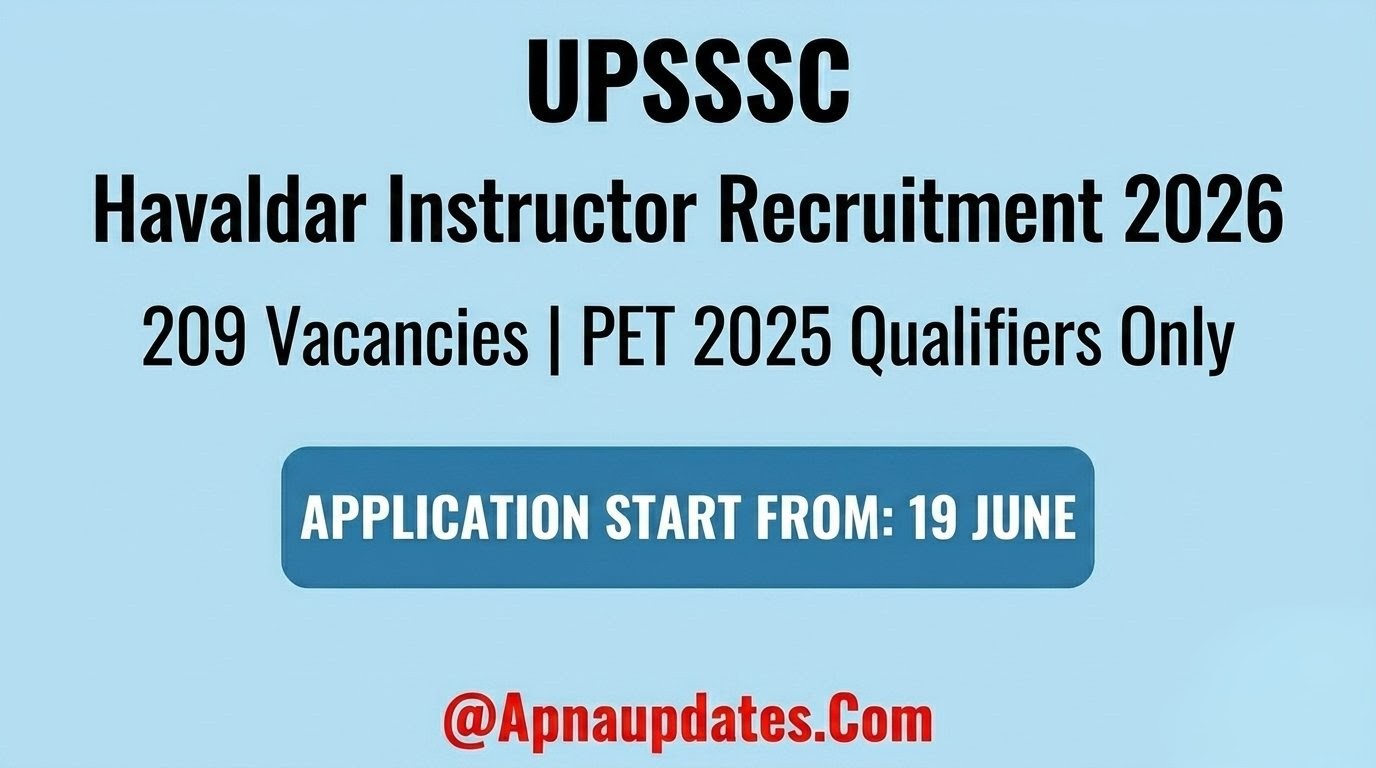
The Uttar Pradesh Subordinate Services Selection Commission (UPSSSC) released Advertisement No. 11-Exam/2026 for direct recruitment of Havaldar Instructor under the Homeguard Headquarters, Uttar Pradesh. A total of 209 vacancies (permanent and temporary) are open for Indian citizens who appeared in PET‑2025 and hold a scorecard with a positive normalised score. The entire selection is conducted through a main written examination and a physical test — there is no interview. Application window opens on 19 June 2026 and closes on 09 July 2026, with candidates paying only ₹25 at this stage.
The Situation No One Talks About
Last year, Ravi cleared the written test with a decent margin and comfortably finished the 4.8 km run. He thought his place was confirmed. But during document verification, his EWS certificate was rejected because it was based on FY 2024‑25 income instead of FY 2025‑26 — and the next candidate moved up. Many applicants focus entirely on the exam and overlook the fine print that decides the final merit. This article unpacks every such detail, using only the official notification, so you can stay ahead.
Key Highlights (All Dates 2026)
| Detail | Information |
| Recruiting Body | UPSSSC, Lucknow |
| Department | Homeguard Headquarters, Uttar Pradesh |
| Post Name | Havaldar Instructor |
| Total Vacancies | 209 |
| Pay Level | Level‑3 (₹21,700 – 69,100) |
| Application Fee | ₹25 for all categories |
| PET Requirement | PET‑2025 with a normalised score > 0 |
| Educational Qualification | Intermediate (10+2); High School for Homeguard unpaid workers |
| Age Limit (as on 01.01.2026) | 18–40 years (relaxation applicable) |
| Physical Standards (Male) | Height: 167.7 cm; Chest: 78.8–83.8 cm; Run: 4.8 km in 25 min |
| Physical Standards (Female) | Run: 2.4 km in 14 min (full details in notification) |
| Selection Stages | PET shortlisting → Written Exam → Physical Test → Document Verification |
| Main Exam Pattern | 100 MCQs, 2 hours, negative marking 0.25 |
| Official Website | upsssc.gov.in |
Who Should Apply and Who Should Reconsider
The Havaldar Instructor role is a uniformed, field‑oriented position. Selected candidates will conduct physical training, assist in disaster‑response operations, and work extensively outdoors. Transfers within Uttar Pradesh are frequent. If your preference is a fixed‑location desk job, this career may not align with your expectations.
On the other hand, if you already have a valid PET‑2025 scorecard and meet the physical standards, this recruitment is particularly attractive because there is no interview or skill test, the exam fee is low, and the compulsory educational qualification is just Intermediate. Moreover, the notification includes significant horizontal reservation for Homeguard unpaid volunteers (52 posts from the 25% departmental quota), making the competition softer for those holding a three‑year continuous service certificate issued by the District Commandant.
Vacancy Distribution – Understand Your Category Position
The official vertical reservation matrix is straightforward:
| Category | Vacancies |
| Unreserved | 88 |
| Scheduled Caste | 39 |
| Scheduled Tribe | 05 |
| Other Backward Class | 57 |
| EWS | 20 |
| Total | 209 |
Horizontal reservation allocations are equally critical because they determine how candidates are adjusted within their vertical bloc:
- Ex‑Servicemen: 10
- Women: 41 (as per Table‑2 of the notification)
- Outstanding Sportspersons: 10
- Homeguard volunteers/unpaid officers (25% departmental quota): 52
A horizontal quota candidate always returns to the vertical category they belong to. For instance, if an OBC woman is selected under the women’s horizontal sub‑quota, she occupies an OBC seat. Similarly, a Homeguard volunteer from the SC category who avails the 25% quota will be adjusted against the SC vertical count. This mechanism keeps the overall category balance while giving a distinct advantage to those with the appropriate certificates.
Important Point: Reservation benefits (including age relaxation) are available only to Uttar Pradesh domicile candidates. Applicants from other states are treated as Unreserved, even if they belong to SC/ST/OBC in their home state.
Eligibility – Straightforward, but Small Print Matters
The notification demands:
- Essential Qualification: Intermediate (10+2) from a recognised board.
- For Homeguard unpaid departmental employees: High School (Class 10) pass.
- Preferential Qualification (tie‑breaker only): NCC ‘B’ Certificate, or 2 years of Territorial Army service, or 3 years continuous service in the Homeguard organisation. These do not grant extra marks or replace the educational requirement.
Women applicants must carry a caste certificate from their father’s side. A certificate issued in the husband’s name is not accepted — this has been a common reason for last‑stage disqualification in previous UPSSSC cycles.
For EWS candidates, the certificate must be obtained between 01 April 2026 and 09 July 2026, based on family income of FY 2025‑26, and it must follow the prescribed 2019 format mentioned in the government order dated 14‑03‑2019. Using an older format or a certificate that reflects FY 2024‑25 income will result in outright rejection.
Physical Standards – Measurements That Eliminate Candidates
Male candidates:
- Height: minimum 167.7 cm (General, OBC, SC). Relaxation of 5 cm for eligible reserved category candidates as per rules.
- Chest: 78.8 cm unexpanded; 83.8 cm expanded (minimum expansion of 5 cm).
- Running: 4.8 km in 25 minutes.
Female candidates:
- Running: 2.4 km in 14 minutes. Further specifications, if any, should be verified from the detailed notification pages.
The physical test is eliminatory. Failing any component — even by a few millimetres in chest measurement or a few seconds in the run — results in disqualification, regardless of the written exam score. Many strong runners lose the opportunity because they neglect chest expansion practice; start measuring and training early.
Main Exam Pattern – Where to Focus
The written paper contains 100 objective‑type multiple‑choice questions, each carrying 1 mark, with a composite time limit of 2 hours. Negative marking is 0.25 marks per wrong answer, making accuracy essential.
| Part | Subjects Covered | Questions | Marks |
| Part‑1 | General Studies (History, Geography, Economics, Polity, Science, Environment, Sports, Current Affairs) | 65 | 65 |
| Part‑2 | Computer & Information Technology | 15 | 15 |
| Part‑3 | Uttar Pradesh General Knowledge (History, Culture, Economy, Administration, Current Events) | 20 | 20 |
| Total | 100 | 100 |
Part‑3 is frequently the differentiator. The notification explicitly lists topics: Uttar Pradesh’s history, art, festivals, folk dances, literature, geography, natural resources, economy, agriculture, industry, polity, and recent achievements. Expect direct questions on state schemes, major irrigation projects, and administrative structure. Computer part includes MS‑Office, internet protocols, digital payments, AI, IoT, and cybersecurity.
Tie‑Breaking Rules – What Happens When Marks Are Equal
When multiple candidates have identical total written marks, the commission uses a well‑defined sequence to break the tie:
- Higher marks in Part‑3 (Uttar Pradesh GK): The candidate with more marks in the UP‑specific section gets the higher rank.
- Higher marks in Part‑1 (General Studies): If Part‑3 marks are also equal, the combined General Studies score decides.
- Preferential Qualification: If both Part‑3 and Part‑1 marks are equal, a candidate possessing an NCC ‘B’ Certificate, or 2 years of Territorial Army service, or 3 years of continuous Homeguard service is placed above others who lack such qualification. If the preference is equal among multiple candidates, the next factor applies.
- Age: The older candidate is preferred.
This hierarchy means that your UP GK preparation is not just another topic — it can directly rescue you in a tie situation. If you hold a preferential qualification, ensure its proof is uploaded correctly; in a close competition, it could be the deciding factor.
Final Merit Flow – Step‑by‑Step From PET to Appointment
Understanding exactly how your name reaches the final list removes guesswork:
Step 1 – Shortlisting via PET‑2025 Normalised Score:
Candidates for each category are ranked in descending order of their normalised score from PET‑2025. The commission calls 15 times the category‑wise vacancies for the main examination, including all candidates at the cut‑off score (up to two decimal places). Anyone with a normalised score of zero or negative is ineligible.
Step 2 – Main Written Examination (100 marks):
This is the only evaluative stage that contributes to the merit score. No marks are carried forward from PET. No additional marks are granted for the physical test or interview (there is none).
Step 3 – Physical Efficiency Test (Qualifying):
Candidates who clear the written cut‑off are invited for the run and measurements. This stage is purely qualifying. You must pass it to remain in the process, but it does not improve your merit score.
Step 4 – Resolution of Ties:
After physical clearance, equal marks are resolved using the tie‑breaking mechanism described above. The final merit list is then prepared.
Step 5 – Document Verification and Appointment:
Appearing in the merit list does not guarantee appointment. Original certificates are inspected. Any mismatch in name, date of birth, category certificate validity, EWS format, or photograph leads to cancellation. Once verified, the candidate receives the appointment order.
Key Insight: Since the physical test adds no marks, your entire fate rests on the written score and the correctness of your documents. Treat every single mark seriously — especially the 20 from UP GK, which also serves as your primary tie‑breaker.
Salary : Level‑3 In‑Hand Estimates
Pay Level‑3 provides an entry basic of ₹21,700. Adding current Dearness Allowance (~50% of basic) and House Rent Allowance based on city class:
- X City (e.g., Lucknow): Gross ~₹40,600; in‑hand ~₹39,200
- Y City: Gross ~₹38,600; in‑hand ~₹37,200
- Z City: Gross ~₹36,700; in‑hand ~₹35,300
Deductions include GPF (6% of basic) and professional tax. Time‑bound promotions to Level‑4 and above gradually increase the package.
Application Process – Step‑by‑Step Without Confusion
- Go to upsssc.gov.in and click the “Live Advertisements” link.
- Find “विज्ञापन संख्या-11-परीक्षा/2026” and login using your PET‑2025 Registration Number and OTP (sent to your registered mobile/email).
- Personal details (name, father’s name, date of birth, category, address, uploaded photo, signature) from PET database will auto‑populate. They cannot be edited. Check them carefully.
- Fill your educational qualification: board/university name, year of passing, certificate number, and marks exactly as on the marksheet.
- If you have a preferential qualification, select the appropriate option.
- Accept the declaration, enter the verification code, and proceed to pay ₹25 via debit/credit card, net banking, UPI, or SBI e‑challan.
- After successful payment and fee reconciliation, the final application form with an 11‑digit registration number appears. Download and print it immediately.
- Corrections to communication address, horizontal reservation, marital status, and a few other fields can be made until 16 July 2026 using the “Modify Application” button on the Applicant’s Dashboard.
Document Verification: Common Pitfalls That Cancel Selection
Even after clearing the written exam and physical, candidates lose their seat at this final stage. The most frequent reasons are:
- Expired or incorrectly dated certificates: Caste certificate must be issued on or before 09 July 2026. EWS certificate must be dated between 01 April 2026 and 09 July 2026 with FY 2025‑26 income.
- Wrong format: EWS certificate must follow the 14‑03‑2019 prescribed format. Older versions are rejected.
- Name mismatch: High School marksheet says “Sanjay Kumar Sharma”, but Intermediate certificate says “Sanjay Sharma”. This discrepancy requires a gazette notification or an affidavit.
- Caste certificate origin for women: Must be from the father’s side; husband‑side certificates are not valid.
- Illegible scans: Photographs and documents that are dark, cropped, or have shadows are refused.
Keep all originals ready and scan them in colour at 200 DPI, under 300 KB each, before starting the application.
5 Mistakes That Can Disqualify You
- Assuming a zero or negative PET score is acceptable – the form might submit, but you will be ineligible later.
- Filling the form on mobile – the UPSSSC portal is not fully mobile‑optimised; mis‑taps can alter your category or preference.
- Missing the narrow exam‑fee payment window after shortlisting – once shortlisted, you must pay the main exam fee before downloading the admit card. In previous cycles, this window lasted barely 3‑4 days.
- Submitting an old‑format EWS certificate – only the 14‑03‑2019 format reflecting FY 2025‑26 income is valid.
- Ignoring Part‑3 (UP GK) during preparation – not only does it cost marks, but it also handles ties against you.
Frequently Asked Questions
Q. Is PET‑2025 compulsory for Homeguard unpaid workers?
Yes, without exception. All applicants must have a positive normalised score.
Q. Can I use NCC ‘B’ Certificate instead of Intermediate?
No. It is only a tie‑breaker and does not substitute for the educational qualification.
Q. What if my caste certificate is issued after 09 July 2026?
It will not be accepted during document verification.
Q. Does the physical test add marks to my merit? No, it is purely qualifying. Failing it eliminates you regardless of your written score.
Q. How is a tie broken if marks are equal?
Higher UP GK marks → higher General Studies marks → preferential qualification → older candidate.
Q. When will the main exam admit card be issued?
After shortlisting, you must first pay the exam fee; the admit card release date will be published on the website.
Also check ;
🔗KRCL Recruitment 2026: Apply for 201 Junior Engineer, ALP, Station Master and Other Posts
UPSC NDA 2 Recruitment 2026 : Admit Card Released
Final Verdict – Should You Apply?
If your PET‑2025 normalised score is positive and you satisfy the physical standards (especially height and chest for males), this recruitment is a clear opportunity. No interview, no subjective paper, and a well‑defined tie‑breaking formula make the process transparent. Your only battlefield is the written exam, where UP GK and computer knowledge give you the extra edge. However, if your PET score is zero or negative, or if a uniformed outdoor role with transfers does not fit your life plan, it is wise to wait for another opening. For everyone else, read the official notification on upsssc.gov.in, measure your physical parameters honestly, and submit the form early.
| Notification published | 17 April 2026 |
| Application start | 19 June 2026 |
| Last date for application and fee | 09 July 2026 |
| Fee reconciliation and form correction deadline | 16 July 2026 |