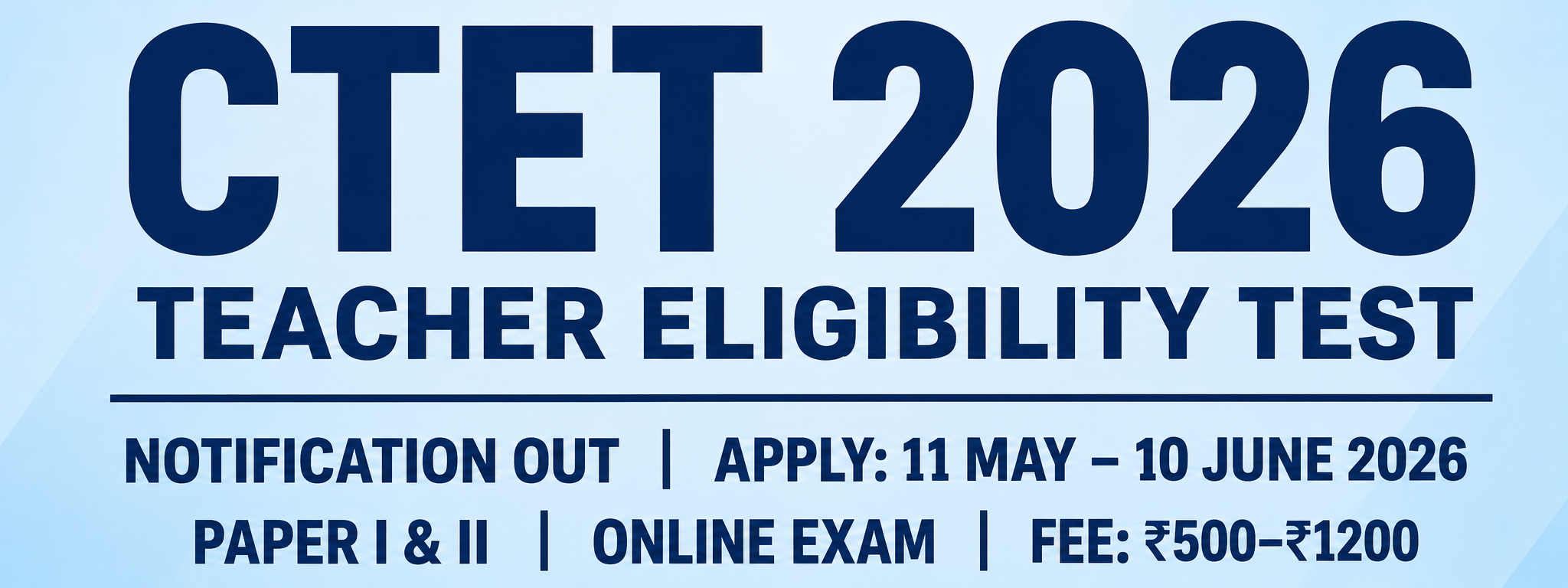
CTET September 2026 Notification Out
Quick Navigation
Notification OverviewRecruiting Authority ProfileExam Overview at a GlanceExam Schedule & Time TableApplication Fee StructureEligibility CriteriaPaper-I Exam Pattern (Classes I to V)Paper-II Exam Pattern (Classes VI to VIII)Available Languages for CTETQualifying Marks & CertificateApplicability of CTETStep-by-Step Application ProcessImportant Dates ScheduleExam Day Execution PlanItems NOT Allowed Inside Exam CentreWho Should Consider Appearing for CTET?30-Day Focused Preparation StrategySalary Reality After CTET QualificationIf You Don't Qualify This TimeFrequently Asked Questions
Quick Apply Snapshot
Notification Overview
CBSE has officially released the information bulletin for CTET September 2026. This is a national-level eligibility test for candidates who want to become teachers in Central Government schools like KVS, NVS, Central Tibetan Schools, and schools in Chandigarh, Dadra & Nagar Haveli, Daman & Diu, Andaman & Nicobar Islands, and NCT of Delhi. State government and private schools may also consider CTET scores.
CTET is conducted under Section 23 of the RTE Act, 2009, which mandates minimum qualifications for teacher appointments. Passing CTET does not guarantee a job it makes you eligible to apply for teaching positions. The actual recruitment is handled by individual schools and organizations through their own hiring process.
One important thing many students miss: CTET qualifying marks in the minimum Educational Qualification get a 5% relaxation for SC/ST/OBC/Differently-abled candidates, as notified by NCTE.
Recruiting Authority Profile
CBSE has been entrusted by the Ministry of Education to conduct CTET. The exam rules are governed by the "Central Teacher Eligibility Test Rules, 2011" (CTET). CBSE handles everything from application processing to result declaration and certificate issuance through DigiLocker.
Exam Overview at a Glance
Note: If you want to teach both primary (I-V) and upper primary (VI-VIII), you must appear for both Paper-I and Paper-II.
Exam Schedule & Time Table
Application Fee Structure
- GST as applicable will be charged extra by the bank.
- Fee is non-refundable and non-adjustable under any circumstances.
- Payment Mode: Debit Card / Credit Card / Net Banking only.
- No money order, demand draft, IPO, or postal order accepted.
Common fee payment issue students face: If your payment status shows "OK" but the amount was deducted, don't panic. The transaction might be cancelled and the amount refunded to your card within a week. Do not pay again immediately check status after 48 hours first. If the fee is paid through net banking and status is not successful, it means the transaction is not completed, and you need to pay again.
Eligibility Criteria
CTET eligibility is based on NCTE (National Council for Teacher Education) norms. The notification clearly states that candidates must verify their own eligibility before applying — CBSE does not verify eligibility at the application stage. Even if you are allowed to sit for the exam, it does not mean you are eligible. Final verification happens at the recruitment stage.
Paper-I (Classes I to V – Primary Stage)
You need any one of the following qualifications:
- Senior Secondary (Class 12) with at least 50% marks AND 2-year Diploma in Elementary Education (D.El.Ed) — completed or appearing in final year
- Senior Secondary (Class 12) with at least 45% marks AND 2-year Diploma in Elementary Education (D.El.Ed) as per NCTE 2002 norms
- Senior Secondary (Class 12) with at least 50% marks AND 4-year Bachelor of Elementary Education (B.El.Ed)
- Senior Secondary (Class 12) with at least 50% marks AND 2-year Diploma in Education (Special Education)
- Graduation AND 2-year Diploma in Elementary Education (D.El.Ed)
Paper-II (Classes VI to VIII – Elementary Stage)
You need any one of the following qualifications:
- Graduation with at least 50% marks AND 1-year Bachelor of Education (B.Ed) — completed or appearing
- Graduation with at least 45% marks AND 1-year B.Ed as per NCTE norms
- Senior Secondary (Class 12) with at least 50% marks AND 4-year Bachelor of Elementary Education (B.El.Ed)
- Senior Secondary (Class 12) with at least 50% marks AND 4-year B.A/B.Sc.Ed or B.A.Ed/B.Sc.Ed
- Graduation with at least 50% marks AND 1-year B.Ed (Special Education)
- Post-Graduation with at least 55% marks AND 3-year integrated B.Ed-M.Ed
Reality check for students: Many candidates apply without verifying their exact percentage and face rejection during document verification at the recruitment stage. Calculate your percentage carefully — some universities use CGPA, which you'll need to convert. Keep your conversion certificate ready.
Paper-I Exam Pattern (Classes I to V)
Subject-wise Focus Areas:
- Child Development & Pedagogy: Educational psychology of teaching and learning for 6-11 age group, inclusive education, learning and pedagogy concepts. Expect 15 questions on Child Development, 5 on Inclusive Education, and 10 on Learning & Pedagogy.
- Mathematics: Content-based (15 questions) covering geometry, shapes, spatial understanding, numbers, arithmetic operations, measurement, data handling, money, patterns. Pedagogy-based (15 questions) covering nature of mathematical thinking, curriculum, community mathematics, evaluation, remedial teaching.
- Environmental Studies: Content-based (15 questions) on family, food, shelter, water, travel, things we make. Pedagogy-based (15 questions) on concept and scope of EVS, significance of EVS, learning principles, approaches, CCE, problems.
- Language-I: Focuses on proficiency related to the medium of instruction. Comprehension (15 questions) + Pedagogy of Language Development (15 questions).
- Language-II: Focuses on elements of language, communication, and comprehension abilities. Must be different from Language-I.
Paper-II Exam Pattern (Classes VI to VIII)
For Mathematics & Science Option:
For Social Studies/Social Science Option:
Key Difference from Paper-I: Paper-II focuses on the 11-14 age group for Child Development. The difficulty level of questions goes up to Senior Secondary stage, acting as bridges to the higher level.
Important Note for Paper-II candidates: If you select "Both Papers" (Math/Science and Social Studies), you'll need to mention the subject for Paper-II. Candidates who apply for Paper-II only or Both Papers but don't mention the subject — their application will be rejected without further notice.
Available Languages for CTET
You can choose from 20 languages for the question paper:
Note: Language-I and Language-II must be different from each other. You must attempt questions in languages opted by you as mentioned in your Admit Card. Attempting in any other language will lead to cancellation. ---
Qualifying Marks & Certificate
As per NCTE Notification dated 11.02.2011:
- A person who scores 60% or more in the TET exam will be considered TET-passed.
- Schools (Government, local bodies, government-aided, and unaided) may consider giving concessions to persons belonging to SC/ST, OBC, differently abled persons, etc., in accordance with their existing reservation policy.
- CTET score alone does not confer a right on any person for recruitment/employment. It is only one of the eligibility criteria for appointment.
Certificate Validity: Lifetime for all categories. No restriction on attempts. You can appear again even after qualifying to improve your score. CBSE will provide CTET mark sheets and eligibility certificates in DigiLocker format. The mark sheets will be digitally signed and legally valid as per the IT Act. The certificates will contain an encrypted QR Code for enhanced security. ---
Applicability of CTET
CTET scores are accepted by:
- Schools of Central Government (KVS, NVS, Central Tibetan Schools, etc.)
- Schools under administrative control of UT of Chandigarh, Dadra & Nagar Haveli, Daman & Diu, Andaman & Nicobar Islands, and NCT of Delhi
- Unaided private schools who may exercise the option of considering CTET
- State Government schools and aided schools (though states with their own TET may or may not consider CTET — check individual state policy)
Practical insight: Many students confuse CTET with a recruitment exam. CTET is a qualification test only. After passing CTET, you still need to apply separately for vacancies in KVS, NVS, DSSSB, or state-level teacher recruitment. Keep tracking these recruitment notifications alongside your CTET preparation.
Step-by-Step Application Process
How to Apply:
STEP 1: Visit the official CTET website — ctet.nic.in or CBSE website cbse.gov.in
STEP 2: Click on "Apply Online" link and open the form.
STEP 3: Fill in the Online Application Form and note down your Registration Number/Application No.
STEP 4 – Authentication Details:
- Fill in State, Identification Type (select any identity — [Aadhaar Redacted], etc.), Candidate's Name, Date of Birth, Gender, and Security Pin
- Create a username, e-mail, and password
- Password Policy: Must be 8-12 characters long, must contain at least one upper case, one lower case alphabet, and one numeric value (no special characters allowed)
- Remember your Application No. and chosen password — CBSE will not be responsible for loss or misuse
STEP 5 – Upload Scanned Images:
- Photograph: JPG/JPEG format, size between 10 KB to 200 KB, dimension 3.5 cm (width) x 4.5 cm (height)
- Signature: JPG/JPEG format, size between 3 KB to 30 KB, dimension 3.5 cm (length) x 1.5 cm (height)
- Keep the scanned images ready in JPEG/JPG format before starting the application
STEP 6: Pay the exam fee through Debit Card / Credit Card / Net Banking.
STEP 7: Print Confirmation page for record and future reference. This page is NOT required to be sent to CTET Unit, but keep it safely.
Common Application Mistakes to Avoid:
- Name mismatch: Write your name exactly as it appears on your Class X certificate. Any difference will create problems during document verification.
- Photo rejection: Many candidates upload selfies or group photos that get rejected. Use a passport-size photo with white background, taken within the last 6 months.
- Wrong category selection: Once submitted, changing your category from General to SC/ST is extremely difficult. Double-check before final submission.
- Filling wrong examination city: You get the option to select an exam city, but if it's not available, CBSE will allot the nearest city based on your residential address. Requests for change of city after allotment will NOT be accepted.
---
Important Dates Schedule
Exam Day Execution Plan
This section can save you from last-minute panic. Here's a practical exam day guide based on what actually happens at CTET centres:
One Week Before:
- Download and print your Admit Card (available two days before exam)
- Visit the exam centre location if possible — check travel time, parking, nearest landmarks
- Verify all details on Admit Card (name, photo, paper, exam centre). In case of any discrepancy, immediately contact CTET Unit
- Arrange your Black Ball Point Pen (the Board will NOT supply pens)
The Night Before:
- Prepare a clear pouch with: Admit Card printout, one valid photo ID (original), 2-3 black ball point pens, a transparent water bottle
- Set two alarms — you need to reach the centre at least 120 minutes before the exam
- Sleep by 10 PM. Avoid last-minute cramming.
Exam Morning (for Paper-I):
- Wake up by 5:30 AM
- Light breakfast. Avoid heavy food.
- Leave home by 6:30 AM (plan for traffic delays)
- Reach centre by 7:30 AM (gate opens at this time)
- Biometric authentication may be introduced — arrive early
Inside the Exam Hall:
- You will receive a sealed Test Booklet 15 minutes before commencement
- Fill in required particulars on the Test Booklet cover page with your own Ball Point Pen
- DO NOT open the Test Booklet until instructed by the invigilator
- Check that the Test Booklet Code printed on your booklet matches what's on the OMR sheet — report any mismatch immediately
- Darken only ONE circle per question using Ball Point Pen. Changing an answer is NOT allowed. No eraser, no white fluid.
- DO NOT use pencil. OMR sheets filled with pencil will be rejected.
- Rough work must be done only on the space provided in the Test Booklet — not on the OMR sheet
Critical OMR Mistakes:
- Do NOT fold the Answer Sheet
- Do NOT make stray marks on it
- If you darken more than one circle for a question — that answer will NOT be evaluated
- Write the correct Test Booklet Number on the OMR sheet — wrong number will lead to cancellation
---
Items NOT Allowed Inside Exam Centre
This list is strictly enforced. Candidates found with any of these items will be treated as using unfair means:
- Mobile phones, Bluetooth, earphones, microphones, pagers, cameras, smartwatches
- Any electronic/communication device
- Books, notes, bits of papers, geometry instruments (pencil box, pouch)
- Writing pad, eraser, whitener, cardboard
- Tea, coffee, cold drinks, or snacks (NOT allowed inside exam room during testing)
- Calculators of any type
- Any metallic items — watches, goggles, handbags, belts, ornaments (avoid wearing these)
Real experience from previous CTET centres: Security is very tight. Many candidates have been turned away for carrying analog watches and belts with metal buckles. Wear simple clothing. Carry only what's essential in a transparent pouch.
Who Should Consider Appearing for CTET?
This exam is right for you if:
- You have a genuine interest in teaching children at primary or elementary level
- You have completed or are completing B.Ed, D.El.Ed, B.El.Ed, or similar teacher education program
- You want to teach in Central Government schools (KVS, NVS, DSSSB schools)
- You want a lifetime-valid teaching eligibility certificate
- You are patient and enjoy working with children in the 6-14 age group
Think twice if:
- You are looking for a direct government job — CTET is only an eligibility test, not recruitment
- You haven't completed any teacher education qualification yet — check eligibility carefully
- You are not prepared to apply separately for teaching vacancies after passing CTET
30-Day Focused Preparation Strategy
Since CTET September 2026 exam is scheduled for 05-09-2026, here's a practical 30-day plan for those starting preparation in August:
Week 1 (Days 1-7): Foundation
- Read complete NCERT textbooks for Classes I-V (Paper-I) or VI-VIII (Paper-II) for Math, Science, EVS, Social Studies
- Make short notes on Child Development & Pedagogy — focus on Piaget, Vygotsky, Kohlberg
- Solve 1 previous year paper to understand the difficulty level
Week 2 (Days 8-14): Subject Deep Dive
- Complete Mathematics content — focus on formulas, geometry, data handling
- Complete Language-I and Language-II grammar and comprehension practice
- Cover EVS/Social Studies pedagogical issues thoroughly
Week 3 (Days 15-21): Pedagogy Focus
This is where most marks are lost. Spend dedicated time on:
- Pedagogy of Mathematics (15 marks in Paper-I)
- Pedagogy of Language Development (15 marks each for Language-I and II)
- Pedagogy of EVS/Science/Social Studies
- Solve 3-4 previous year papers in timed conditions
Week 4 (Days 22-30): Revision & Mock Tests
- Solve one full mock test daily
- Revise Child Development & Pedagogy notes every day
- Focus on weaker sections identified from mock tests
- Last 2 days: only revision, no new topics
Subject-specific tip: Child Development & Pedagogy carries 30 marks and is the most scoring if understood conceptually. Don't memorize — understand the application. Questions often give classroom scenarios and ask which theory applies. Focus on: learning theories, types of assessment, inclusive education, and NCF 2005 recommendations.
Salary Reality After CTET Qualification
CTET itself doesn't come with a salary — it's the teaching positions you get hired for after qualifying that pay. Here's what you can realistically expect:
These figures include basic pay + DA + HRA (location-dependent). KVS and NVS teachers also get free/subsidized accommodation in many locations, which significantly reduces living expenses.
Long-term picture: Government teachers progress through MACP (Modified Assured Career Progression) even without promotion. After 10, 20, and 30 years, you get financial upgrades. Pension benefits under NPS also apply. Job security and work-life balance in government teaching positions are genuinely better than most private sector teaching jobs. ---
If You Don't Qualify This Time
Not qualifying CTET is not the end. There's no limit on attempts, and your certificate is valid for lifetime once you qualify.
Immediate steps after result:
- Download your scorecard and analyze section-wise performance
- Identify which sections pulled your score below 60% (or 55% for reserved categories)
- Most candidates lose marks in Pedagogy sections — if that's your case, invest more time in understanding teaching methodologies rather than content
What to do while waiting for results:
- Start preparing for the next CTET cycle — CBSE typically conducts it twice a year
- Simultaneously prepare for KVS, NVS, DSSSB notifications — these have similar syllabus
- Consider appearing for State TETs as well — many states conduct their own TET with similar pattern
- Build your profile: complete any pending teacher training courses, learn digital teaching tools
Frequently Asked Questions
Can I appear for both Paper-I and Paper-II in the same sitting?
Yes. Paper-I is in the morning session and Paper-II is in the evening session. You can appear for both on the same day by paying the combined fee.
Q:
Is there negative marking in CTET?
No. There is absolutely no negative marking. Each correct answer gets 1 mark. Wrong answers carry zero marks. Attempt all questions.
Yes. CTET qualifying certificate for appointment is valid for lifetime for all categories. You can also appear again to improve your score.
No. The request for change of allotted examination city, for whatsoever reason, will NOT be accepted. Choose your city carefully while applying.
Contact CTET Unit immediately before the exam. At the centre, the invigilator will verify your identity using your Admit Card and original photo ID. Major discrepancies can lead to denial of entry.
Yes. In KVS and NVS recruitment, CTET qualification is mandatory. Some recruitments also give weightage to CTET scores in the final merit list. Higher CTET scores can give you an edge.
Yes. Candidates appearing in the final year of B.Ed or D.El.Ed can apply for CTET. However, they must complete the course before the document verification stage of any recruitment.
Related NVS Recruitment Updates
Disclaimer: All information in this article is based on the official CTET September 2026 Information Bulletin released by CBSE. Candidates are advised to always verify details from the official notification before applying. CTET qualification does not guarantee employment — it is one of the eligibility criteria for teacher recruitment.